The core tension: Organic reach is declining, yet time spent on the platform is rising. For PR and communications professionals, this paradox defines both the challenge and the opportunity. Instagram remains one of the most powerful channels for earned media amplification, brand reputation management, and influencer marketing but only for those who understand how the platform actually works in 2026.
The State of the Platform: Numbers That Matter for Communicators
Instagram now has 2.4 billion monthly active users. More than 100 million pieces of content are published daily. Average daily time spent has grown from 30 minutes in 2023 to 37 minutes in 2026.
At the same time, organic reach for feed posts has dropped from 4.1% to 1.94%. For Reels, it has fallen from 8.3% to 5.8%.
These two trends are not contradictory, they are complementary. Users are spending more time on the platform while being more selective about what holds their attention. For PR professionals, the implication is direct: reaching an audience is harder, but when you do reach them, they are more engaged than ever. The platforms that reward quality have never rewarded it more.
Account Architecture: The Foundation Most Brands Overlook
Professional vs. Creator Account
For brand accounts and corporate communications, professional accounts offer the analytics, shopping integrations, and advertising tools most organizations need. For brand ambassadors or influencers you manage as part of a campaign, creator accounts provide more granular post-performance data that can meaningfully improve campaign measurement.
Bio as a Strategic Asset
Your Instagram bio has three jobs: tell new visitors what you do, convince them to follow, and drive a specific action. Most brand bios fail at all three. A high-converting bio structure follows this pattern:
- Line 1: Specific niche and value proposition who you serve and how
- Line 2: Credibility signal awards, media mentions, social proof
- Line 3: Clear CTA with a link
Research from Later.com (2025) found that bios with a specific niche description convert profile visitors to followers at 3.2x the rate of vague, generic bios. Apply the same discipline you bring to a press release.
Cross-Platform Handle Consistency
Using the same handle across platforms ensures that earned media coverage, a podcast mention, a journalist’s tweet, a newsletter shoutout translates directly into Instagram traffic. Inconsistency here produces measurable audience loss that most brands never attribute correctly.
Content Strategy: What the Data Says
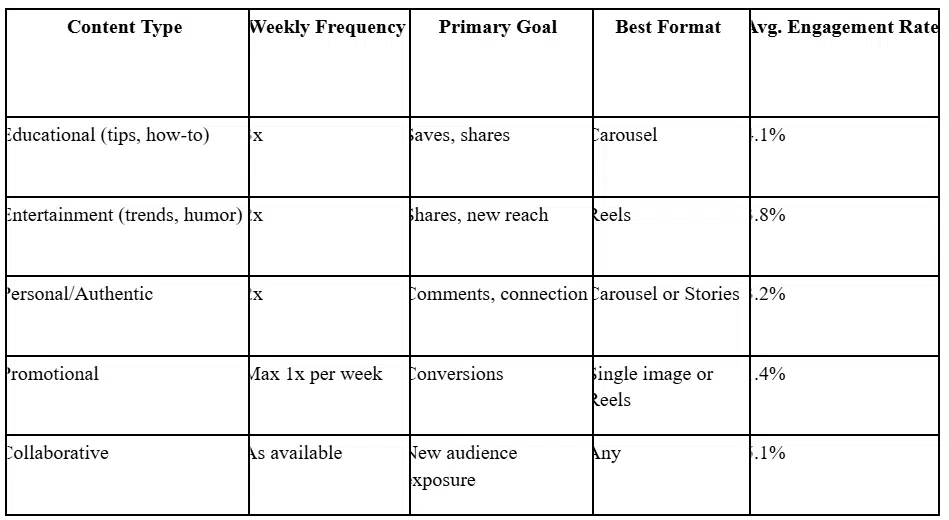
Collaborative content leads with a 5.1% average engagement rate because it simultaneously activates two audiences. For PR professionals managing influencer campaigns, this is the data-backed case for co-created content over simple product placement: the algorithmic reward for genuine collaboration is measurable.
The critical takeaway for communicators: Promotional content earns the lowest engagement at 1.4%. Accounts that lead with promotional messaging receive algorithmic penalties that suppress organic growth across all content types. Value-first content is not a brand nicety, it is the mechanism by which promotional content earns the right to be seen.
Reels: The Format You Cannot Afford to Ignore
Instagram continues to give Reels preferential algorithmic distribution in 2026, driven by the platform’s ongoing competition with TikTok. For PR teams that have resisted short-form video, the opportunity cost is significant.
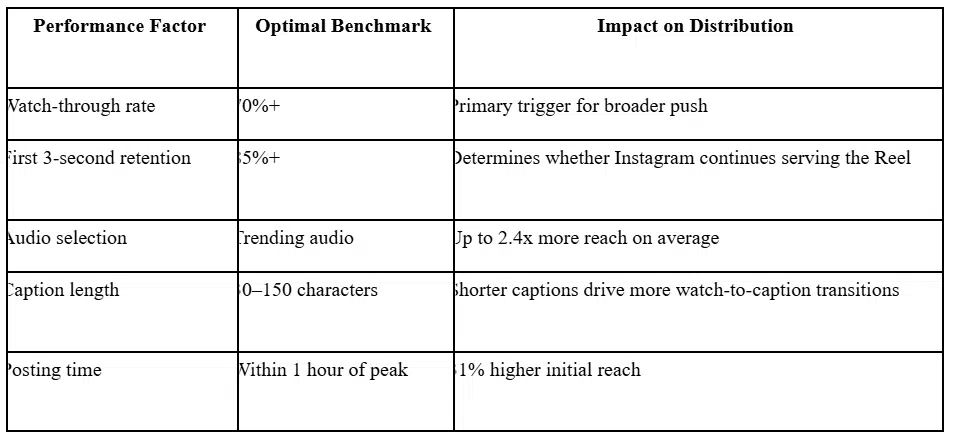
The most actionable insight here is the first-3-second retention threshold. If a Reel loses more than 15% of viewers in the opening three seconds, the algorithm interprets this as a signal of low relevance and restricts further distribution. This is the video equivalent of a buried lead and the fix is identical: lead with your most compelling information.
The Three Signals the Algorithm Weights Most Heavily
Instagram’s algorithm in 2026 prioritizes three engagement signals above all others:
Likes signal immediate emotional response. They are generated by strong visuals and compelling hooks.
Saves signal lasting value. Content that teaches, solves a problem, or provides a reference people will return to earn saves. For PR professionals, this means turning institutional knowledge media pitching frameworks, crisis communication checklists, measurement methodologies into content formats that audiences bookmark.
Shares signal social currency. People share content they are proud to associate with. Before publishing, ask one question: would a professional in my target audience forward this to a colleague? If the answer is no, the content needs revision.
Posts that earn all three signals consistently outperform posts that earn only likes by a factor of ten. Most brands over-optimize for likes while neglecting saves and shares a strategic error that algorithmic data makes increasingly visible.
Hashtag Strategy in 2026: What Actually Works
The 2023 advice to use 30 hashtags is now actively counterproductive. Instagram confirmed in 2024 that the platform no longer distributes content to non-followers via hashtags the way it once did. Hashtags now function primarily as content categorization signals rather than discovery engines.
Recommended approach:
- Niche hashtags (under 500K posts): 4–6 per post your primary discovery strategy
- Mid-size hashtags (500K–2M posts): 2–3 per post supporting strategy
- Large hashtags (2M–10M posts): Minimal use; high competition reduces effectiveness for most accounts
- Mega hashtags (10M+ posts): Avoid negligible impact for accounts under 100K followers
- Branded hashtags: 1–2 per post to encourage user-generated content and community discovery. Use 5–9 highly relevant hashtags. Maximizing the limit is a relic strategy.
Practical Growth Tactics for PR and Communications Teams
Engage your target audience before they follow you. Spending 20 minutes daily leaving thoughtful comments on posts from accounts in your niche drives profile visits that convert to follows at a significantly higher rate than passive posting. This is the digital equivalent of the foundational PR principle: build the relationship before you need it.
Post consistently at your own peak hours. Consistent timing trains both the algorithm and your audience to anticipate your content. Use your own account analytics rather than generic benchmarks. Your audience’s behavior is the only data that matters.
Develop a recognizable visual identity. Accounts with an immediately distinctive aesthetic retain followers 35% more effectively than accounts with inconsistent visual presentation. Brand guidelines that stop at logo usage are incomplete.
Use all of Instagram’s native features in the same week. Accounts that publish Stories, Reels, and feed posts within the same seven-day window receive a measurable distribution advantage. Instagram rewards creators who use the full platform.
Treat the comment section as a distribution lever, not a customer service queue. Responding to every comment within the first 24 hours especially within the first hour drives comment velocity, which the algorithm interpreted as an engagement signal and used to justify broader content distribution.
Repurpose high-performing content across formats. If a carousel earns exceptional saves, convert the same information into a Reel. If a Reel reaches a new audience, distill its key points into a carousel optimized for saves. Strong content is not single-use.
What This Means for the PR Industry
Three structural shifts in Instagram’s 2026 environment have direct implications for how communications professionals plan and measure social media work.
First, engagement quality has replaced reach as the primary success metric. An account with 8,000 followers and 8% engagement consistently outperforms one with 30,000 followers and 1.2% engagement in both algorithmic distribution and influencer partnership value. Measurement frameworks that prioritize follower count alone are no longer defensible.
Second, influencer selection criteria need to be reweighted. The data supporting collaborative content 5.1% average engagement versus 1.4% for promotional posts makes the case for co-creation over placement. When evaluating influencer partners, save rate and share rate are more predictive of campaign performance than follower size.
Third, content strategy and media relations strategy are converging. The same editorial discipline that produces a compelling media pitch, strong hook, clear value, immediate relevance is what produces a high-performing Instagram post. PR professionals who recognize this convergence are positioned to lead social strategy conversations that historically have been siloed in marketing.
Instagram’s algorithmic complexity is not a barrier for communications professionals, it is an advantage for those who understand it. The skills that define effective PR practice in 2026 translate directly to platform success.