
Every FIFA World Cup produces unexpected results. A tournament favorite falls. An underdog advances. A new star emerges.
This tournament saw something more.
Rather than one surprise team capturing attention, multiple African nations built momentum throughout the group stage. Historic qualifications, breakthrough performances, and memorable moments gradually shifted the conversation beyond individual matches, creating one of the tournament’s defining storylines.
To understand how that narrative evolved, we analyzed social conversation surrounding African teams and examined the themes that resonated most with audiences.
How the narrative took shape
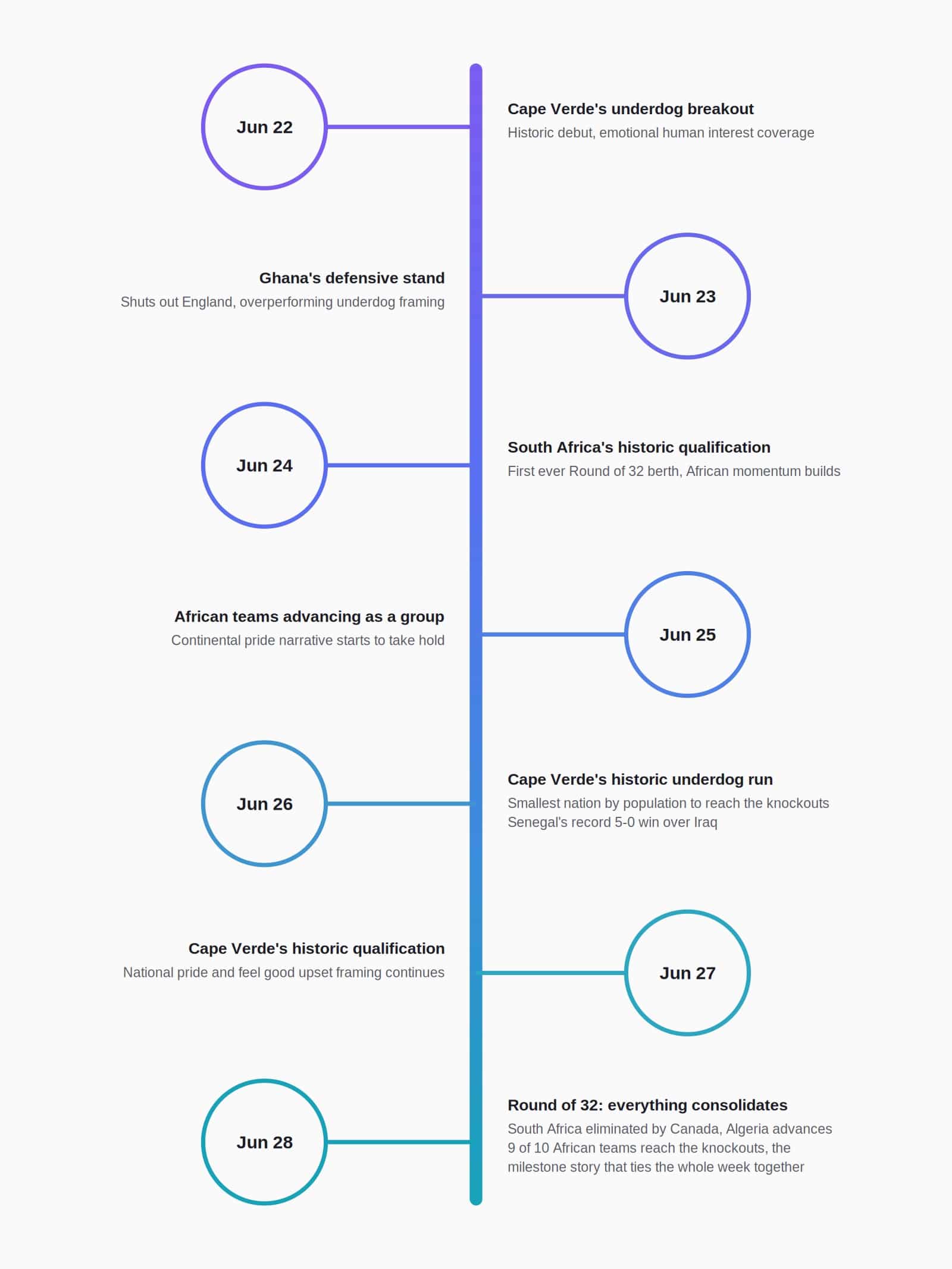
Unlike a single viral moment, the conversation surrounding African teams developed gradually.
Cape Verde’s remarkable tournament debut introduced one of the competition’s earliest underdog stories. Soon after, Ghana’s defensive performance against England reinforced the growing perception that African teams were outperforming expectations.
Momentum continued to build as South Africa secured its first ever Round of 32 berth, Senegal delivered one of the tournament’s most dominant victories, and Algeria advanced to the knockout stage. Cape Verde’s historic run also continued, becoming the smallest nation by population ever to reach the Round of 32.
What began as individual achievements gradually became something larger. By the end of the group stage, the conversation had shifted from isolated upsets to a broader narrative celebrating the strength and success of African football.
Momentum wasn’t limited to one team
The engagement data suggests that this wasn’t a story driven by a single breakout nation.
Across African teams, conversation was distributed among several countries. South Africa generated the highest engagement, followed by Cape Verde, Ghana, Senegal, and Morocco, with multiple teams surpassing four million engagements during the analysis period.
To provide a point of comparison, we looked at engagement alongside the ten teams favored to win the tournament after the Round of 32.
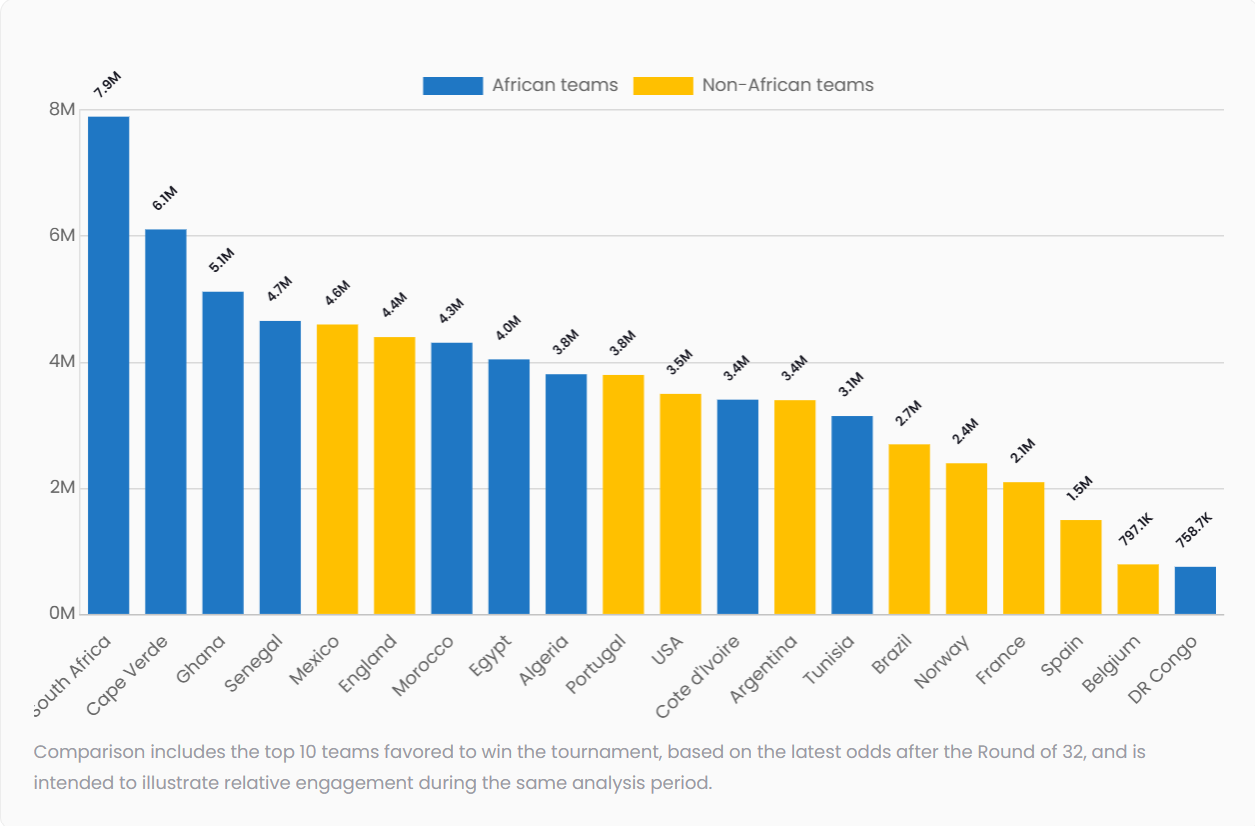
While established football powers such as England, Brazil, Argentina, and France remained prominent in the conversation, several African teams generated comparable, and in some cases higher, engagement during the same period. South Africa and Cape Verde, for example, outperformed every team in this comparison group, while Ghana and Senegal also ranked among the most engaged teams.
This doesn’t necessarily mean African teams dominated the tournament conversation overall. Rather, it illustrates how a series of historic performances elevated multiple African nations into the broader World Cup discussion. Instead of one Cinderella story capturing attention, audiences followed several breakthrough narratives unfolding at the same time.
The story behind Cape Verde’s numbers
Cape Verde offers one of the clearest examples of why certain stories resonated so strongly.
The country doesn’t lead the region in total mentions or overall reach. Yet its content consistently generated strong engagement relative to the size of its conversation.
One of the tournament’s most memorable posts about Cape Verde didn’t come from a match report.
BBC Sport shared the story of Vozinha’s mother, who had her visa fees waived so she could finally watch her son play at a World Cup, arriving in time for Cape Verde’s draw with Uruguay.
“Vozinha’s mum finally made it to watch her son play at the World Cup. Having had her visa fees waived, she was able to attend Cape Verde’s enthralling draw with Uruguay!” — BBC Sport (@BBCSport), June 22, 2026 · 105.7K views, 857 likes, 60 reposts
Five days later, as Cape Verde’s run reached the Round of 32, the story shifted from family to legacy.
“Vozinha is the third goalkeeper to record multiple FIFA World Cup clean sheets after turning 40 years old, joining Peter Shilton (3) and Dino Zoff (2). Legendary.” — OptaJoe (@OptaJoe), June 27, 2026 · 161.4K views, 3.8K likes, 683 reposts
Two posts, five days apart, told two different sides of the same story, a mother in the stands, and a goalkeeper joining a short list of World Cup legends.
Neither post was simply a scoreline recap.
One connected Cape Verde’s tournament to family and sacrifice. The other connected it to history and legacy. Both gave people a reason to share far beyond the result itself.
The football created the moment. The human story gave people a reason to share it.
What people engaged with
Looking beyond individual matches, we manually reviewed a representative sample of posts to better understand the themes shaping the conversation. Three recurring narratives emerged.
National pride (29%). The most common theme centered on historic firsts, maiden knockout qualifications, and the collective success of African teams. Many posts framed these achievements as milestones not just for individual countries, but for the continent as a whole, with messages like “Africa to the World.”
Human stories (8%). Personal narratives added emotional depth to the tournament. Posts highlighting players’ journeys, family reunions, devoted supporters, and humble beginnings helped audiences connect with the people behind the results. The story of Vozinha and his mother is one example of how these moments resonated beyond the match itself.
Cultural identity (7%). Football also became a platform for celebrating culture. Supporter traditions, music, national celebrations, and community identity all appeared throughout the conversation, demonstrating that fans were engaging with more than just what happened on the pitch.
Together, these themes suggest that audiences weren’t simply reacting to wins and losses. They were engaging with what those moments represented, for players, supporters, and entire nations.
The finding reflects one of the defining characteristics of social media. Traditional coverage often prioritizes what happened. Social audiences are more likely to share why it matters. High engagement doesn’t necessarily reflect competitive success; it reflects which stories audiences found meaningful enough to amplify.
Methodology note: Themes were identified through manual coding of a representative sample of posts and are intended to illustrate recurring narratives rather than quantify the entire conversation.
More than football
The World Cup will always be remembered for its goals, trophies, and champions.
But social media tells a broader story.
Across the tournament, African teams earned attention not only through their performances but through the stories that surrounded them. Historic milestones became symbols of national pride. Personal journeys transformed match results into shared moments of celebration. Cultural identity extended the conversation far beyond the final whistle.
Looking at the conversation as a whole, the tournament wasn’t simply producing memorable matches. It was producing moments people wanted to celebrate together.
For communicators, the takeaway extends beyond football. Audiences don’t simply amplify results—they amplify stories that carry meaning. Historic achievements, personal journeys, and expressions of identity often travel further than the score itself. That’s why understanding public conversation requires looking beyond volume alone to the narratives that people choose to share.
This analysis was conducted by Bea Reganit and Karisse Decena of Agility PR Solutions’ media intelligence team.