
Study Reveals a Significant Gap in Foundational Marketing Knowledge, and what to do about it.
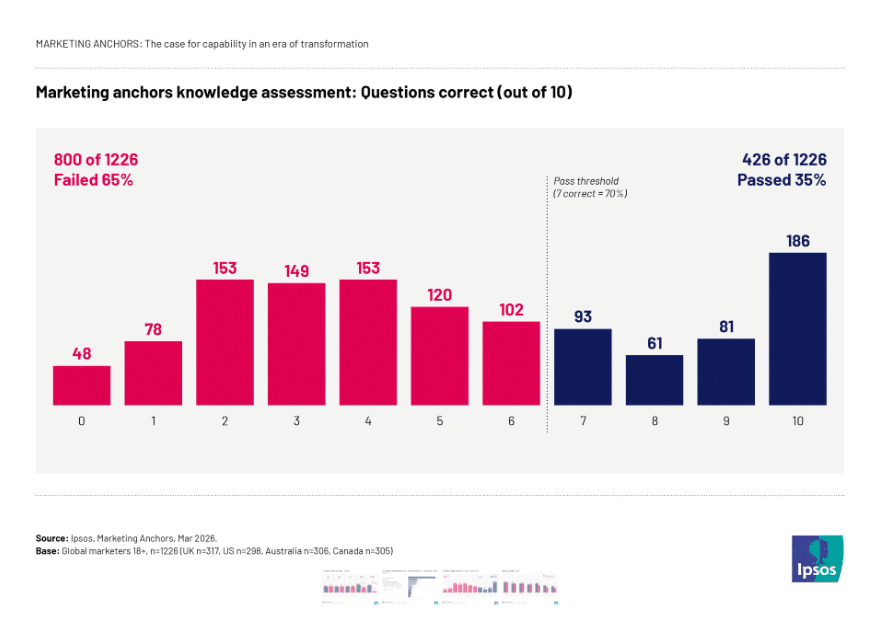
- Only 35% Of Marketers were able to correctly define foundational Marketing concepts, set as part of a ten-question assessment. Two in three marketers did not pass the capability assessment benchmark of seven correct answers.
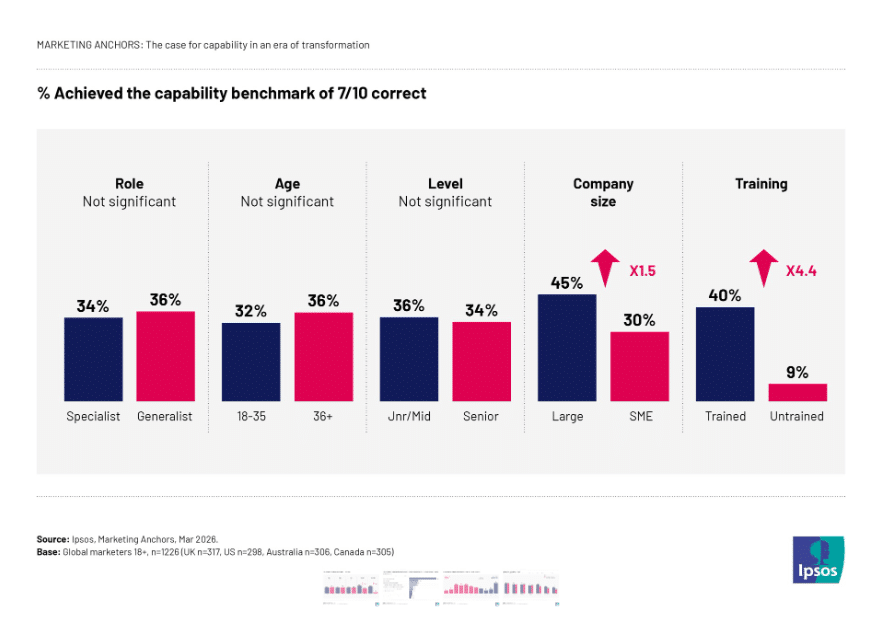
- Formally trained marketers are four times more likely to reach the benchmark – 40% achieve it compared with just 9% of those without formal training
- 60% of marketers say they experience high levels of stress at work and 47% identify budget pressure as their biggest challenge over the next 12 to 18 months
- 54% of marketers are concerned about the impact of AI on their job security – rising to 55% among those with formal training
- Trained marketers report greater confidence, steadier career progression and stronger budget advocacy than their untrained peers
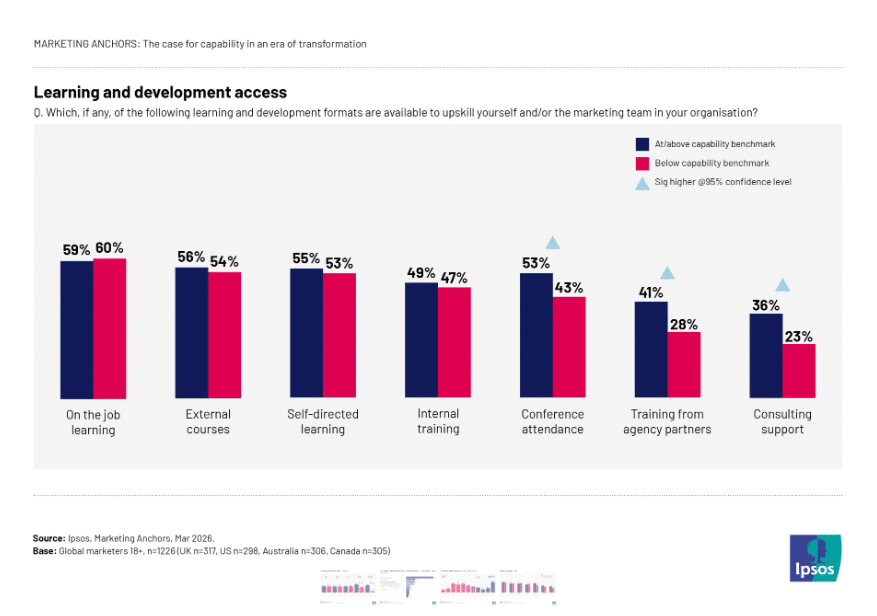
- High-performing teams learn continuously bringing the outside in and seeking independent challenge. Access to agency training and consultation is a key differentiator of capability, as is access to conferences
19th March, 2026, London, UK. A new Ipsos study, Marketing Anchors, reveals that only 1 in 3 (35%) marketing practitioners across the UK, US, Canada and Australia can correctly define core foundational marketing concepts.
The study explores the knowledge landscape facing today’s marketing profession, at a time when AI-led acceleration and shifting consumer behaviour are placing new demands on teams. Marketers are navigating more signals, more pressure and greater scrutiny than ever before. Speed is not the challenge in itself — the risk lies in uninformed speed. The Ipsos report is intended to generate broader conversations around whether marketers need a firmer grasp of the fundamentals to enable the kind of systems thinking that can handle real complexity. As well as what individual marketers and their organisations can do to build high-performing teams, grounded in the anchor knowledge needed to navigate an increasingly demanding landscape.
The Marketing Anchors study comprised of a ten question assessment and marketers’ perspectives on their performance and professional and personal experiences of being in marketing. The ten question assessment of foundational marketing concepts was set and piloted in collaboration with Professor Mark Ritson. The capability benchmark was set at seven out of ten correct answers.
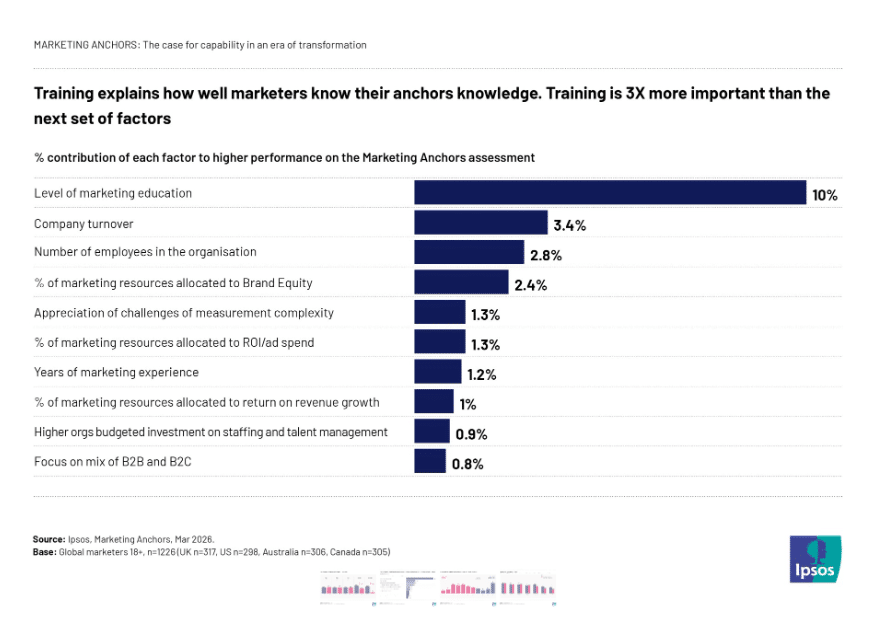
Two important factors emerge in explaining capability. Training is the largest factor, followed by working at a large enterprise. This data suggests that on-the-job learning alone is not sufficient, and that not all forms of training deliver the same outcomes.
Among those who had completed a marketing degree, professional certification or structured online course, 40% reached the benchmark. Among those whose experience came primarily through workshops, seminars or on-the-job learning, just 9% did. Organisation size was also a factor: 45% of marketers in large enterprises met the benchmark compared with 30% in small and medium-sized businesses.
The study also shows the importance of bringing the outside in and that learning is a continuous journey. Marketers who achieve the capability benchmark have greater access to agency partner training, consultancy and conferences. This suggests that capability strengthens where teams are connected to wider industry perspectives and disciplined external insight. Independent challenge and structured evidence can accelerate decision-making, particularly in smaller organisations where internal exposure may be limited.
The study also highlights the personal toll of today’s marketing environment. Three in five marketers (60%) say they experience high levels of stress at work, while almost half (47%) point to budget pressure as the biggest challenge they expect to face over the next 12 to 18 months.
More than half (54%) are worried about how artificial intelligence could affect their job security. That concern is slightly higher among marketers with formal training (55%) than those without it (45%), suggesting that a deeper understanding of the profession can also bring a greater sense of responsibility — and worry about what lies ahead.
Despite these pressures, the research shows clear benefits for marketers who have received formal training. They are more likely to report steady career progression, with 77% saying their career is advancing compared with 54% of those without formal training. They are also more likely to say their work delivers measurable business results (86% versus 68%).
Confidence levels are higher too, with a 28-percentage-point gap between trained and untrained marketers. Those with formal training are also more likely to say their teams are effective at securing budget (79%, a 17-point difference) and that marketing knowledge is properly documented within their organisation (75%, a 20-point gap).
The findings also show that trained marketers take a longer view of their careers. Seven in ten (70%) expect to still be working in marketing in ten years’ time, compared with 41% of those without formal training. They are also more likely to describe themselves as happy with their career development and highly motivated.
The research arrives at a moment of significant structural pressure on the profession. Active marketing job listings in the US fell 8.2% year on year in 2025 and online advertising and marketing roles have been declining in the UK too. Ipsos Karian & Box research points to a rise in ‘job hugging’ – fewer vacancies, reduced mobility and clogged career pathways. In this environment foundational capability increasingly functions as a form of professional protection.
Commenting on the findings, Samira Brophy, Ipsos, said:
“This report evidences the value of structured learning and the role that good foundations can play in strengthening marketer performance. When speed, systems thinking and continuous trial and error are needed, having a shared language, frameworks and a knowledge of the core principles is a springboard to mastery.
Given the current baseline, there is a clear opportunity for businesses who invest in their people, data literacy and building external connections with agency and industry bodies. The opportunity is to convert pace into performance and therefore a competitive advantage. For individuals, it is a rallying cry to invest in your development, build community and stay resilient.”
Commenting on the findings, Sophie Devonshire, CEO at The Marketing Society, said:
“This research is a really important sense check, particularly in the context of fewer roles being advertised. If there are fewer jobs, then the people in those jobs have to perform, and perform brilliantly. At The Marketing Society, we are all about marketers who mean business. This reinforces that performance and professionalism matter more than ever.”
Commenting on the findings, Bennie F. Johnson, CEO at the American Marketing Association said:
“Imagine the friction when there’s challenge around definitions of core marketing concepts – now multiply that across global teams working on integrated campaigns. Training solves that. Beyond capability itself, training builds something equally valuable: institutional knowledge that survives leadership transitions and strategy shifts. How do you communicate strategy in a way that has a handoff between this year’s approach and next? How do you integrate that strategy into other parts of the business? That’s where core marketing training becomes core business training.”
Ipsos interviewed a representative sample of 1,226 marketers across the UK, US, Canada and Australia. Polling was conducted between the 30th January and 18th February 2026.