In the fall of last year, a client released a thought leadership byline in a large trade publication. Two days later, a reporter advised that three paragraphs had been copied nearly verbatim from a competitor’s blog post from six months ago. The byline was disabled. The editor sent us a message saying they would no longer accept any work by the client. All of it bore our agency brand.
Individuals on the team had not intentionally committed plagiarism. What occurred was much more straightforward and commonplace than you may assume. A junior copywriter took advantage of ChatGPT by having it generate portions of the document, which in turn had pulled up the same reference source as the competitor. This overlap was enough to flag for manual inspection, and the fallout was a damage-control disaster that took weeks to resolve.

That was the turning point for our team. We implemented a pre-publication process where each press release, byline, op-ed, and pitch deck is run through prior to leaving the office. Here is what we’ve put into motion:
Why Content Originality Is a PR Problem, Not Just an Academic One
When “plagiarism checking” is mentioned, most minds think of universities and student essays. Yet the danger is no less real in PR, and the outcome potentially far graver. A student who is accused simply has to churn out yet another boilerplate essay. A PR team caught republishing someone else’s content can face losing media placements, clients’ confidence and the writing profession’s standing with long-memory editors.
The problem has grown sharper since AI writing tools became standard in communications workflows. A 2025 survey by the Institute for Public Relations found that 68% of PR professionals now use generative AI in some part of their content creation process. That is not a problem by itself. The problem is that AI models draw from the same training data, which means two different teams using the same tools can produce strikingly similar outputs without either team knowing it.
A further concern is the AI detection problem. Media organizations are now passing all submitted work through to AI detectors. If your byline seems to have been composed by ChatGPT, it will be rejected before it ever gets to the ideas. The standard is tougher than ever before, and PR teams who fail to rise to the challenge are gambling.
The Three Content Risks Every PR Team Faces
1. Accidental duplication from AI-assisted drafting
This is the most common scenario. Your team uses AI to speed up a first draft, and the output includes phrasing that matches existing published content. Nobody notices because the writer assumes the AI generated something original. It did not. Generative models remix existing text patterns, and sometimes the remix is too close to the source.
2. Vendor and freelancer content you cannot fully vet
Content is commonly contracted from freelancers, contract authors or offshore teams. You trust the work is original, but have no way of confirming that, without running the output through a checker. I have witnessed the odd “original” freelance blog post contain full paragraphs of copied and pasted text from industry reports. This isn’t always malicious. Sometimes people write from their own notes, unknowingly plagiarising their source.
3. Recycled messaging across multiple client campaigns
If your agency handles similar clients in the same vertical, it is surprisingly easy to reuse phrasing from one campaign in another. A boilerplate description, a stock value proposition, a product benefit sentence. These fragments travel from deck to deck and eventually show up in published content that is supposed to be unique to each client.
Our Pre-Publication Workflow (Step by Step)
After the October incident, I built a three-step process that we now run on every piece of external content. It takes about 15 minutes per piece and has caught issues on at least a dozen occasions since we started using it.
Step 1: Run a plagiarism scan on the final draft
Before anything goes to a client for review or to an editor for publication, we run the full text through PlagiarismCheck.io. This tool scans your text against web sources, published articles, and academic databases, then highlights matching passages with clickable links to the original source.
What made us pick this tool over others we tested was the combination of three things. First, the results are not gated behind a paywall. You see the full similarity report, the highlighted text, and every source URL immediately. Second, there is no account required. You paste your text and run the scan. Third, and this mattered to us given the sensitivity of client work, the tool does not store your text after the scan completes. That zero data retention policy is critical when you are checking press releases that contain unreleased product announcements or confidential client information.
The free plan manages 2,000 words per scan, which is enough for most Press Release, Byline and Pitches. For longer Thought Leadership articles we break the document into chunks and scan each one. It takes five minutes but the accuracy is worth it:
Why data retention matters for PR teams Some plagiarism checkers store submitted text in their databases and use it to check future submissions against. This means your unpublished press release could end up in someone else’s similarity report. Always confirm that the tool you use deletes text after scanning. PlagiarismCheck.io and a few others make this promise explicitly. Many free tools do not address it at all.
Step 2: Check for AI-generated patterns
PlagiarismCheck.io also includes a built-in AI detection toggle. We run this on every piece that involved AI at any stage of the drafting process. It flags sections that read as machine-generated, which tells us exactly which passages need a rewrite before we send the content to an editor who might be running their own detection.
This is where we protect the byline author’s credibility. If a CEO, VP of a company is endorsing an article, it needs to feel like it came from a knowledgeable expert, not a computer prompt.
Step 3: Humanize flagged sections
When the AI detection flags sections that sound too mechanical, we rewrite them. For smaller edits, our writers handle it manually. For larger blocks of AI-assisted text that need to be reworked quickly, we use MyHumanizer.
Here’s how it works. First, you have to copy and paste the source material that was flagged, select the tone of voice for your article (we generally choose formal or general tone for client work), and it starts modifying the verbiage until it comes back as if a writer, you in fact, sat down and conjured it up. It’s free for up to 3,000 words, and you don’t need to sign up to give it a shot.
I want to be clear about how we use this. We do not paste an entire ChatGPT output into MyHumanizer and call it done. We use it as a finishing tool on specific paragraphs that our AI detection step flagged. The strategic thinking, the positioning, the core arguments: those come from our team. The humanizer just smooths out the phrasing so the final product does not trigger detection tools on the editor’s side.
✓ This three-step workflow adds about 15 minutes per piece and has prevented multiple content issues since October
What We Learned After Six Months of Using This Process
Freelancer content needs the most scrutiny
Approximately 40% of the problems our scans uncover come from freelancer-written articles. This is not a criticism of freelancers. It’s a reminder that whenever a writer covers similar topics for several clients, said overlap will occur. Executing a plagiarism check isn’t about lack of trust. It is about due diligence.
AI drafting is fine if you verify the output
We simply didn’t go completely against AI. We actually put an extra step in between. Our writers still use ChatGPT, Claude, and other tools to come up with the angles, break down the outlines, and write the first version. The key is nothing leaves our office until those three steps are checked off. That did about a 30% reduction in the rate we have to revise our content because nobody else is pointing out those issues.
Editors notice the difference
Two editors at trade publications told us they started rejecting more bylines this year because they “read like AI.” When we submit content that has been through our workflow, it clears their review faster. One editor specifically said our submissions “feel like they come from someone who actually works in the industry.” That is exactly the signal you want.
Comparing Free Plagiarism Tools for PR Use
We tested several free plagiarism checkers before settling on our current workflow. Here is how they compared for PR-specific use cases:
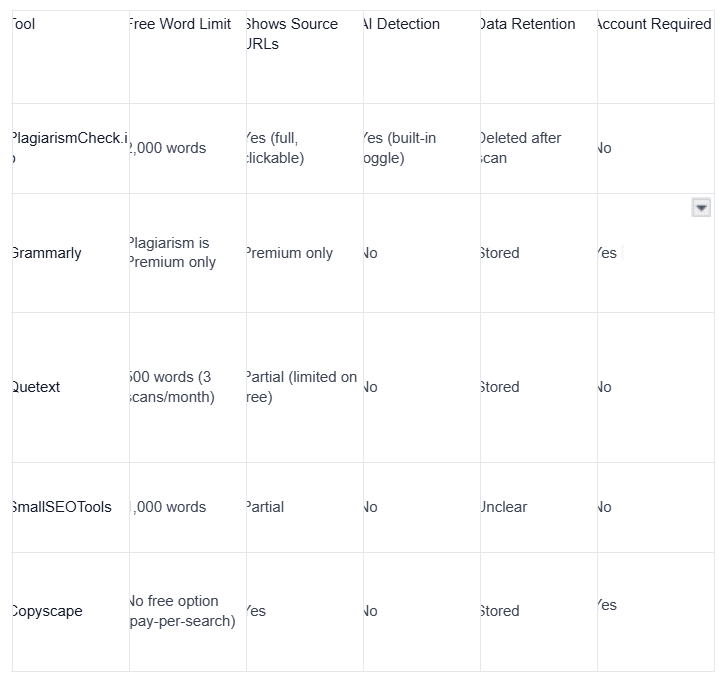
For PR teams, it’s data retention and source linking that really set the tools apart. You want to know precisely what you’re comparing your content to so that you can judge if this is an overlap worth raising or just coincidence (industry jargon for this is ‘common ground,’ for instance). And the last thing you want is a tool that will keep hold of your embargoed content.
Pre-Publication Checklist for PR Content
Run through this before any content goes external
- Scan the full text through a plagiarism checker (we use PlagiarismCheck.io)
- Review flagged passages and verify they are not close matches to competitor content
- Run AI detection on any content that involved generative AI in the drafting process \
- Rewrite or humanize sections that read as AI-generated
- Confirm the plagiarism tool does not store your text (critical for unreleased announcements)
- Have a second team member review the content for tone and brand voice consistency
- Save the plagiarism report as a PDF for your records
- Send to client for final approval with a note that originality has been verified
When to Use This Workflow
We run the full three-step process on every piece of content that will be published under someone else’s name or in someone else’s publication. That includes:
- Bylined articles and thought leadership pieces for trade publications
- Press releases distributed through newswire services
- Op-eds and contributed content for media outlets
- Blog posts ghost-written for client executives
- Pitch materials and media kits that contain substantive copy
For internal documents, social media captions, and email pitches, we use a lighter touch: a quick AI detection check if the content was drafted with AI tools, but no full plagiarism scan.
The Bottom Line for PR Professionals
Content originality is no longer an afterthought in PR quality control. The technology is there, it is free, and it can be checked in a matter of minutes. The cost of not doing so is a retracted byline, distanced editor relationship, or a client wondering if you are the team cheating at poker.
Our workflow is simple. Scan for plagiarism. Check for AI patterns. Humanize anything that sounds mechanical. It adds 15 minutes to the production process and has saved us from situations that would have taken weeks to recover from.
Every press release, every byline, every pitch. No exceptions.