Developing a content marketing strategy that has the potential for long-term expansion is never easy.
If your goals include sustainable brand growth, there are several non-negotiables that your marketing strategy will need. These include a rock-solid understanding of your industry and niche. You have to keep an eye on what your competitors are doing. Furthermore, you have to always prioritize quality when producing posts, which can be quite the challenge — especially if you’re aiming for a high publishing volume.
And the fact is, most businesses are going for volume over quality.
According to research from 2025:
- 30% of businesses post on social media multiple times per week
- 26% do so once a day
- 19% have the resources to publish content multiple times per day
This data clearly shows that, to most businesses, content marketing is a numbers game.
But is that the right approach? Particularly for smaller brands with limited marketing budgets, who need next-level ROI to ensure sustainability? The answer is probably no.
This guide will cover some of the reasons why expertise is the only sustainable content strategy. Moreover, it’ll give you several tips for how to do this type of marketing right, along with some examples to inspire your efforts.
How Expertise Creates a Difference in Content Marketing
One of the primary motivators to center your content marketing strategy on resources that highlight your brand’s expertise is the fact that Google prioritizes content that aligns with its EEAT ranking system.
Essentially, EEAT stands for experience, expertise, authoritativeness, and trustworthiness, and represents Google’s mission to present its users with helpful, reliable, and people-first resources. And while this focus on credibility-first publications may have been important five to ten years ago, the truth is that it’s even more essential today, particularly with the rise of AI-generated ‘slop.’
According to research, only about a third of consumers have a high level of trust in AI-generated search results. The majority of people fall closer to the mid-to-low part of the scale, seeing such content only somewhat credible (or not at all).
In other words, the value of investing in expert-led content isn’t just about ensuring high rankings on SERPs (which are crucial for attracting qualified traffic to your website). It’s also worth noting that it’s one of the most effective ways to earn your prospects’ trust, which plays a crucial role in determining their purchase intent.
Furthermore, there are several additional benefits to developing an expertise-based content strategy.
For starters, in-depth resources can offer next-level value for readers, generating credibility and social proof. They can earn a higher ROI thanks to their role in optimizing consumers’ movement through the buyer’s journey. Finally, expert-led content is more difficult to copy. That not only prevents your content from being recreated by AI but also makes it more challenging for competitors to steal your marketing tactics.
But how do you incorporate expertise into your content strategy, specifically if you’re looking for sustainability, that is, long-term success? Here are the best ways to do so in 2026.
How to Employ Knowledge-Rich Content to Drive Business Growth
Invest in Depth-First Resources to Build Awareness and Interest Where There Was None Before
One of the most commonly overlooked ways to incorporate expertise-led content into your brand’s growth strategy is to use it to create brand and product awareness where there was none before. Here’s why this matters.
When evaluating potential solutions to their pain points, people — both B2B and B2C buyers — regularly seek a high level of alignment between their needs and what businesses can offer.
A survey conducted by Salesforce discovered that 73% of people expect companies to understand their unique needs and expectations. And 50% want brands to anticipate their requirements.
The data may be interpreted as a signal highlighting the importance of developing highly tailored customer experiences. Nevertheless, it also indicates that customer-centricity works for winning over new clients. Here’s how.
When moving through the buyer’s journey, consumers regularly start from the pre-awareness stage, where their topic-specific knowledge is low. Through the different stages of the sales cycle, they’ll increase their understanding of their pain points and potential solutions, gaining the experience required to make a smart purchase decision. Presenting them with awareness-stage content is a great way to attract their attention and build brand/product awareness that can later lead them toward becoming your customers.
However, this can be slightly more challenging in complex industries and niches.
Yes, buyers may have a general idea of what they require. Nevertheless, if you offer a niche solution that most people don’t even know exists, your ideal customers may never come across your offer. And that’s a huge obstacle to business growth.
By investing in knowledge-rich content that targets awareness-stage search terms, you can guide readers through the more nuanced ways to resolve their pain points and position your unique solutions as the best answer to their needs.
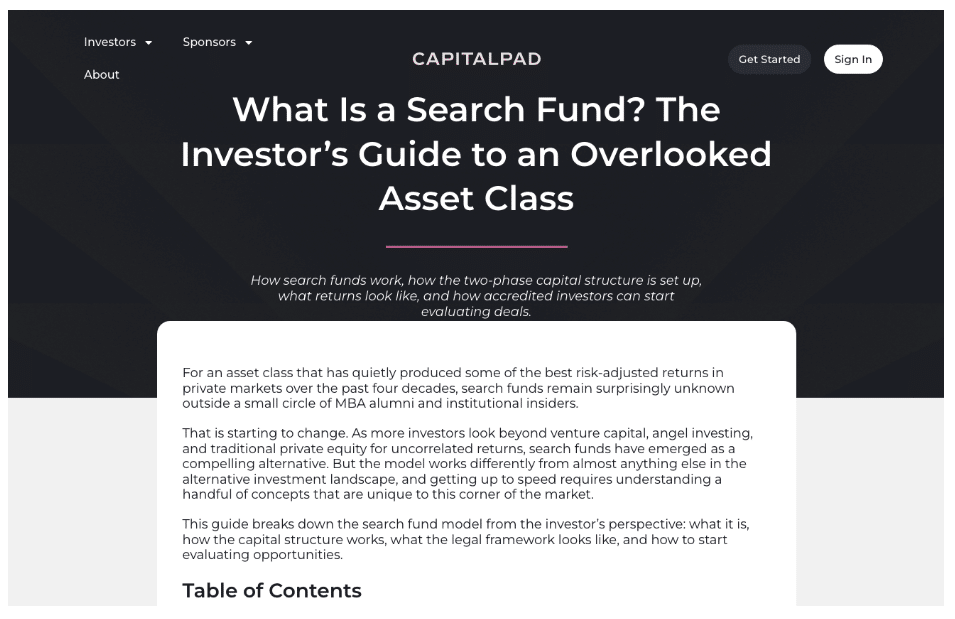
This is precisely what CapitalPad does in the “What Is a Search Fund? The Investor’s Guide to an Overlooked Asset Class” article.
- The article targets a specific audience segment, aiming to generate interest in the brand’s offer.
- The resource doesn’t just pitch an offer. Instead, it fills an awareness gap with expert-led content.
- It establishes the brand’s (and idea’s) legitimacy with citations and data.
- The article teaches readers how to implement the knowledge from the resource, empowering them to consider this type of investing.
- Finally, CapitalPad introduces its platform as a solution for investors considering this model, using the expertise-based approach to drive trust and generate new leads.
Source: capitalpad.com
Use Insight-Led Content to Qualify Leads
In some cases, the biggest content marketing challenge stopping your business from achieving sustainable growth isn’t a lack of brand awareness. Instead, it’s your target audience’s uncertainty about whether your solutions are the right answer to their needs.
Here’s how doubt affects the buyer’s journey.
In the initial stages of the sales cycle, doubt often represents the first filter buyers use to determine whether to engage with a business. If they’re not convinced that a solution is the right fit for their needs, they will often write it off, moving in a different direction, looking for something more relevant.
However, uncertainty doesn’t diminish after the awareness stage of the customer journey. It reappears during the evaluation and conversion stages as well, fundamentally affecting each prospect’s chances of converting into a customer.
The way insight-led content resolves consumer doubt is by operating on two levels.
On the one hand, it educates readers, giving them the knowledge they need to make the best possible call for their specific needs. On the other hand, it removes trust-based doubts, positioning your company as a credible, user-oriented entity that is happy to help its customers make the right call — even if it means losing a sale.
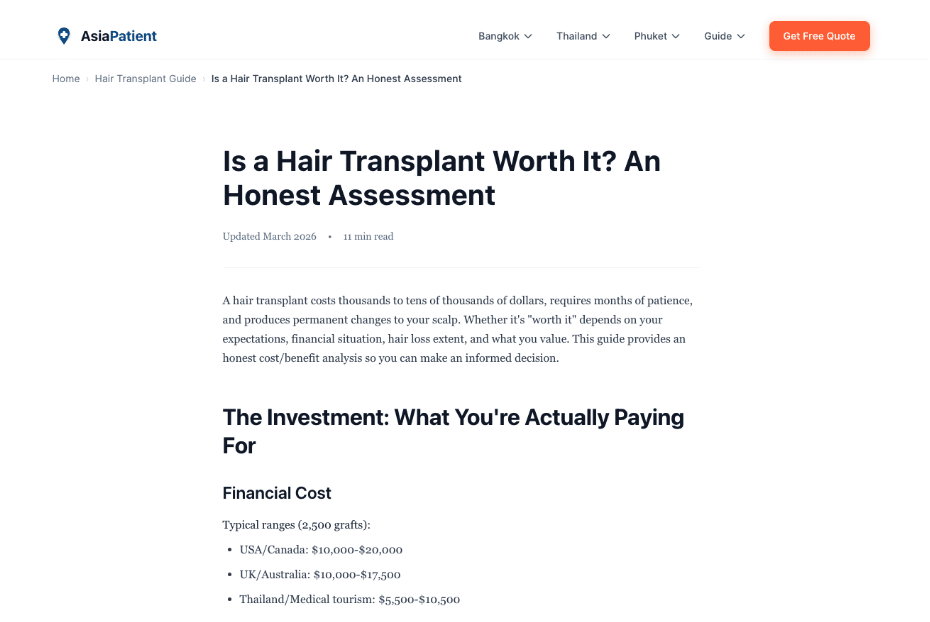
The post “Is a Hair Transplant Worth It?” on Asia Patient is an exceptional example of this type of content.
- The resource is filled with expert insights about the process, risks, and value of different hair transplant procedures.
- It educates readers and sets their expectations about this type of intervention, assisting them in the self-qualification process.
- It builds brand trust and credibility by prioritizing honesty and disarming common customer fears.
- Lastly, it shows a willingness to lose potential profit by prioritizing reader education over customer acquisition.
Source: asiapatient.com
Produce Expertise-Highlighting Content to Differentiate Your Business in Competitive Industries
Although high-quality content can be an amazing way to build brand awareness, educate your target audience about the nuances of your solutions, and encourage them to move into the lower stages of the buyer’s journey, it’s not always sufficient to establish your offer as the best choice in your industry. And the reason for this may not be the quality or effectiveness of your solutions (or the CX you provide). It might simply be that you’re up against competitors with heftier marketing budgets or more history in your target industry.
In such cases, you have two simple choices to ensure your brand stands out.
On the one hand, you can increase your marketing budget to secure more exposure for your content and campaigns, hoping that they will resonate with your ideal customers and encourage them to choose your solutions. On the other hand, you can rely on your content team’s experience to differentiate your business by presenting leads with trust-building value they can’t find anywhere else.
If you opt for the second option, highlighting your brand’s authority and dependability is going to be crucial.
According to research, the biggest benefit of building brand trust is that 68% of buyers would pay more for solutions by businesses they trust. And if that’s not enough to encourage you to focus on credibility-building marketing tactics, it’s worth noting that trust automatically drives loyalty as well, giving your business the unique advantage of high customer retention rates.
With this in mind, it’s always a great idea to produce expertise-highlighting content that can help position your business as the best choice in your industry.
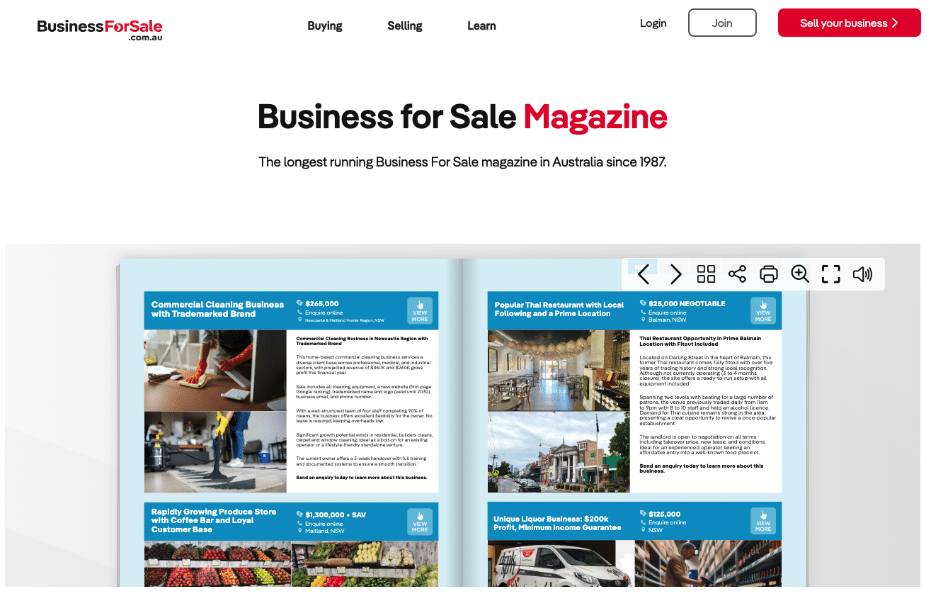
If you check out Business for Sale, you’ll notice that this is precisely what the brand does with its Magazine content page.
- In the top section of the content page, the brand emphasizes that it’s the longest-running magazine of this type in Australia, having been established in 1987.
- The editorial content in the publication demonstrates authority and expertise. Furthermore, it shows a high level of customer-centricity (the willingness to prioritize reader education over conversion goals).
- The business listings represent an easy method for readers to skim through Business for Sales’ offer and evaluate whether it aligns with what they want — an excellent entry into the brand’s sales funnel that doesn’t feel like pressure.
Source: businessforsale.com.au
Use Authoritative Content to Create High-Value Conversion Opportunities
In some industries, the biggest benefit of a high-performing content marketing strategy is its ability to help brands reach and engage their audiences. In others, it’s that some high-quality resources can act as conversion mechanisms themselves. And this can be exceptionally valuable — especially in niches where consumers don’t necessarily feel the need to convert into leads.
In some business models, the main goal (and the primary opportunity for earning a profit) doesn’t rely on selling products or services. Instead, specific verticals like content websites and lead-generation brands live off sustained reader engagement and interest.
Naturally, these organizations could wait for leads to come to them. However, that’s not always a good choice, particularly when considering that today’s consumers have worryingly short attention spans and even lower loyalty rates.
So, the better solution for these businesses would be to generate leads to whom they can then deliver content directly.
The issue with this strategy, however, is that conversion opportunities can be scarce. Yes, some internet users may be willing to join a community or sign up for a newsletter just because they’re interested in the topic. But most will want some guarantee that what they’re getting is genuinely valuable insights.
So, if you want a sustainable approach to content marketing to support your conversion goals, consider producing and distributing authoritative content to create high-value conversion opportunities.
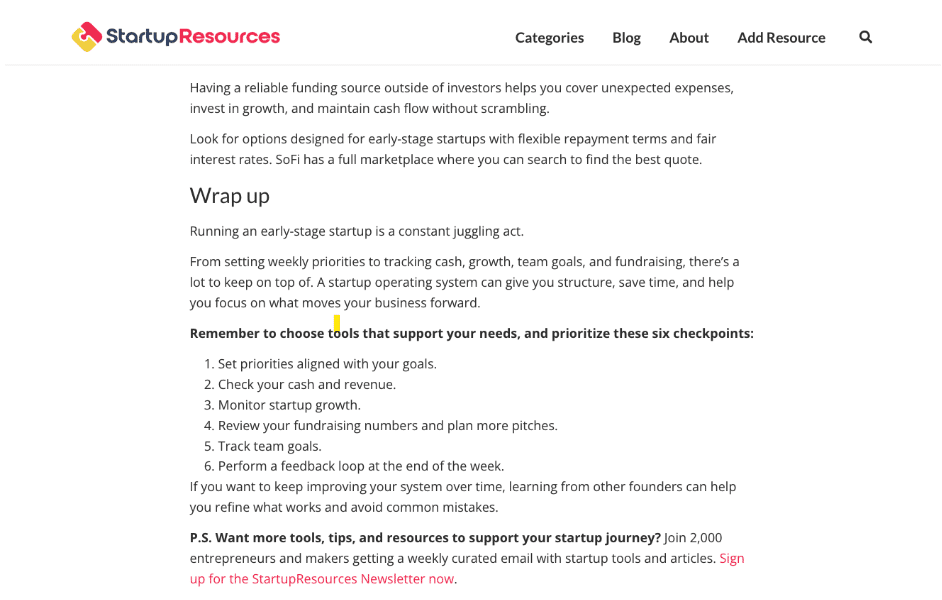
Startup Resources does this beautifully, as you can see in the “Startup Operating Systems For Early-Stage Founders” guide.
- The brand attracts qualified leads by targeting a niche topic.
- It establishes authority by using its experience and expertise to educate readers.
- Then, at the bottom of the article, it invites readers to sign up for its newsletter, which delivers a weekly curated email with startup tools and resources straight to their inbox.
Source: startupresources.io
Produce Expert-Led Articles That Act as Social Proof
While we’re on the topic of building brand confidence, it’s worth noting that most consumers won’t trust your brand’s claims unconditionally.
Yes, they may make a positive conclusion about your company’s expertise and dependability based on the content you publish. But they’re practically guaranteed to check for customer feedback as well.
In fact, research suggests that 95% of consumers regularly read product reviews as part of their shopping journey, and 43% wouldn’t even consider buying a product with zero customer feedback.
In other words, social proof is an irreplaceable factor for business growth.
But here’s the deal. While you could wait for your prospects to leave ratings and reviews, then highlight this type of content in your online presence, you could also generate this type of content to emphasize your brand’s expertise and dependability.
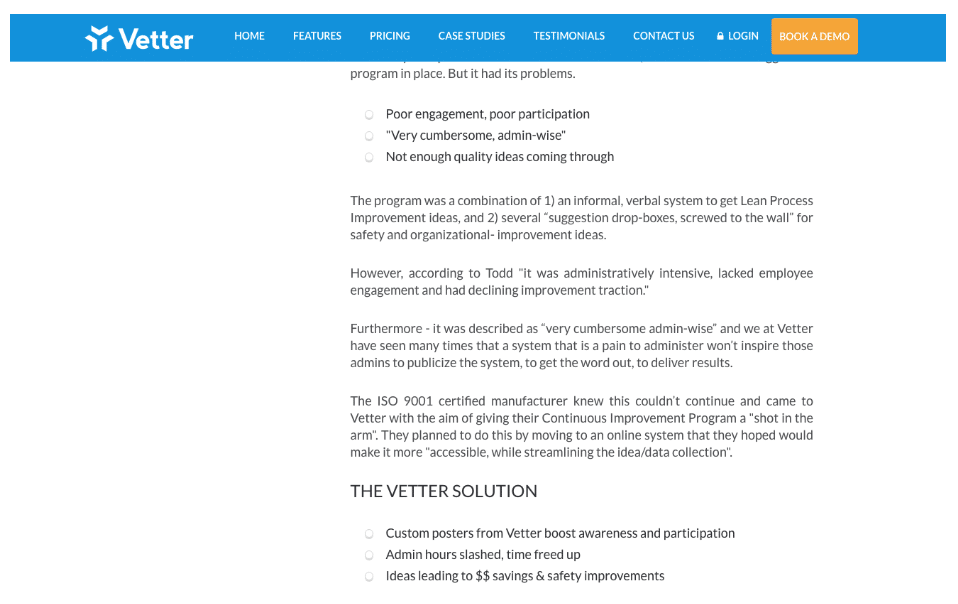
For example, the Case Studies page on Vetter showcases a ton of high-value content that testifies to the organization’s positive track record at resolving customer pain points.
- Each article introduces a unique customer pain point that the brand tackled.
- The content goes into detail on how Vetter approached the problems and what types of solutions it came up with.
- The expert-led content created a verifiable, real-life example of the value Vetter delivers to its clients, effectively managing customer expectations, driving product understanding, and guiding qualified leads closer to conversion.
Source: getvetter.com
Employ In-Depth Educational Content to Support Local SEO
Still not convinced that expertise is truly the only sustainable content marketing strategy for business growth?
Remember that the most effective way to build your brand isn’t to expand at a lightning-fast pace. Instead, it’s to scale your operations incrementally, aiming for a pace your team can handle. And, in many cases, the best way to do this is to start local.
By gaining the attention and trust of consumers in your area, you can establish your brand’s reputation, then slowly build global awareness from that starting point.
So, how do you get local customers to discover (and convert) with your business?
Well, you start by investing in local SEO to get them to try your products and services in the first place.
By targeting location-related keywords and presenting readers with high-quality, in-depth educational content, you can easily establish your company’s credibility and position it as the superior choice over other options in the area (mostly because most small local brands don’t use expert-led content to market their solutions).
Just check out how CodaPet does it in articles on their cities pages, like this one for Orange, California.
- The brand targets location-specific keywords to attract relevant traffic to its website.
- It optimizes on-page content to ensure alignment between visitors’ wants and needs and the copy they see first.
- CodaPet establishes its credibility through price transparency, in-depth educational content, social proof elements, and additional resources for visitors to peruse.
- Finally, the brand incorporates several CTA buttons on the page, ensuring that each website visit has the likelihood of turning into a conversion.

Source: codapet.com
Final Thoughts
There you have it — some of the best ways to use expert-led content to drive sustainable business growth.
In truth, the key to getting this content marketing approach right isn’t necessarily to focus on demonstrating your company’s experience and authority. Instead, it’s to prioritize your ideal customers’ needs and explore opportunities to present leads with value they can’t find anywhere else.
If you do it right, you’ll build brand trust, elevate product understanding, prove the credibility of your claims, and inspire your prospects to try your solutions. Differentiating your brand in a sea of similar options will be just a small added bonus that will ensure that your success continues well into the future.