

Public relations is all about shaping how people think and feel about a brand and building trust. The way PR professionals work has changed a lot in 2026. Getting featured in the media still matters. What’s changed is that now the trustworthy endorsements often come from customers.
Word-of-mouth has always influenced what people buy. What’s different now is that brands have the tools to make customer recommendations structured and repeatable. That’s where referral marketing comes in. In this blog, we will understand the importance of referral marketing in modern PR strategies and how brands are using it for targeted campaigns
The Evolution of Modern PR Strategies
Modern PR strategies have evolved from traditional media outreach to digital-first, audience-experience-driven communication. Today, brands are all about real-time engagement, leveraging data insights and telling their story at multiple different touchpoints through referral platforms to capture trust in the long run.
From Media Placements to Community-Led Growth
Traditional PR was largely a placement game. It used to include securing a feature in a trade publication, a quote in a national newspaper, or a segment on broadcast media. Those wins still count but the media landscape has changed a lot.
The audience is fragmented across media, newsletters, podcasts, and private communities – making a pitch-and-place model increasingly inadequate by itself. Therefore, grabbing the audience’s attention on the platforms where they spend most of their social media time is essential. The question is no longer just “who can we get to cover us?” It’s “who already loves us and how do we help them share that?”
The Rise of Customer Advocacy in Brand Communications
People trust their friends and family more than they trust advertising. When a friend tells you about a product, you listen. When you see an ad on television, you change the channel. And that is where public relations steps in a place that can help the brand develop the trust factor with customers. Prompt them to talk about the brand with their friends.
User generated content, customer reviews, and social proof are vital information which helps nurture trust. Referral Marketing is a way to do this.. It gives customers a reason to tell their friends about a brand. It gives the brand a way to measure how well it is working.
What Is Referral Marketing?
Referral marketing is simply promoting a product or service in a way that a current client is rewarded to bring others to buy or sign up. In contrast to traditional advertising which announces its message to cold audiences that didn’t ask for it, referral marketing is done through a warm, trusted relationship where the sharing has a completely different meaning.
Here is how a refer-a-friend program typically works: someone currently using your brand successfully brings in a new customer, and the reward to that first customer can be based on discounts, credits or gifts. When both parties win, it makes the offer generous instead of transactional. More than most brands know, framing is a crucial consideration.
| Note: A lot of people mix referral marketing with affiliate marketing, but they are different. Affiliate sales come from publishers or influencers who promote products for a commission and to an audience that is not yours. On the other hand, referral marketing depends on bona fide peer-to-peer relationships. |
Why Referral Marketing Aligns Naturally With PR?
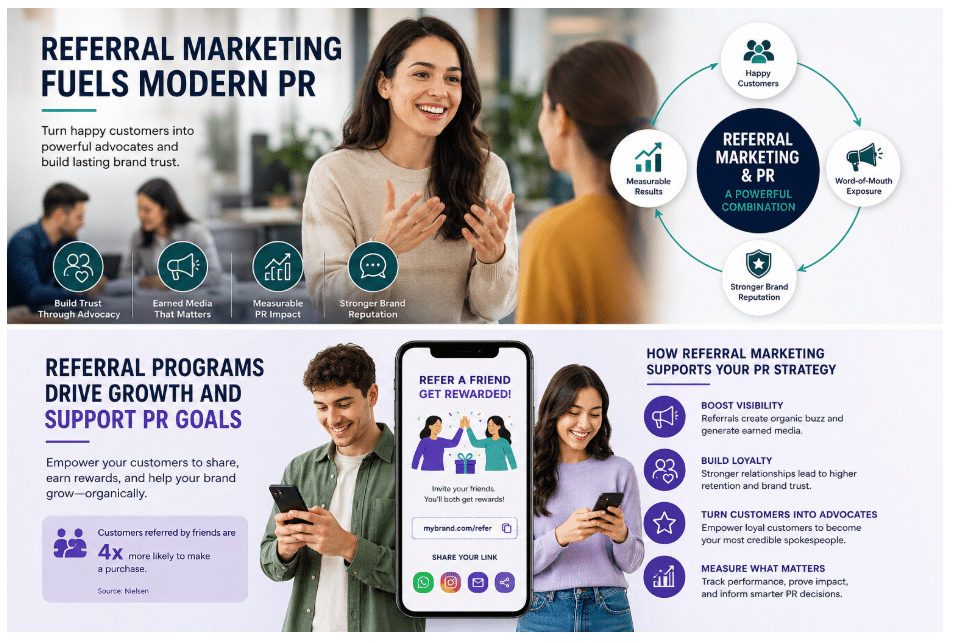
Both Referral marketing and PR rely on trust, credibility, and authentic word-of-mouth communication. Together, they strengthen brand reputation by turning satisfied customers into powerful advocates. Here are the main reasons why referral marketing aligns naturally with PR:
Referral Campaigns Generate Earned Media
Earned media, including coverage, mentions, and conversations that a brand doesn’t pay for, is the gold standard of PR. When run properly, referral programs create earned media at scale in channels where paid campaigns fail to penetrate. When customers broadcast referral links in WhatsApp groups, on social media and over email or in private conversations that brands can never access, they are creating organic brand exposure by transferring it into precisely the environments where advertising expenditure cannot be purchased.
Referral Programs Strengthen Brand Reputation
Few things signal brand health as clearly as customers willing to put their own reputation on the line by recommending a company to people they care about. Strong refer a friend programs create a feedback loop – happy customers refer friends, referred customers arrive with positive expectations already set, and satisfaction rates tend to be higher as a result. Each successful referral is, in effect, a vote of confidence in the brand.
Referral Data Helps PR Teams Measure Impact
One of PR’s persistent challenges is measurement. How do you quantify the value of a mention, a feature, or a shift in brand sentiment? Referral marketing offers clear, trackable data including share rates, conversion rates, referral source analysis, and reward uptake. PR professionals can use this to understand which audiences are most enthusiastic, which messages resonate well enough to pass along, and where word-of-mouth is spreading most naturally.
How Brands Are Using Referral Programs to Support PR Goals?
Brands are increasingly using referral programs to support PR goals by letting happy customers naturally spread the word and build genuine trust. Here is how it is changing the marketing efforts:
Boosting Product Launch Visibility
Product launches are high-stakes moments. Momentum is a precondition for generating early buzz, building anticipation and driving initial trial. To maintain momentum, it takes more than just a well-timed press release. Referral campaigns are becoming a larger part of the launch playbook as they provide your existing users with early or exclusive access in exchange for alerting their networks to expect an official launch date.
Increasing Customer Retention and Loyalty
PR is not just about getting attention; it is about building relationships that last. The role that referral programs play in retention is often underestimated. If a referring customer refers to someone, and this leads to conversion by the referred person, then it means deeper connection with your brand for the original referrer. They have socially invested in the success of the brand. Discount-led loyalty is much easier to erode than this kind of emotional and moral investment.
Turning Loyal Customers Into Brand Ambassadors
Consumers are the most credible spokespeople a brand can have. Not paid spokespeople, not influencers with a brief, but real customers who were drawn to the brand and remained loyal.
Referral marketing is a systematic approach to discovering who those people are and offering them an organized method to advocate. A good programme also creates a more engaged base of genuine advocates – individuals who not only buy, but actively promote the brand within their friends and colleagues. When you work in PR, that community is a resource: testimonials, case studies and inherently real people.
What is the Role of Referral Platforms in Modern Marketing?
Running a referral program manually is difficult to scale and often leads to inefficiencies in tracking, rewards, and performance analysis. Modern referral platforms simplify and automate these processes, allowing teams to focus on growth and strategy.
- Automates referral tracking, reward distribution, and performance monitoring
- Helps prevent fraud and ensures accuracy in data
- Provides real-time insights for better decision-making
- Identifies high-value customer segments more likely to refer
- Referral marketing software like Mention Me help streamline campaigns and improve overall marketing effectiveness
The data these platforms produce is particularly valuable for PR teams. Being able to show that a meaningful percentage of new customers arrived through peer recommendation is a compelling story about brand trust and organic growth. It’s the kind of number that shifts conversations in boardrooms.
Best Practices for Integrating Referral Marketing Into PR Campaigns
Here are the most effective practices to integrate referral marketing into your PR campaigns:
Align Referral Messaging With Brand Voice
A referral campaign is a brand communication. It should be treated as one. The language in referral prompts, reward notifications, and sharing mechanics needs to be consistent with the broader brand voice, because inconsistent messaging undermines the authenticity that makes referral marketing work in the first place.
Promote Referral Campaigns Through Earned Media Channels
Don’t silo your referral program in your CRM and expect customers to find it. If the program has compelling results, that’s a story – whether through a press release, a contributed article, or a social campaign. Use PR channels to build awareness of the program among existing customers and prospective ones.
Use Social Proof and Customer Stories
The most powerful content for a referral campaign is real customer stories. Use your referral data to identify enthusiastic advocates and invite them to share their experiences. Those stories can be repurposed across press materials, social content, and campaign landing pages, creating a consistent narrative about why customers love the brand that doesn’t rely on the brand saying so itself.
Measure Referral-Driven PR Outcomes
Set clear metrics before launching. Track not just referral conversions, but sentiment shifts, social share volume, and changes in brand search behavior. Over time, this data builds the case for referral marketing as a core PR investment rather than a bolt-on tactic that gets cut when budgets tighten.
Common Mistakes Brands Should Avoid in Referral Programs
Even well-intentioned referral programs fall flat when the execution is off. The most common pitfalls:
- Messaging that feels promotional rather than genuine – people can identify it
- Complicated referral processes that create friction and reduce sharing before it starts
- Neglecting to track and analyze performance makes it impossible to improve
- Over-indexing on incentives while under-investing in the experience that makes advocacy worth sharing in the first place
Incentives amplify advocacy but they don’t manufacture it. If the underlying brand experience isn’t strong, no reward structure will compensate for that and a poorly received referral program can actually damage advocacy by making genuine recommendations feel transactional.
Conclusion
The boundaries between public relations, marketing, and customer experience are getting blurry. It’s a chance for us to do something new, rather than just trying to work around it. Referral marketing is right in the middle of all three, taking real customer happiness and turning it into a powerful tool that we can measure and use to grow our business.
For people who work with public relations, referral marketing is a really powerful way to show results, build trust with a brand, and help it grow commercially. It creates the kind of natural, word-of-mouth conversations that public relations has always tried to achieve – but now it’s backed by data, technology, and a clear plan, making it a reliable strategy rather than just a lucky break.
As customer advocacy becomes a more central pillar of brand communications, the question for PR teams isn’t whether referral marketing belongs in the strategy. It’s how quickly they can make it part of it.