

Talk to anyone who’s worked in PR long enough, and at some point the conversation turns to the same sore spot: nobody believes the numbers actually mean something.
That’s a harsh way to put it, but it’s closer to the truth than most teams are comfortable admitting. The work gets done, the coverage lands, the monthly report goes out, and then someone in leadership glances at it, nods politely, and moves on. Because a list of media mentions doesn’t answer the questions they’re sitting with:
- Did PR drive meaningful traffic to the website?
- Did it improve how the brand is perceived and trusted?
- Did it contribute to conversions or influence the sales pipeline?
A mention count answers none of that. It just tells you something happened, not whether it mattered. Closing that gap isn’t about pitching harder or landing splashier placements. It comes down to measuring the right things. That’s what this guide covers.
9 PR Metrics That Matter
Here are 9 PR analytics metrics that show the ROI of your campaigns:
1. Share of Voice
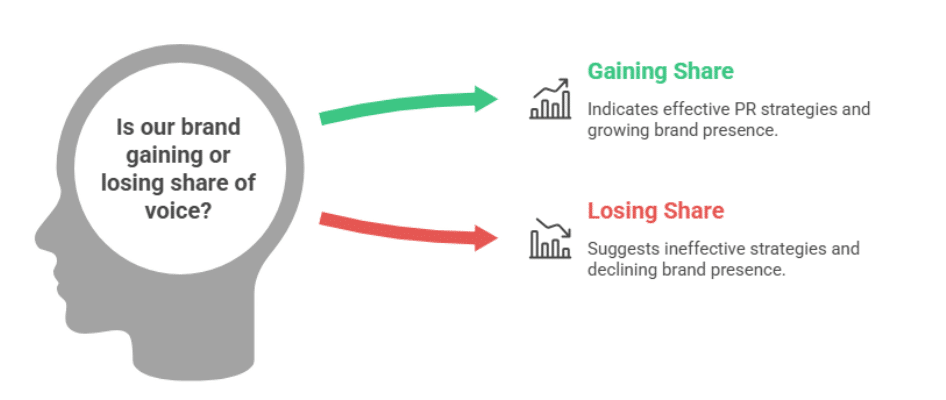
At some point in time, every PR team asks some version of the same question: Are we actually gaining ground, or just staying busy? A voice gives you that answer.
It measures how much of the state of the media conversation your brand owns compared to competitors and, more importantly, whether that share is growing or shrinking. Two questions that drive this metric are:
- How often is our brand mentioned relative to competitors?
- Is that gap widening in our favor, or are we losing ground?
What you’re really looking for is the direction rather than just the number. A brand slowly but consistently claiming more of the conversation is building something real. A brand generating plenty of activity while competitors quietly pull ahead has a problem that volume alone won’t fix.
2. Quality of Media Coverage
Ten mentions in outlets nobody reads is genuinely not the same as one mention in a publication your buyers have bookmarked. Most PR people know this. The reporting just doesn’t always show it.
When evaluating whether coverage is worth anything, three things matter most:
- Does this outlet carry real weight in your industry?
- Is the audience relevant to your business and the people you want to reach?
- Is your brand the focus of the story, or just a passing mention in a long list?
Chasing mention counts feels increasingly productive until someone asks what came from it. Shifting focus to quality gives you coverage that does something useful rather than coverage that just exists.
3. Authority Signals Highlighted in Media Coverage
Some coverage puts your name in front of people. Some coverage makes them think you’re worth paying attention to. Those are not the same thing, and only one of them moves a business forward.
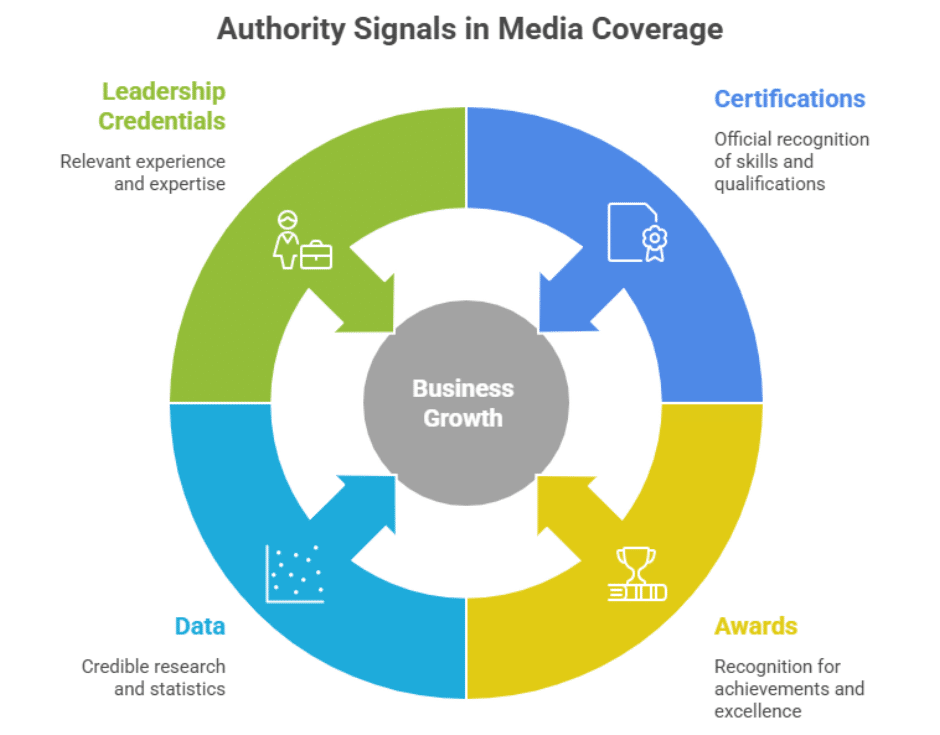
Authority signals separate the two. The ones that carry the most weight include:
- Certifications or accreditations that a journalist references while writing about your company
- Awards or industry recognition that get mentioned naturally within a story
- Data or research your brand produced, cited as a credible source
- Leadership credentials that come up because they’re genuinely relevant
This last point is worth expanding on. Many brands today use a digital badge platform to make credentials and certifications shareable and verifiable across the web. This means when a journalist or reader wants to confirm what you’re claiming, the proof is already there and easy to find.
Buyers in considered-purchase categories don’t make decisions based on name recognition alone. They want evidence. They also respond to how that evidence is presented, where using an AI humanizer tool can help ensure the messaging feels authentic rather than overly automated.
A journalist independently bringing up your credentials does something no marketing copy can replicate: it tells readers someone outside your organization thinks you’re worth citing.
4. Referral Traffic From Media Coverage
This is the metric that tends to get the attention of people who weren’t previously paying attention to PR at all.
Once a placement includes a working link back to your site, you’re no longer dealing in estimates and projections. You have real data, actual visits you can point to, trace back to a specific article, and analyze in the same way you’d analyze any other traffic source. This applies across every type of business, whether a startup launched through formation complies like ZenBusiness or an established company with a dedicated PR team.
For example, a local automobile garage that gets mentioned in a regional automotive publication can track how many people clicked through, how long they stayed, and whether they booked a service.
So, the questions worth asking are:
- Which articles are reliably sending people to a site?
- Which publications produce visitors who actually engage once they arrive?
- Are people coming in and immediately leaving, or sticking around?
“We got great coverage last month” is one kind of report. “That coverage drove 400 site visits with a lower bounce rate than our paid traffic” is a different conversation altogether.
5. Branded Search Growth
Something worth keeping in mind: a lot of people who come across your brand in an article don’t do anything about it right away. They read it, move on, and then a few days later, when they’re ready to look into something, they search for your name directly.
Branded search growth measures that delayed effect. When search volume for your company or product name climbs in the weeks after a campaign, it’s a reasonable signal that the coverage is registered with people. They didn’t just scroll past it. They remembered it well enough to come looking later.
This is particularly true when coverage highlights verified credentials. Brands that showcase achievements often see stronger branded search growth because their credentials are easily discoverable and shareable across the web. Paid media spends a lot of money trying to manufacture that kind of intent. Good earned coverage can produce it without the spend.
6. Engagement From PR Traffic
Getting visitors through the door is step one. What those visitors do once they’re on your site is the part that tells you whether step one was worth anything.
A recent study reports that a bounce rate of 41% to 55% is considered average, though this varies by industry and website type. Insights from Talkative’s IVR in 2026 report also show that when customer interactions feel slow or unhelpful, drop-offs increase quickly.
This means a large share of visitors may leave without taking action. In that context, PR-driven traffic can be evaluated more precisely: if your media coverage is reaching the right audience, your bounce rate may trend lower than typical benchmarks.
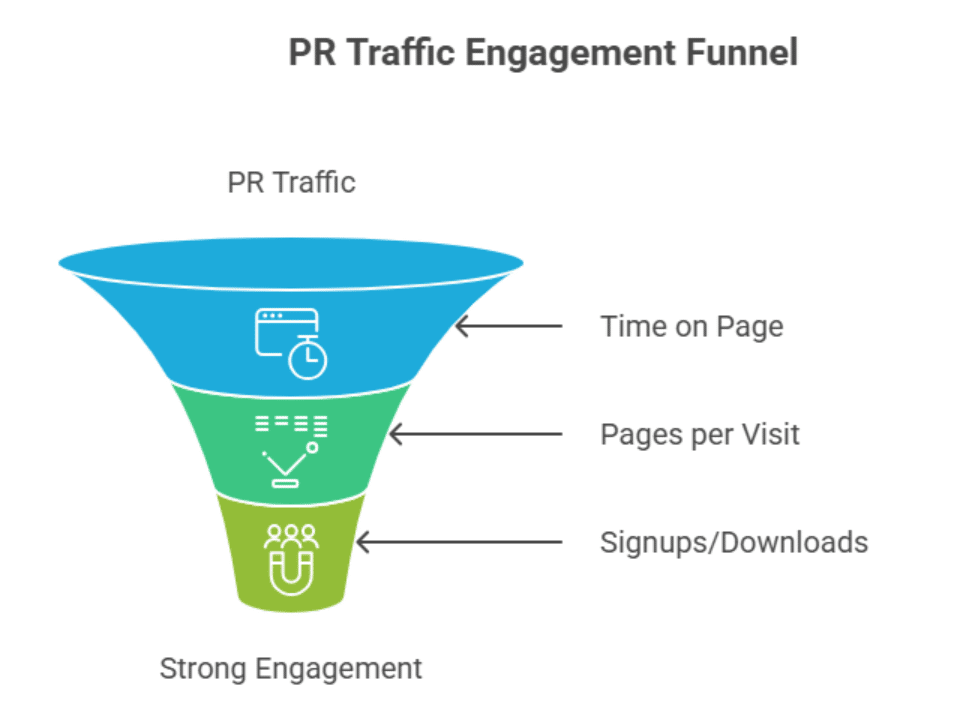
The engagement signals that tell a more honest story:
- Time on page: Are people reading or just landing and leaving?
- Pages per visit: Are they interested enough to keep clicking?
- Signups or downloads that show they want to stay connected
7. Backlinks Earned From Media Coverage
Most of the attention around PR coverage is focused on what happens in the week it runs. Backlinks are what keep working quietly in the background long after that.
When quality publications link back to your site, a few things happen over time:
- Search engines register those signals and factor them into how your site ranks
- Domain authority builds gradually and makes future content easier to rank in AI overviews and in SERPs
- Organic traffic arrives without any ongoing spend required to sustain it
One authoritative publication mentioning your site far outweighs a bunch of links from low-quality sites. That’s not always clear to stakeholders, which is why integrating backlink data into PR reporting helps paint a more complete picture of what campaigns are delivering.
8. Conversions Influenced by PR
PR rarely gets the last touch before someone converts. That gets used as a reason to discount its role in conversions entirely, which is a mistake.
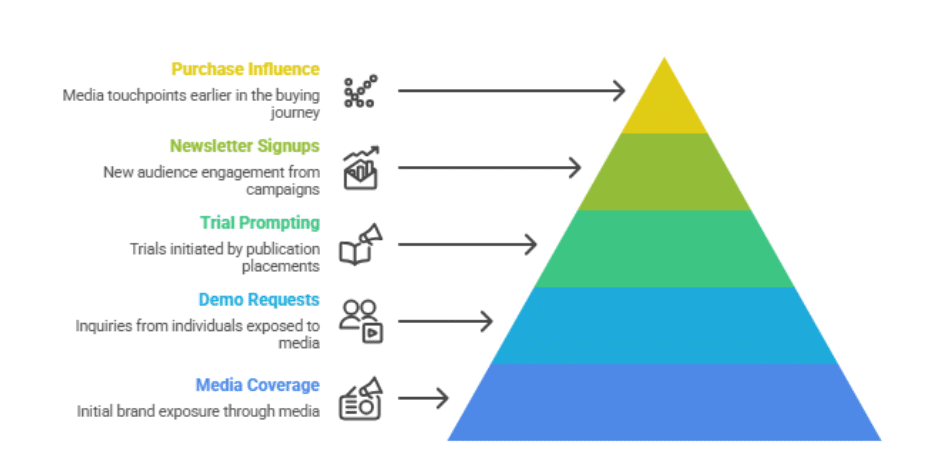
The distinction between being the final touchpoint and being influential is an important one. Conversion influence from PR tends to show up as:
- Demo requests from people who first came across your brand through media coverage
- Trials prompted by a placement in a publication they follow
- Newsletter signups from audiences introduced to the campaign for the first time
- Purchases where a media touchpoint appears earlier in the journey
Standard last-click attribution buries all of that. Assisted conversion data surfaces this impact. It takes a bit more work to pull together, but it produces a version of the story that reflects how PR fits into the buying process, which is usually earlier and more meaningful than the default reporting suggests.
9. Long-Term Brand Trust Signals
A fair amount of what PR builds doesn’t show up anywhere for a long time. That tends to make it easy to dismiss in the short term, which is unfortunate, because it’s often the most durable value PR creates.
The signs that a brand’s reputation is genuinely gaining traction over time don’t usually look like metrics. They look more like:
- Speaking invitations that show up without any pitching on your part
- Partnership conversations started by organizations that already view you as credible
- Industry recognition that reflects how peers in your space think about you
- Journalists treating your team as a go-to source rather than someone to cold pitch
Quantifying that trust over time is where customer loyalty metrics like Net Promoter Score become useful; they measure whether your audience would actively recommend you to others.
None of that fits into a weekly dashboard. But it reflects something that a single campaign can’t manufacture a reputation built steadily over time. This makes every future PR effort easier and more effective than the last.
Bringing It All Together: From Metrics to Meaning
Taken individually, each of these metrics gives you a partial view. Taken together, they give you something genuinely useful:
- Share of voice shows whether the brand is earning attention relative to competitors
- Coverage quality and authority signals reflect whether that attention is building credibility
- Referral traffic and engagement reveal whether people are responding
- Conversions show whether PR activity is contributing to real business outcomes
- Long-term trust signals tell you whether consistent effort is building something that compounds
That’s a story worth telling in a leadership meeting, not just a slide full of numbers that gets politely acknowledged and forgotten.
For joining cross-system data and extracting deep insights from it, consider organizing that dataset in a database and then connecting it to the AI chat. For example, you can easily connect PostgreSQL database to Claude with no coding skills required, eliminating engineering and analyst bottlenecks.
PR Value Was Always There. Now Prove It.
PR’s credibility problem has never really been about the work itself. It’s been about how the results get reported. Impression counts, and mention volumes were always going to struggle to convince people holding budgets, because they don’t speak the language those people think in.
Report on metrics that reflect behavior and business contribution, and the conversation shifts. Not because the work changed, but because the proof finally did.
If your reports still open with coverage volume and total impressions, the most persuasive part of the story isn’t being told. Your campaigns are reaching buyers before they’ve identified themselves. This shapes how your market thinks about your brand and builds a reputation that quietly accumulates in the background.
Measure that work honestly, and PR stops being something leadership tolerates in the budget. It becomes something they want more of. Learn more about it at agilitypr.com.