
PR ROI sounds simple on paper: spend money on PR, get more value back than you spent.
In reality, it’s rarely that clean.
Most PR work touches people long before they convert. A founder interview sparks curiosity. Someone Googles the brand a few days later. They read a blog post, sign up for a webinar, and then finally book a demo weeks after that. By the time revenue shows up, the original media hit is buried somewhere in the middle of the journey.
That’s where the tension comes from. Consider that PR sits better with customers than paid ads, but since advertising can attribute its results adequately, there is less debate on whether it works.
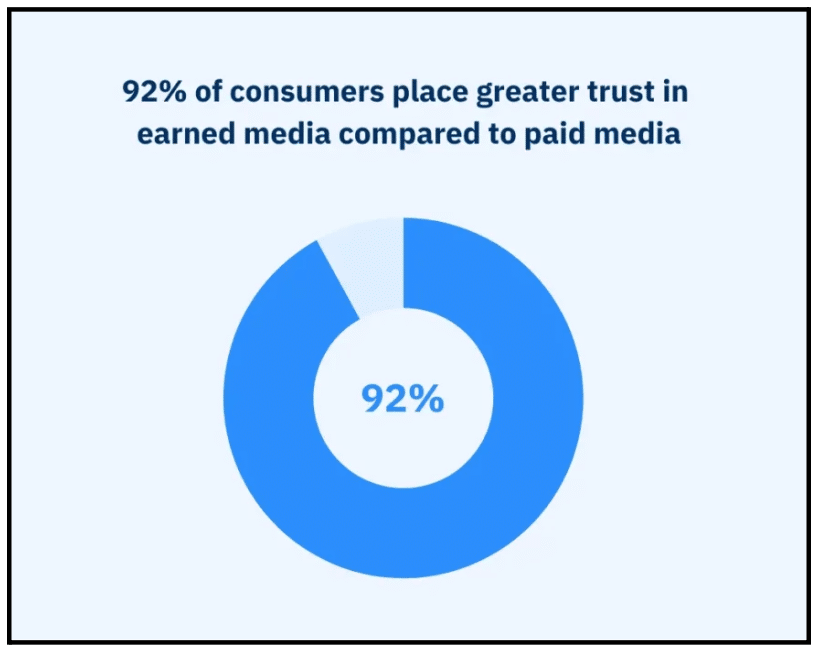
Everyone wants proof that PR works, but the path from coverage to revenue rarely runs in a straight line.
Still, the pressure to show that connection is real. When PR teams can tie earned media to leads, pipeline, or revenue signals, the conversation shifts. Suddenly, the work isn’t framed as awareness or reputation building. It becomes a necessary part of the growth engine.
Understanding PR in the Digital Age
PR used to be easier to measure, at least superficially.
You counted clips or looked at circulation numbers. Maybe someone calculated Advertising Value Equivalency and called it a day.
Those reports looked impressive. Thick binders full of logos and headlines.
But they didn’t say much about what actually happened after someone saw the coverage.
Today, the picture is different. One article can trigger several measurable reactions within hours. Branded search spikes. Referral traffic jumps. A founder quote gets shared across LinkedIn. Someone clicks through and signs up for an email list.
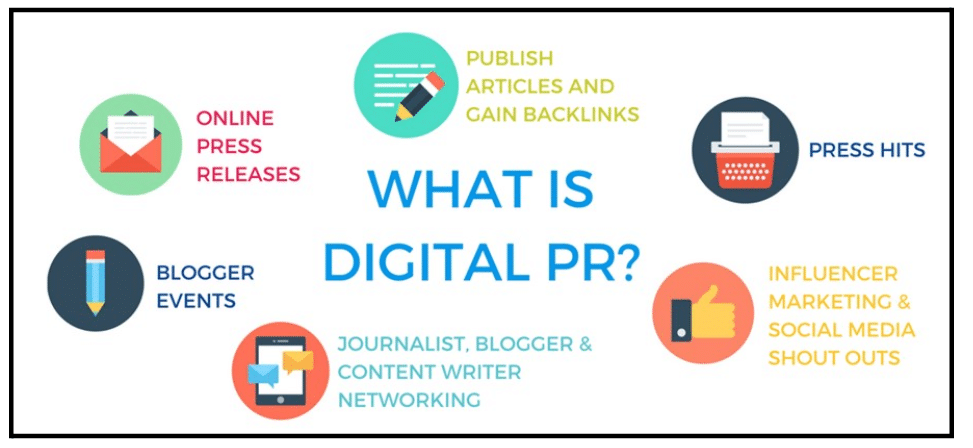
In sectors where conversions happen on owned websites, this journey is easier to observe. Vacation rental operators, for instance, often study guides on how to build a direct booking site because those resources emphasize capturing traffic from media mentions, travel blogs, and social posts before it disappears back into search or aggregator platforms.
The signals are there.
The problem is that they live in different systems. There are web analytics, social listening platforms, media monitoring tools, and CRM records. Each one captures a fragment of the story.
The real work is stitching those fragments together.
Frameworks like AMEC’s Barcelona Principles pushed the industry in this direction years ago: stop counting outputs, start connecting activity to outcomes. Not impressions. Impact.
Traditional Attribution Models
For a long time, PR measurement leaned on shortcuts.
Advertising Value Equivalency is the classic example. Take the ad rate for a publication, multiply it by the size of your coverage, and call that the “value” of the placement. Here’s an example of how this is usually used to measure an initiative.
It’s quick. It’s easy to explain.
It’s also misleading.
It assumes earned coverage works like advertising. It ignores whether anyone actually engaged with the story, whether the audience matched your buyers, or whether the coverage changed behavior at all.
So once PR moved fully into digital channels, these limitations became obvious. Customer journeys now span search, social, email, communities, and product trials, and a single touchpoint can’t explain the outcome.
Advanced attribution models try to handle that complexity.
They combine data across channels, weigh different touchpoints, and estimate how much PR actually contributed alongside paid and owned efforts. Let’s dig into that.
Types of Advanced Attribution Models
Each of these three attribution models answers a slightly different question. Most teams end up using a combination.
Multi-touch attribution (MTA)
Multi-touch attribution spreads credit across the interactions that happen before conversion.
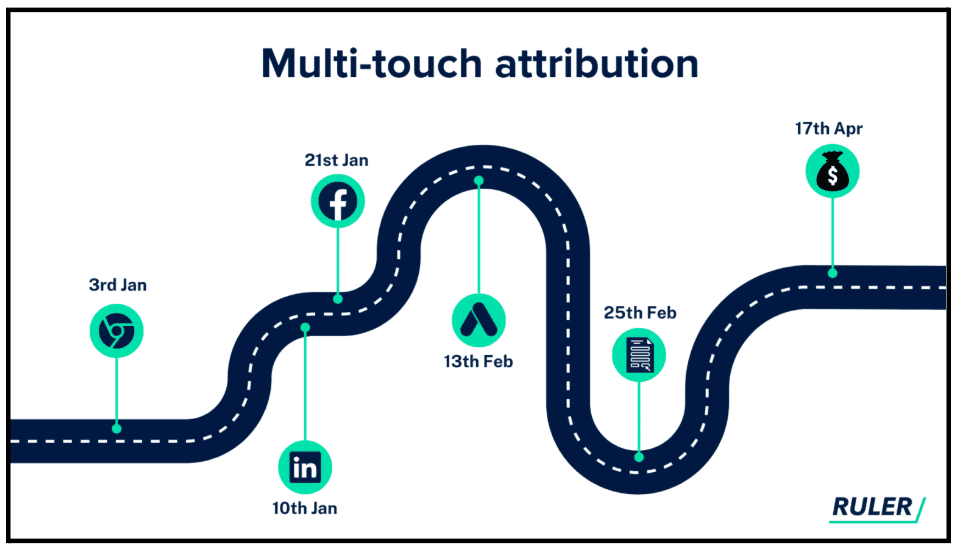
Instead of giving all credit to the last click, it distributes value across the journey: the article someone read, the social post they engaged with, the webinar they attended before signing up.
There are several versions. Linear models treat every step equally. Time-decay models give more weight to recent interactions. Position-based models prioritize the first and last touch.
What MTA does well is reveal the journey.
Wade O’Shea, Founder of BusCharter.com.au, runs a business where bookings rarely happen on the first interaction, especially for group travel and events.
He explains, “We seldom see someone convert straight after discovering us through media or content. A press mention might bring them in, but then they compare options, check pricing, and come back later. If you’re only looking at last-click data, PR looks like it didn’t work. Multi-touch attribution shows you that it actually started the conversation.”
You can see patterns. A press feature drives traffic. Some of those visitors follow the brand on LinkedIn. A subset later converts after seeing a product announcement.
But MTA also runs into limits. Tracking is harder now. Cookies disappear. Platforms hold more data inside closed ecosystems. Visibility across the full path isn’t always possible.
Media mix modeling (MMM)
Media mix modeling approaches the problem from the opposite direction.
Instead of tracking individuals, it analyzes aggregated performance data over time. The model looks at how changes in media activity correlate with changes in outcomes like revenue, leads, or search demand.
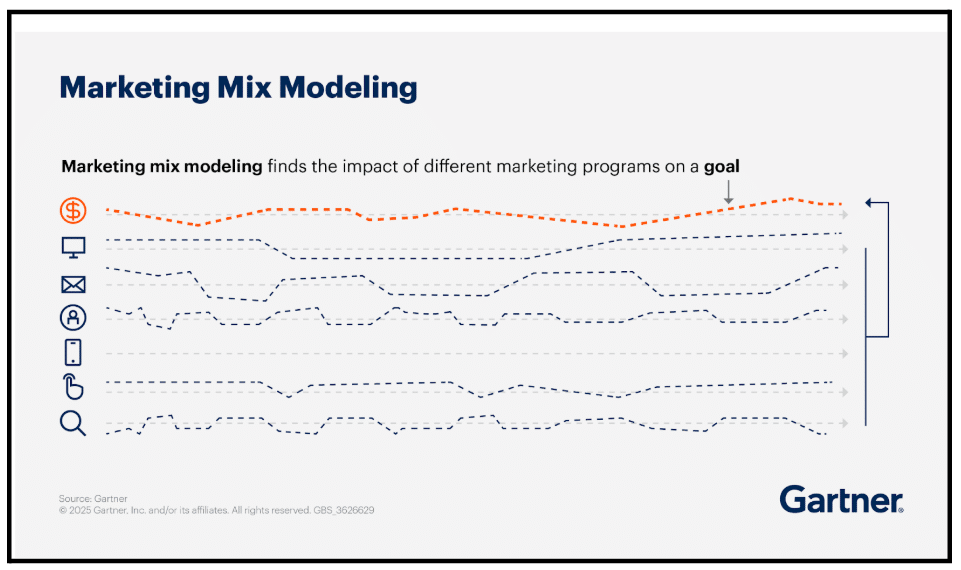
If earned media spikes during a launch window and conversions move at the same time, MMM estimates how much of that lift belongs to PR versus other channels.
It’s slower and more analytical. The modeling requires good historical data.
But it solves an important problem. It doesn’t depend on user-level tracking. That makes it resilient in a privacy-constrained environment.
Machine learning–driven models
Some teams take things further by introducing machine learning models that incorporate additional signals.
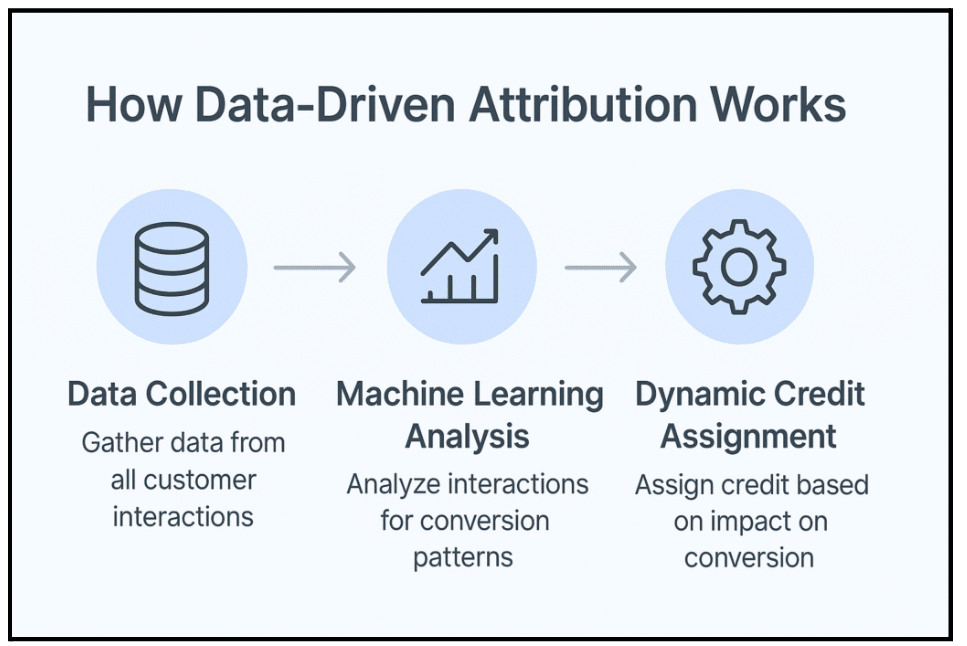
Sentiment scores. Outlet authority. Social amplification patterns. Even the type of narrative being used in coverage.
These models can surface patterns that traditional attribution misses. They can also become opaque if teams aren’t careful.
Which is why experiments still matter.
Models estimate relationships. Experiments confirm them.
Implementing Advanced Attribution Models
Most organizations assume attribution is a modeling problem. In practice, it’s usually a data problem.
Before you worry about algorithms, the basics need to work.
Clarify outcomes first
Start with the outcomes that matter to the business.
These would be qualified leads, product trials, and revenue.
PR objectives should connect to those outcomes in a testable way. For example, coverage in industry outlets increases branded search within a week of publication.
Without a clear hypothesis, attribution models drift into guesswork.
Capture data at key user interactions
Links in media coverage should carry UTM parameters.
That sounds obvious. It’s surprising how often it’s missing.
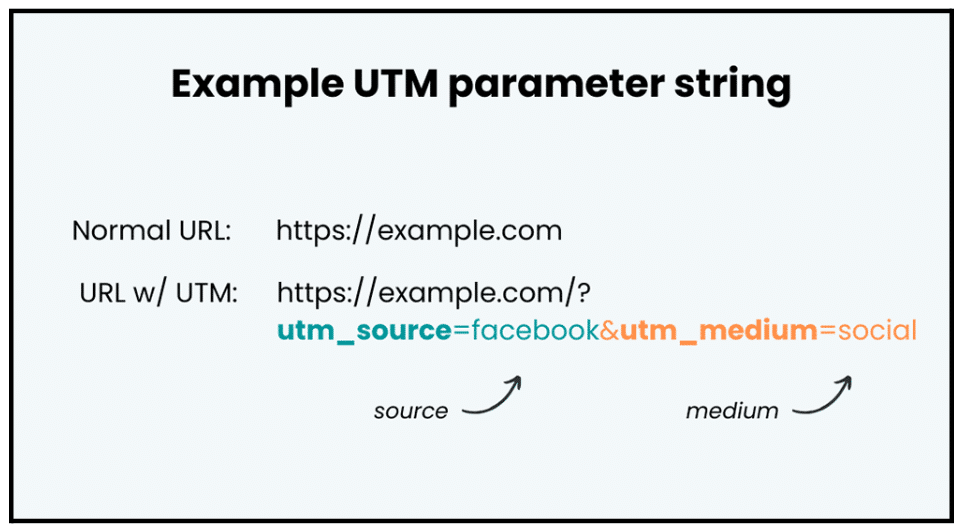
PR traffic also tends to behave differently from paid campaigns. People land on a story, explore the site, then return later through search or direct visits. Tracking micro-conversions helps capture those early signals: email signups, demo requests, and time spent on key product pages.
Those early behaviors are often the first measurable effect of PR.
Integrate your stack
The real value appears when systems connect.
Media monitoring identifies the placement. Web analytics captures the visit. CRM data shows whether that visitor eventually became a customer.
Once those systems talk to each other, the narrative becomes clearer.
Eric Yohay, CEO & Founder of Outbound Consulting, works closely with B2B teams trying to connect marketing activity to the actual pipeline.
He says, “The biggest gap we see is between engagement data and revenue data. Teams know a campaign drove traffic or responses, but they can’t tie it to deals. Once you connect PR signals with CRM stages, you start seeing which conversations actually turn into pipeline. That’s when attribution stops being theoretical and starts influencing decisions.”
You can see coverage generate attention, attention creates engagement, and engagement eventually produces revenue.
Choose a model mix
Most teams settle on a hybrid approach.
Multi-touch attribution helps map journeys where tracking is reliable. Media mix modeling estimates the broader contribution of PR across markets and time periods. Experiments like geo holdouts or staggered announcements help confirm causality.
No single model answers everything.
Together, they get closer to the truth.
Build governance into the process
Attribution systems decay quickly without discipline. Naming conventions drift. Campaign tags change. Data pipelines break quietly.
The fix isn’t complicated, just document your data sources. Standardize naming conventions. Refresh models regularly.
And make the outputs visible.
Dashboards that combine coverage, traffic, conversions, and revenue influence make adoption easier across the organization.
Measuring Earned Media Value
There is no single metric that captures the value of earned media.
Trying to compress everything into one number usually hides more than it reveals.
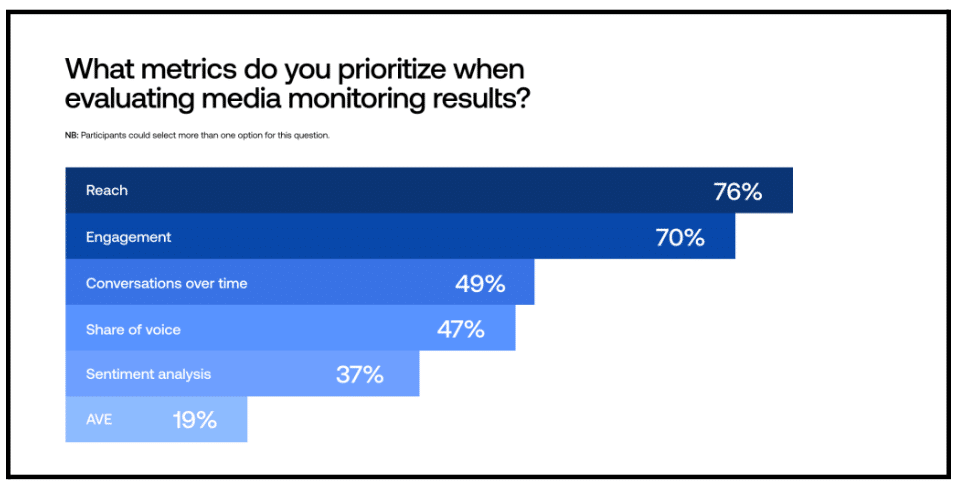
The useful signals tend to appear across several layers:
- Referral traffic from coverage
- Engagement on social shares
- Branded search lift after major placements
- Backlinks from authoritative publications
- Assisted conversions in analytics platforms
- Pipeline influence recorded in the CRM.
Some metrics predict outcomes better than others.
Sentiment alone rarely tells the full story. But when sentiment is combined with behavioral data like clicks, engagement, and conversion signals, it becomes more meaningful.
Patterns emerge. You identify certain outlets that consistently drive engaged traffic. Or narratives that worked for you, which you in turn can work into your strategy.
Also, something you have to consider now is that influencers, subject-matter experts, and social creators often extend the lifespan of a story far beyond the original placement. When that amplification happens, tracking becomes critical. Otherwise, the ripple effects disappear from the measurement system.
Challenges and Considerations
The technical work is only half the challenge.
The bigger shift is cultural.
PR teams have historically been evaluated on visibility.
This challenge is even more visible in industries where decisions take time. In healthcare, for example, someone researching TRT may read multiple articles, expert opinions, and patient experiences before ever contacting a provider, which makes attribution harder to trace back to a single media mention.
Introducing attribution changes the conversation. Suddenly, campaigns are discussed in terms of pipeline influence and revenue contribution.
That can create skepticism.
The best response is transparency. Start small. Run a pilot in one market or product line. Share the data openly, including the parts that didn’t work.
Credibility builds over time.
Future of PR Measurement and ROI
PR measurement is moving toward models that rely less on user-level tracking and more on causal analysis.
Incrementality testing, geo experiments, and synthetic control methods.
Media mix modeling is seeing renewed interest because it works in privacy-constrained environments. Clean rooms and conversion APIs are closing gaps between platforms.
Machine learning will continue to surface patterns across large datasets. But the strongest teams will still validate those patterns through experiments.
Final Note
When teams can show how earned media drives discovery, shapes consideration, and contributes to conversions, PR stops being framed as an awareness activity. It becomes part of the growth strategy.
The mechanics are practical. Define outcomes. Instrument links. Connect analytics with CRM. Run models that match your data reality.
Then test, learn, and refine.
The teams that treat measurement as part of storytelling, not a reporting exercise, tend to make better bets.
Understanding PR impact starts with the right data and visibility into media coverage.
With Agility PR Solutions, teams can monitor mentions, track media performance, and connect earned media activity to the metrics that matter. Explore how smarter media monitoring and analytics can help you measure the real impact of your PR efforts.