

Marketing is under more pressure than ever to prove its impact on business growth, and Boathouse’s fifth annual CEO Study offers a clear look at how CEOs are evaluating that impact today. The study surveyed 150 CEOs from top U.S. companies to better understand how they view marketing, the role of the CMO, and what’s driving growth inside their organizations.
This year’s findings point to a notable shift. CMOs are more embedded, trusted, and aligned with leadership than ever before. But that progress has not translated into stronger confidence in marketing’s ability to drive business impact.
As expectations rise around driving growth, alongside increasing emphasis on brand and company narrative, marketing and communications leaders are under increasing pressure to clearly connect their work to measurable business outcomes.
We spoke with Maurya Overall at Boathouse to unpack what’s changed, where the gaps remain, and what it means for marketing and communications leaders moving forward.
Q: What’s the biggest takeaway from this year’s CEO study when it comes to marketing and communications?
The biggest shift is that the conversation is no longer about access. For years, there was a question around whether CMOs had a real seat at the table. That question is largely behind us. In this year’s data, 79% of CEOs say their CMO shows strong commitment to the CEO and board and 85% say they build trust across the organization.
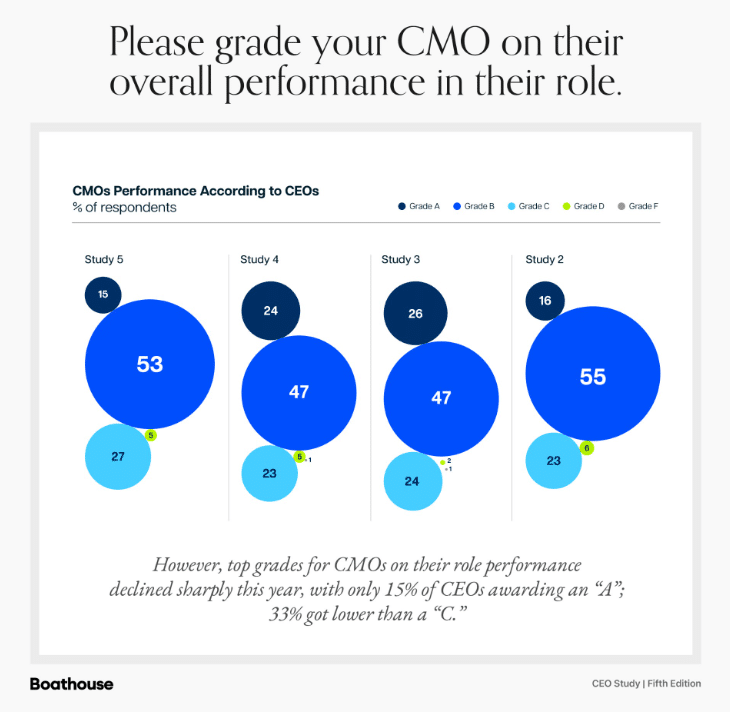
But that progress hasn’t translated into stronger confidence in marketing’s impact. Only 15% of CMOs are rated at the top level, and more than half are still seen primarily as execution-focused. So the issue isn’t proximity to leadership anymore. It’s whether marketing and communications can clearly demonstrate how they’re driving the business forward.
Q: Why do you think there’s still a gap between what marketing is doing and how CEOs perceive its impact?
It’s not a lack of effort or even a lack of data. If anything, there’s more measurement than ever. More than 70% of CEOs say marketing metrics are aligned with business goals.
The challenge is that the data isn’t consistently connecting to financial outcomes in a way that builds conviction. Only 13% of CEOs say they are very confident in marketing’s ability to demonstrate incremental financial impact. That’s a very low number given how central marketing is expected to be to growth.
Narrative, reputation, engagement, those things matter, but they have to be tied more directly to business performance. Otherwise, they’re seen as important, but not essential to how the company grows.
Q: What are CEOs expecting from marketing right now?
The mandate is very clear. Sixty-five percent of CEOs say marketing’s primary role is to drive sales growth, and there’s increasing emphasis on brand and company narrative alongside that.
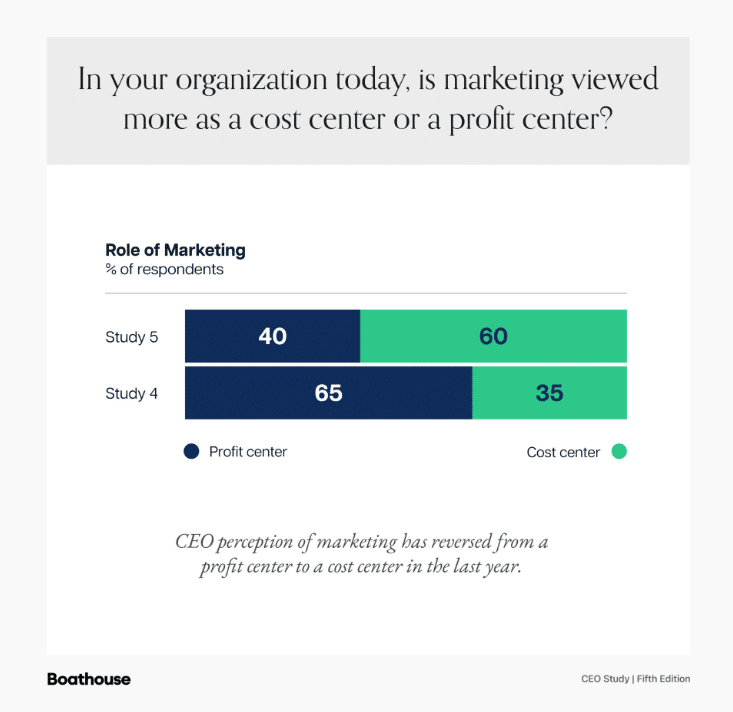
But the belief isn’t fully there. Fifty-nine percent say they’re confident marketing contributes to growth, and only 15% are very confident. At the same time, 60% of CEOs now view marketing as a cost center rather than a profit center, which is a sizable shift in mindset from just a year ago when only 35% of CEOs felt that way.
That tension is defining the role right now. Expectations are rising, but confidence hasn’t kept pace.
Q: How is that affecting the role of the CMO and communications leaders day to day?
When impact isn’t clearly demonstrated, the role naturally shifts. More time goes into reporting, defending performance, and managing execution. Less time is spent shaping strategy.
That shows up in how CEOs describe the role. Fifty-seven percent primarily see CMOs as execution leaders rather than strategic drivers, even though many are involved in strategic discussions.
For communications leaders, it’s a similar dynamic. If you’re not clearly tied to business outcomes, you get pulled into execution. If you are, you have a much stronger voice in how the company is positioned and how it grows.
Q: What needs to change for marketing and communications to close that gap?
It comes down to integration and clarity. Right now, data is still fragmented across marketing, sales, and finance in a lot of organizations. Attribution is improving, but it’s not always consistent or trusted at the executive level.
Closing the gap means connecting marketing activity, including communications, to broader business outcomes in a way that’s credible and repeatable. Not just showing performance, but showing cause and effect.
If that connection becomes clearer, the perception of marketing changes with it. It moves from being seen as a cost center or execution function to a real driver of growth.