A few years ago, most professionals used AI as a faster search engine. They asked questions, received answers, and moved on with their work. In 2026, something more significant is happening.
AI is no longer just helping people find information. It is helping them learn. The shift sounds subtle, but it changes how professionals acquire skills, close knowledge gaps, and stay relevant in rapidly evolving industries.
For communications, marketing, and PR professionals who face constant pressure to master new tools and platforms, AI is increasingly becoming more of a personalized learning partner that works alongside them every day.
The real problem was never access to information
For decades, professional learning suffered from a strange contradiction. Information became easier to access while meaningful learning became harder to achieve.
Marketing professionals could access thousands of articles about SEO. PR teams could find endless webinars about crisis communications. Brand strategists could download reports, attend conferences, and subscribe to industry newsletters. Yet despite having more information than ever before, many professionals still struggled to develop expertise in unfamiliar areas.
The issue was never information scarcity. The issue was cognitive overload.
The average professional does not need another thousand-page guide about generative AI, audience analytics, or attribution modeling. They need a way to understand what matters, identify what they do not know, and learn efficiently within the limited hours available between meetings, deadlines, and client demands.
This is where AI is beginning to change the equation.
Instead of simply delivering information, modern AI learning systems increasingly focus on helping users move from awareness to understanding. The distinction matters because knowing where information exists is different from being able to apply it in practice.
The World Economic Forum recently observed that “Artificial intelligence (AI) is transforming the nature of work” while simultaneously changing the skills and competencies workers need throughout their careers.
The consequence is becoming visible across nearly every industry. Learning is no longer a periodic event. It is becoming a continuous process integrated directly into daily work.
The shift from answer engines to learning systems
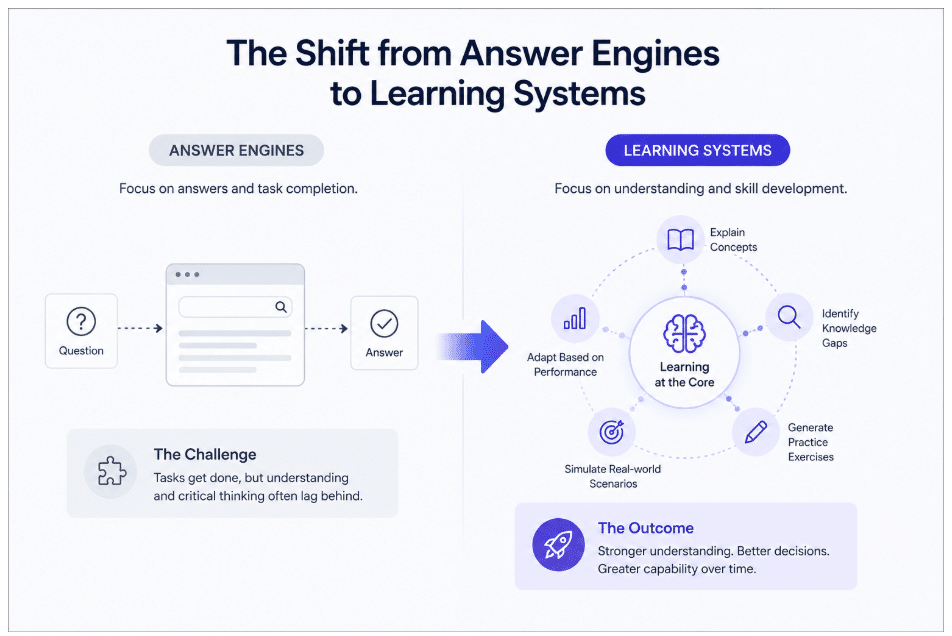
The first wave of generative AI tools focused primarily on answers.
Professionals asked questions and received responses. While useful, this model created an unexpected challenge. People could complete tasks faster without necessarily understanding the concepts behind them.
Many organizations began noticing a growing gap between task completion and actual skill development. Employees could generate presentations, draft reports, or summarize research, but often struggled to explain the reasoning behind the outputs.
This concern is increasingly reflected in workplace discussions. LinkedIn executive Aneesh Raman recently warned that excessive dependence on AI can weaken critical thinking if professionals simply pass prompts and outputs back and forth without engaging with the underlying ideas.
The next generation of AI platforms is responding to this challenge by shifting from providing answers to facilitating learning.
Instead of simply solving a problem, these systems increasingly explain concepts, identify knowledge gaps, generate practice exercises, simulate real-world scenarios, and adapt lessons based on performance. The objective is not just to help users finish work faster. The objective is to help them become more capable over time.
The difference can be illustrated clearly.
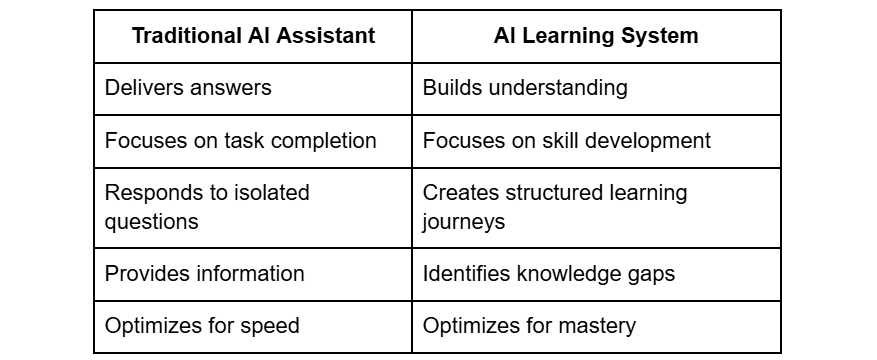
This shift represents one of the most important developments in professional learning today because it addresses a problem that traditional online education often struggled to solve: personalization.
Why traditional professional development is breaking down
Professional learning was built for a slower world.
A marketing certification completed three years ago might have remained relevant for a decade. A PR professional could develop expertise in a specific media landscape and apply that knowledge for years without major disruption.
That environment no longer exists.
Generative AI tools, evolving search algorithms, emerging social platforms, privacy regulations, synthetic media technologies, and rapidly changing audience behaviors continuously reshape professional requirements.
The half-life of knowledge is shrinking.
LinkedIn’s Workplace Learning research highlights that many organizations now view skill development as directly connected to business adaptability and competitive performance. Nearly half of learning and talent development leaders report concerns about whether employees possess the skills necessary to execute organizational strategy.
Traditional learning approaches struggle because they were designed around fixed curricula.
A course developed twelve months ago may already contain outdated examples. A certification program may cover concepts that no longer reflect current tools or workflows. Even excellent professional development programs often struggle to adapt quickly enough to changing market conditions.
AI-powered learning systems operate differently.
Instead of relying entirely on static content, they can continuously generate updated explanations, examples, simulations, and practice opportunities based on emerging developments.
The result is not merely faster learning. It is more adaptive learning.
Learning in the flow of work
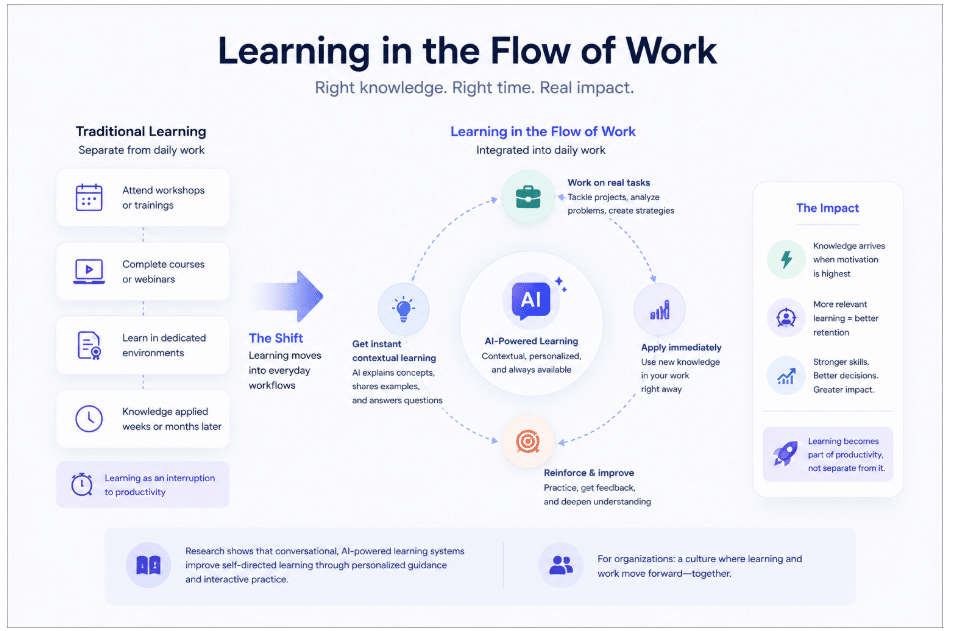
One of the most significant developments in 2026 is the movement of learning from separate environments into everyday workflows.
Historically, professionals learned in dedicated settings. They attended workshops, completed courses, joined webinars, or participated in training programs outside their daily responsibilities.
Increasingly, learning happens while work is being performed.
A communications manager preparing a crisis response strategy might use an AI system to understand emerging risk scenarios. A content strategist exploring a new search algorithm may learn optimization principles while actively building a campaign. A PR professional researching media outreach techniques can receive contextual explanations during the planning process rather than weeks later in a formal training environment.
This model creates a fundamentally different learning experience.
Knowledge arrives precisely when motivation is highest because it is immediately relevant to a real-world problem.
Researchers studying AI-powered workplace learning have found that conversational learning systems can improve self-directed learning by combining personalized guidance with interactive practice.
The implication is important for organizations.
Instead of treating learning as an interruption to productivity, AI increasingly enables learning to become part of productivity itself.
The emergence of personalized learning platforms
Perhaps the clearest indicator of this transition is the emergence of AI-native learning platforms designed specifically around how people learn rather than how content is delivered.
Many traditional learning systems begin with content and ask users to adapt to it.
New AI learning platforms increasingly begin with the learner.
A professional identifies a goal, knowledge gap, project, or challenge. The system then creates a customized learning path designed around that specific objective.
One example is Fenzo.ai, which reflects many of the broader trends emerging across AI-powered learning. Rather than presenting users with a predefined curriculum, the platform generates personalized courses, structured lessons, interactive exercises, practice assessments, and AI-guided tutoring experiences based on an individual’s goals and existing knowledge level. It also identifies learning gaps and adjusts learning pathways accordingly.
What makes platforms like this notable is not merely the use of AI. It is the shift toward adaptive instruction.
Traditional learning platforms ask users to follow a course.
Adaptive learning platforms increasingly build the course around the user.
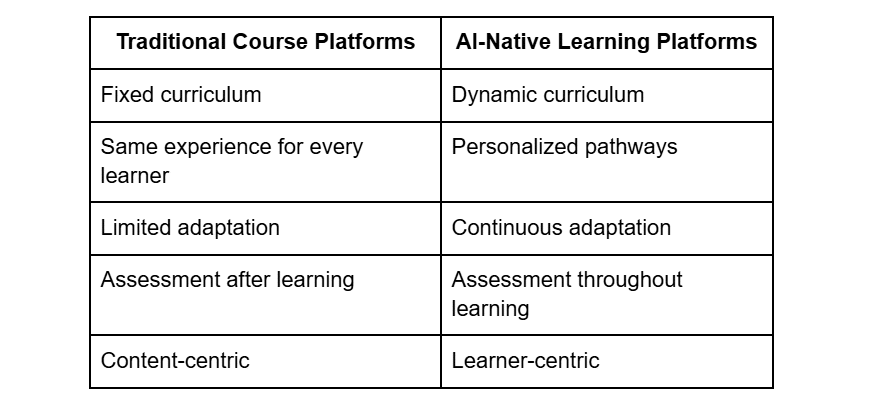
This distinction becomes increasingly valuable for professionals who rarely have time to complete lengthy programs that may only partially address their actual needs.
Why PR and marketing professionals stand to benefit most
The communications industry offers a particularly useful example of why AI-driven learning is gaining traction.
Few professions experience the combination of technological change, platform disruption, audience fragmentation, and skill diversification that PR and marketing professionals face today.
A single communications leader may need working knowledge of media relations, analytics, AI content workflows, audience segmentation, crisis management, SEO, social strategy, data interpretation, and executive communications.
No university program can continuously update itself fast enough to cover all of these evolving requirements.
The challenge becomes even more pronounced when new technologies emerge.
When generative AI first entered mainstream marketing workflows, many professionals found themselves responsible for evaluating tools they barely understood. They needed to learn prompting, governance, ethics, workflow integration, content verification, and measurement methodologies simultaneously.
Traditional learning pathways often moved too slowly.
AI-assisted learning systems accelerated adaptation because they allowed professionals to explore unfamiliar topics in highly contextual ways. Instead of completing generic courses about AI, professionals could learn exactly what they needed for their specific responsibilities.
The result is a more targeted approach to skill acquisition that aligns with actual workplace demands.
The rise of skill-gap detection
One of the most overlooked developments in AI learning may be its ability to identify what professionals do not know.
Historically, people often struggled to improve because they could not accurately identify their weaknesses.
A marketer might believe they needed more knowledge about content creation when the actual issue involved analytics interpretation. A PR professional might focus on media relations techniques while overlooking deficiencies in audience measurement.
AI systems increasingly analyze performance patterns to uncover hidden skill gaps.
This represents a significant evolution because diagnosis often determines the effectiveness of learning.
The strongest learning systems now function less like libraries and more like coaches. They observe patterns, identify weaknesses, recommend targeted interventions, and track progress over time.
Fenzo, for example, highlights missed concepts and unmastered topics before generating learning pathways designed to close those specific gaps.
This mirrors a broader trend across workplace learning technology, where personalization increasingly depends on understanding what learners need rather than simply exposing them to more content.
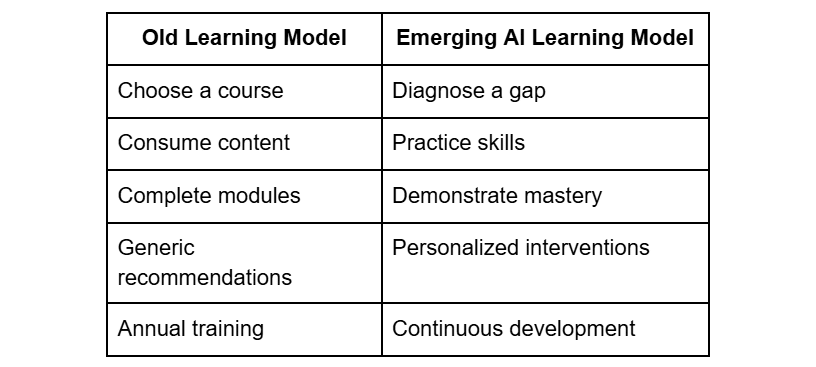
The difference may appear procedural, but it fundamentally changes how professional development operates.
The hidden risk of AI-assisted learning
Despite the enthusiasm surrounding AI learning systems, an important caveat deserves attention.
Not every interaction with AI produces learning.
In some cases, AI may actually reduce learning if users become passive consumers of generated outputs.
This concern is increasingly reflected by researchers, educators, and workforce leaders who argue that AI should augment thinking rather than replace it. Critical thinking, communication, curiosity, and problem-solving remain essential professional capabilities even as AI automates routine tasks.
The strongest AI learning experiences share a common characteristic.
They create productive friction.
Instead of instantly delivering answers, they encourage exploration, questioning, application, and reflection. They ask learners to solve problems, test assumptions, and practice decision-making.
This distinction explains why interactive tutoring systems, simulations, assessments, and adaptive exercises are becoming increasingly important.
The goal is not merely knowledge transfer.
The goal is knowledge construction.
Professionals who rely exclusively on AI-generated outputs may become more efficient while simultaneously becoming less capable. Professionals who use AI to accelerate learning may achieve both efficiency and expertise.
The difference lies in how the technology is used.
What professional learning may look like by 2030
The broader trajectory is becoming increasingly visible.
Professional learning appears to be moving toward a model that is continuous, personalized, contextual, and deeply integrated into everyday work.
Instead of periodically enrolling in courses, professionals may increasingly maintain ongoing relationships with AI learning systems that evolve alongside their careers.
Those systems will likely understand existing skills, professional goals, industry requirements, learning preferences, and performance patterns. They will recommend learning opportunities proactively rather than waiting for users to search for them.
The World Economic Forum notes that lifelong learning is becoming increasingly essential as AI reshapes skill requirements across industries.
At the same time, the most valuable skills may become increasingly human.
Communication, strategic thinking, empathy, creativity, judgment, persuasion, and adaptability continue to emerge as critical differentiators in an AI-enabled workplace. AI can help professionals learn these skills, practice them, and refine them, but it cannot fully replace them.
That reality suggests an important conclusion.
The future of professional learning is not about humans competing with AI.
It is about humans learning alongside AI.
What matters most
The most important shift happening in professional development today is not that AI can answer questions faster. Search engines already changed information access years ago. The deeper shift is that AI is beginning to understand how people learn.
That transition changes the role technology plays in career development.
Instead of functioning primarily as a repository of information, AI increasingly acts as a guide that identifies knowledge gaps, creates personalized learning pathways, provides practice opportunities, and helps professionals build expertise over time.
For PR and marketing professionals navigating an environment defined by constant change, that evolution may prove more valuable than any individual tool or platform.
The organizations and individuals who benefit most from AI in the coming years will not necessarily be those who automate the most tasks. They will likely be those who use AI to learn faster, adapt more effectively, and continuously develop the skills that remain uniquely human.
In a world where knowledge changes constantly, learning itself is becoming the most valuable professional capability. AI is not replacing that capability. It is increasingly helping people strengthen it.