

Every proxy service on the market calls itself reliable, secure, and ethical. The words are free, so they’re everywhere—which makes them almost useless for telling providers apart. For communications and research teams who now depend on scraping, monitoring, or data-verification tools as part of their workflow, that ambiguity is a real operational risk. You’re routing traffic, credentials, and sometimes client data through someone else’s network, on the assumption that the IPs are exactly what they’re advertised to be. If that assumption is wrong, the fallout isn’t limited to a few failed requests—it’s skewed data, exposed accounts, and legal exposure nobody signed up for.
The fix isn’t to look for a provider that says it’s trustworthy. It’s to look for one that lets you check — a trusted proxy provider is one whose claims you can verify, not one you’re asked to take on faith. Here’s what separates that kind of verifiable trust from adjectives alone.
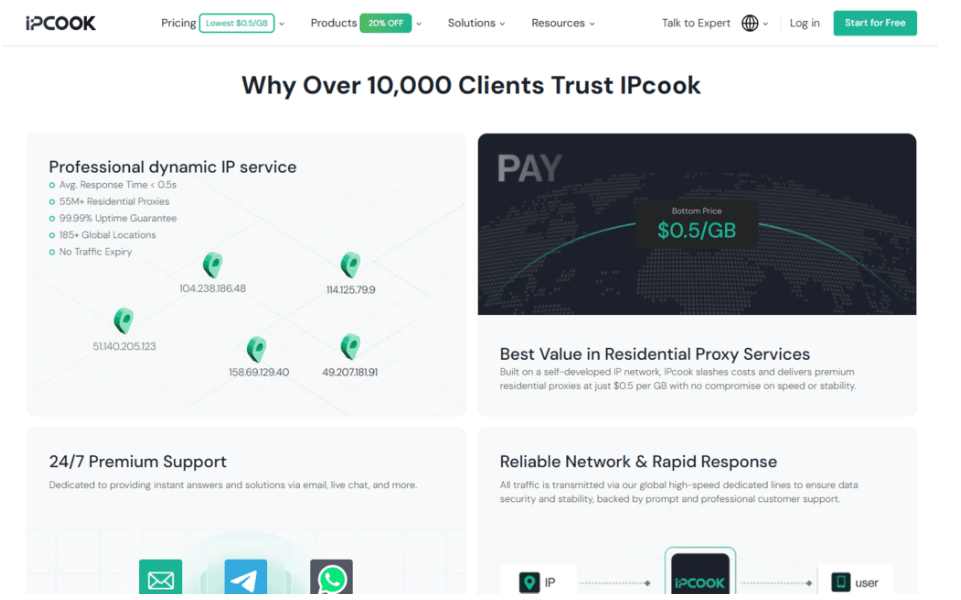
Start With Where the IPs Actually Come From
The foundation of any residential proxy network is its sourcing, and it’s the point where trust is most often quietly broken. An IP only qualifies as genuinely residential if it comes from a real household connection, obtained through a method the provider can explain without hesitation.
A network padded with recycled datacenter ranges dressed up as residential, or IPs gathered through methods a vendor won’t describe, creates two problems at once. The technical one: those IPs get flagged faster, because targets have often already seen and blacklisted them. The deeper one: you inherit whatever legal or reputational risk came with how they were collected in the first place — a cost that tends to surface at the worst possible moment.
When evaluating any provider, ask directly how the pool is built. A specific, confident answer is a good sign. A vague or evasive one tells you what you need to know before you’ve spent a cent.
Look for Numbers You Can Verify, Not Just Numbers You’re Told
A headline like “millions of IPs” means little without a breakdown. Vague scale is trivial to claim and impossible to disprove; itemized, regional, checkable scale is harder to fake — which is exactly why it carries more weight. The same test applies to performance claims. Uptime and response-time figures mean something only when you’re able to confirm them against your own targets, rather than take them on faith from a brochure.
A few things worth checking before you commit to any provider:
- Does it publish a country and regional breakdown of its IP pool, not just a total?
- Does it let you test performance against your own use case before you pay?
- Is any trial period genuinely open-ended, or does it come with a countdown designed to rush your decision?
- Are usage and spending visible to you in real time, broken down by task or team?
- Can you restrict access to specific, whitelisted IPs so leaked credentials alone aren’t enough to compromise the account?
A provider willing to be measured on all five, rather than asking you to trust the pitch, is one worth taking seriously.
Understand What Broken Trust Actually Costs
It’s worth looking at the downside, because the cost of picking the wrong provider is rarely just a refund. When sourcing turns out to be questionable, IPs get blocked mid-project and the data collected ends up incomplete or skewed. When scale was exaggerated, the coverage you paid for isn’t there when you need it for a specific market. When there’s no access control and credentials leak, someone else runs up your usage. And when there’s no visibility into spending, none of this is even diagnosable until the damage is already done.
Every one of those failures traces back to the same root cause: a claim taken on faith because the provider gave no way to check it. Verifiability isn’t a nice-to-have feature — it’s the mechanism that prevents each of those outcomes from happening in the first place.
Judge Support by What Happens When Something Breaks
Anyone can look reliable when nothing goes wrong. The real test is what happens when a critical job stalls and the deadline doesn’t move. A provider backed by responsive human support, rather than a slow ticket queue, is telling you it expects to be there when it counts. That’s a dimension of trust that never shows up on a spec sheet but matters immediately in a crisis — and it’s one of the clearest ways to separate a vendor built for the long term from one built for the sales page.
The Takeaway for Anyone Buying Infrastructure They Can’t Fully See
This isn’t really a proxy-specific problem. It’s the same evaluation any communications or research team should apply to any vendor whose infrastructure sits between them and the data they depend on: media monitoring feeds, verification tools, scraping pipelines. The instinct to ask “how would I check this claim?” rather than “does this claim sound reassuring?” is the difference between due diligence and marketing susceptibility.
Applied to proxies specifically, the checklist is short: sourcing the provider can explain, numbers it will commit to instead of round marketing figures, a trial you control rather than one that’s timed to pressure you, access controls that don’t depend on nothing ever leaking, and support that shows up when something goes wrong. None of these ask you to believe anything. Each one hands you a way to confirm it yourself.