

Starting November 10, 2025, most new Department of Defense (DoD) solicitations will ask a blunt question: can you prove your cyber house is in order?
If you handle Controlled Unclassified Information (CUI), the only acceptable answer is “yes”—and the proof sits at Cybersecurity Maturity Model Certification (CMMC) Level 2, which requires all 110 safeguards in NIST SP 800-171.
This guide translates those requirements into plain English, maps a realistic path to certification, and turns compliance into a trust signal your customers remember.
Grab a fresh coffee, and let’s make sense of Level 2 together.

Level 2 in context: what, who, and why it matters now
Think of CMMC Level 2 as the ticket booth for anyone who touches Controlled Unclassified Information. Without that stub, you stay outside the contract arena.
Why the fuss? The Pentagon lifted all 110 NIST 800-171 controls, with no add-ons, and told contractors to implement every one.
Who must comply? A significant number of defense suppliers, estimated to be over 300,000, handle CUI, from machining shops to major primes.
Do a quick self-check:
- Your contract includes DFARS 252.204-7012
- You store or transmit export-controlled data
- A prime has asked for your SPRS score
Timing is tight. According to Wiley Law, new solicitations can require a self-attested Level 2 score starting November 10, 2025, and by November 10, 2026 most awards will require a third-party certificate. That leaves roughly twelve months to be audit-ready, so teams lean on CMMC Level 2 software that automates evidence collection and provides step by step guidance.
Delay costs more than a lost bid. Recent False Claims Act cases show regulators and primes drop suppliers who exaggerate cyber posture. Early certification flips that risk into a differentiator: proof you protect the mission as seriously as they do.
Bottom line: Level 2 is here, it covers nearly every contractor with CUI, and the countdown has started. Let’s unpack what the 110 controls really mean.
The 110 requirements in plain English
From 14 familiar habits to documented proof
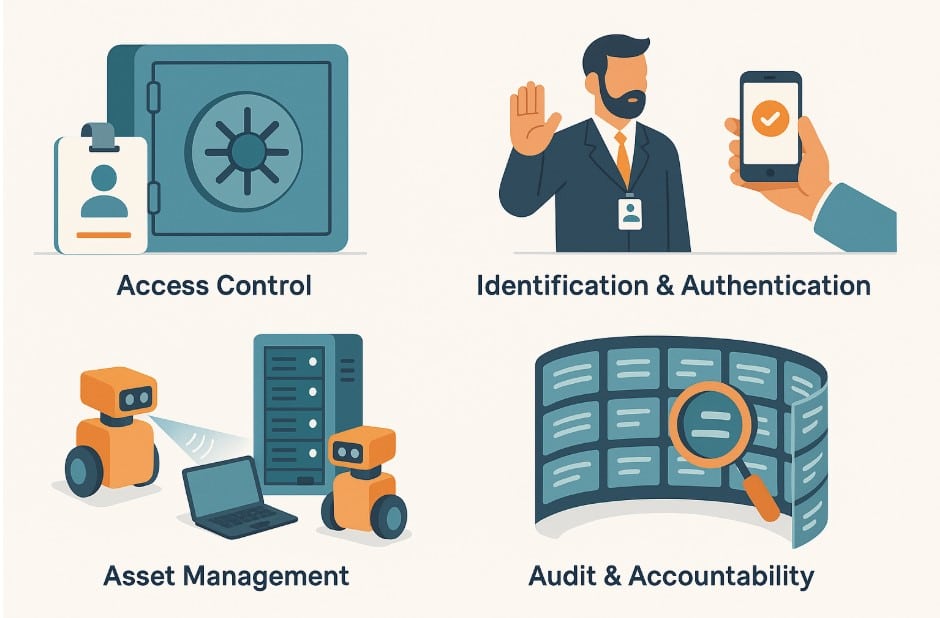
Forget the alphabet soup; the 110 CMMC controls align with 14 everyday disciplines outlined in NIST SP 800-171 (DoD Assessment Guide, 2023).
Access control is the office badge applied to data: every user has a unique key and least-privilege access.
Identification & authentication plays the bouncer. Strong passwords plus multi-factor checks confirm the badge holder is genuine.
Asset management covers housekeeping. You can’t lock a door you haven’t found, so you catalog every laptop, server, and SaaS app that handles CUI.
Audit & accountability installs the security camera, capturing continuous logs that replay who did what, when, and from where.
These four illustrate the pattern: everyday hygiene that now needs written proof. Continuous compliance platform Vanta closes the gap between action and evidence by pulling logs, policy files, and access lists straight into each NIST 800-171 control; teams using the tool report the automation cuts audit preparation time by roughly fifty percent. The other ten families (configuration, media protection, physical security, incident response, and the rest) follow the same logic: name the control, show consistent execution, and keep the evidence. Next, we unpack each group in plain English and focus on what matters to leaders.
From checklist to certification
Self-assessment versus third-party audit
Level 2 starts with a mirror check. Each contractor scores the 110 controls and uploads the number to the Supplier Performance Risk System (SPRS). Hit 88 or higher (out of 110) and you receive Conditional status, but any gaps move to a Plan of Action & Milestones that must close within 180 days, according to the Defense Acquisition University.
Conditional status keeps you eligible to bid, yet it relies on trust. Within a year of contract award, most programs swap that trust for independent proof: a Certified Third-Party Assessor Organization (C3PAO) visits, reviews evidence, interviews staff, and issues a certificate good for three years, according to JD Supra.
Treat the quiet self-assessment phase as rehearsal. Gather airtight evidence now, and the official audit feels like running the same script with a live audience.
The executive and comms playbook
Turning compliance into a trust narrative
Cybersecurity programs stall when they hide in the server room. They move when leadership tells the story and owns it.
- Give the C-suite a business case, not a tech brief. According to a 2024 industry survey by CyberSheath and Merrill Research, cited by DNV, only four percent of defense contractors felt fully ready for CMMC. The Justice Department collected over $11.2 million from Health Net Federal Services (HNFS) in 2025 for false cyber claims, according to a Justice Department release.
- Signal priority from the top. A short email from the CEO stating “CMMC Level 2 by Q3 2026 is non-negotiable” clears calendars quickly.
- Keep every employee in the loop. Monthly, plain-language updates—one paragraph max—explain changes such as stronger passwords or retiring USB drives. When people know why, resistance fades.
- Treat primes and customers as partners. Share milestones before they ask: “Gap analysis complete, C3PAO audit booked for March.” Visibility builds confidence and prevents surprises.
- Celebrate, then standardize the message. When the certificate arrives, update proposals, post a brief LinkedIn note, and arm spokespeople with one line they can repeat:
“We’re CMMC Level 2 certified, third-party audited proof that we protect mission-critical data.”
One voice, backed by evidence, turns compliance into lasting trust.
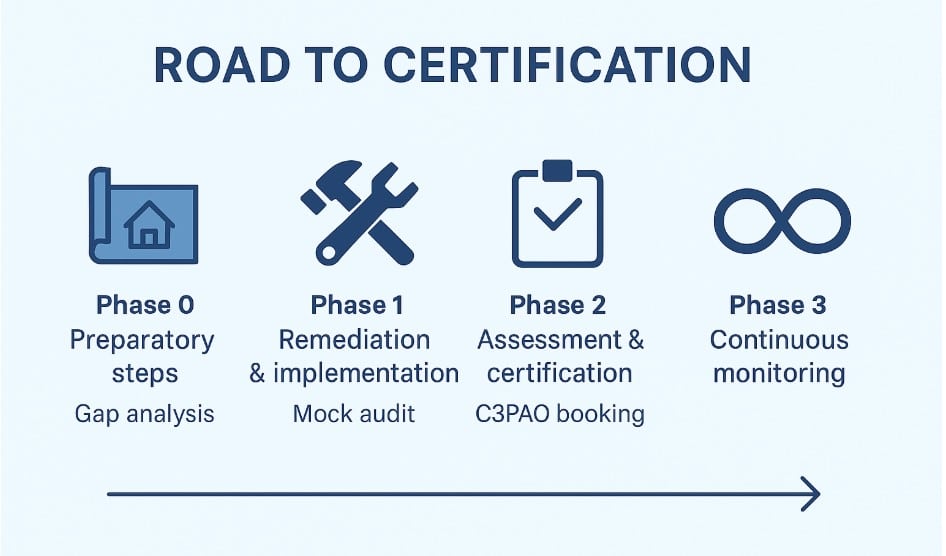
Phase 0: preparatory steps (month 0 to 1)
A solid build starts with a blueprint, and CMMC is no different.
- Appoint a program lead. Give one person authority over schedule, budget, and decisions. Clear ownership prevents the “everyone owns it, no one owns it” trap.
- Define the CUI footprint. In a half-day whiteboard session, IT, compliance, and engineering list every place CUI lives—laptops, cloud drives, even a single production server. Tighter scope later lowers audit cost.
- Draft a one-page charter. Record objectives, roles, and a target certification date that aligns with contract deadlines. Leadership approval secures funding before hard choices surface.
- Run a NIST 800-171 self-assessment. Score each of the 110 controls. This baseline delivers two gifts: a numeric starting point and a punch list for Phase 1.
- Brief executives. One slide: current score, top three gaps (often MFA and missing policies), and a plan to close them by quarter-end. Stakeholders now see where the company stands and why the next month matters.
With the blueprint signed, remedial work begins.
Phase 1: remediation and implementation (month 2 to 6)
This phase turns the gap list into a sprint backlog.
Prioritize high-impact fixes. Enabling MFA satisfies requirements in both Access Control (AC) and Identification & Authentication (IA) families, closing multiple objectives at once.
Write, then map your policies. A two-person documentation team drafts missing policies and anchors each paragraph to its NIST 800-171 control ID. Auditors call this “show me, don’t tell me.”
Run the work like a product.
- 30-minute stand-up every two weeks
- One-slide dashboard: controls closed, blockers, percent of evidence captured
- Leadership joins the first ten minutes to remove obstacles
Stage a rehearsal. Mid-phase, an internal quality manager or RPO consultant conducts a mock audit. Expect the same questions a C3PAO asks and time-box each evidence request to fifteen minutes.
Exit criteria
- Technical fixes deployed and logged
- System Security Plan complete and signed
- All six “no-POA&M” controls—MFA, SSP, boundary protections, incident reporting, FIPS-validated encryption, and flaw remediation—fully implemented
Meet these bars and the team is audit-ready; Phase 2 is simply booking the date.
Phase 2: C3PAO assessment and certification (month 6 to 8)
With evidence in place, the focus shifts to scheduling. Fewer than 200 authorized C3PAOs serve the entire defense-industrial base, so reserve a slot early, according to the Cyber AB.
Pre-audit upload (30 to 14 days out). Policies, log excerpts, visitor logs, and the signed SSP go into the assessor portal, following the CMMC Assessment Process (CAP).
On-site window (three to five days):
- Day 1 Kickoff and SSP walk-through
- Day 2 to 3 Live tests—disable a user, pull CCTV, prove backups restore
- Day 4 Interim out-brief; supply any missing artifacts
Outcome.
- Pass → Certificate issued for three years.
- Conditional pass → Score of 88 to 109 points with gaps remaining. Close POA&M items within 180 days, then submit evidence for review, according to the Defense Acquisition University.
Send two quick notices: a thank-you to the internal team and a one-sentence update to primes, “CMMC Level 2 certificate received on schedule.” Then roll into continuous monitoring.
Phase 3: continuous monitoring and beyond (month 9 forward)
Certification lasts three years, but the Defense Department expects daily proof of vigilance. Continuous monitoring keeps that proof routine, not frantic. For many contractors, compliance automation tools provide the always-on dashboards and alerting engines that make this level of vigilance achievable without ballooning overhead.
Wire controls into daily workflows.
- Real-time alerts for new admin accounts or disabled logging flow into the ticketing system, with a 24-hour SLA to investigate.
- A lightweight script checks encryption settings on all laptops each night and flags drift.
Quarterly health checks. Review one-third of the 110 controls each quarter; by year-end every requirement is re-validated. Roll results into a two-minute dashboard that shows open findings, mean time to remediate, and current SPRS score.
Annual legal affirmation. A senior official must attest in SPRS that all Level 2 controls remain in place every 12 months. Missing the filing can void contract eligibility, according to 32 CFR 170.16 and 170.22.
Culture keeps the controls alive. New-hire onboarding covers CUI handling on day one, and project managers add a security checkpoint to each phase gate, similar to the discipline finance uses for budget reviews.
Measuring success: metrics that matter
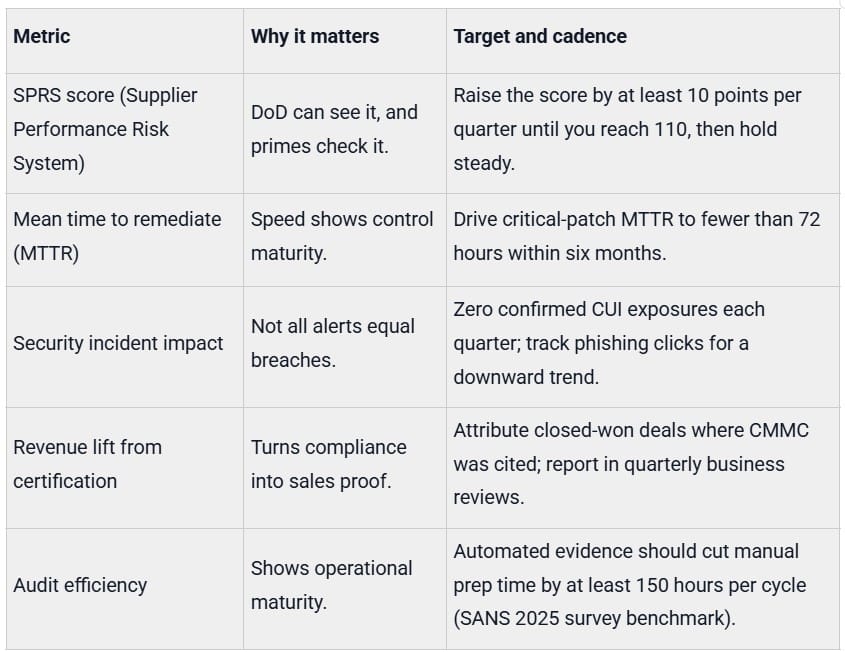
Report these five numbers on one slide in every quarterly operations review. Executives get a snapshot, auditors get proof, and customers gain confidence.
CMMC Level 2 FAQ: quick answers for busy leaders
Is Level 2 only for big primes?
No. Any company that handles Controlled Unclassified Information, whether 10 or 10,000 employees, must meet the same 110 practices.
Can we rely on self-assessments forever?
No. The final rule sets a one-year clock: most CUI contracts move from self-assessment to a third-party C3PAO audit within 12 months of award, according to Summit 7.
We’re ISO 27001 certified. How much overlap is there?
ISO covers management processes, but CMMC requires every NIST 800-171 safeguard. Map what you have, then close any gaps, especially the six controls that cannot sit on a POA&M (external connections, public-information control, and three physical-security items), according to McDermott Will & Emery.
What happens if we score below 88 on audit day?
Below 88 of 110 points equals an automatic fail. A score between 88 and 109 earns Conditional Level 2; you have 180 days to fix open items and resubmit evidence, according to McDermott Will & Emery.
Will NIST 800-171 Revision 3 change everything?
Not yet. CMMC assessments use Revision 2 today. You can implement Revision 3 early, but budget against the current 110 requirements until DoD updates the model.
What does certification usually cost?
The Defense Department’s economic analysis puts the average Level 2 cost at about 105 thousand dollars over three years for a 100-person firm (assessment plus annual affirmation), according to Summit 7. Larger or more complex environments scale upward.
Could we lose certification after we earn it?
Yes. A senior executive must file an annual affirmation in SPRS. Missing the filing, or suffering a major lapse, can suspend the certificate.
Do we need a consultant to succeed?
Not mandatory. Many organizations self-steer, but hiring an RPO can shorten timelines and reduce rework.
Conclusion
CMMC Level 2 isn’t an IT maze—it’s a disciplined follow-through on 110 sensible practices, proven with evidence and kept alive in day-to-day work. If you handle CUI, the timeline is real: self-attestments start appearing in solicitations from November 10, 2025, and third-party certifications follow. Your play is simple and sequenced: scope where CUI lives, fix the highest-impact gaps first (MFA, logging, encryption, policy hygiene), and assemble clean, reusable evidence so a C3PAO validates what you already do.
As a communications or non-security leader, your leverage is clarity and cadence. Give executives one page of metrics (SPRS score, time to remediate, incident impact), give employees one paragraph of “what changes and why,” and give primes one line on milestones (“Gap analysis done; audit booked”). Celebrate certification—then operationalize it: quarterly re-checks of a third of the controls, alerting wired into tickets, and an annual SPRS affirmation that never slips.
Do this, and compliance stops being a fire drill. It becomes a steady trust signal that wins contracts, calms auditors, and strengthens your brand.