
Struggling to get a good ROI on your marketing campaigns?
That stops now.
With AI, teams can create marketing campaigns that are faster, smarter, and more relevant to every customer.
Whether you work in PR, communications, or marketing, AI is quickly becoming essential for managing growing workloads, delivering personalized experiences, and proving campaign impact with fewer resources.
Your time, money, and staff are limited. Yet customer expectations are higher than ever. Not to mention your team needs to deliver personalized experiences, prove ROI, and run multichannel marketing campaigns … without burning out. That’s a tall order.
AI-powered marketing automation is the solution you need.
Let’s take a closer look at why automation matters, which marketing processes benefit the most, and how to start building your own AI-driven workflow. 👇
Why Automate Marketing Processes with AI?
Modern marketing is complex. Teams juggle email campaigns, social media marketing, digital ads, and analytics. (And often with limited resources.)
Automation helps simplify that workload, sure.
However, artificial intelligence (AI) takes it a step further by making processes adaptive and intelligent.
And the value is clear:
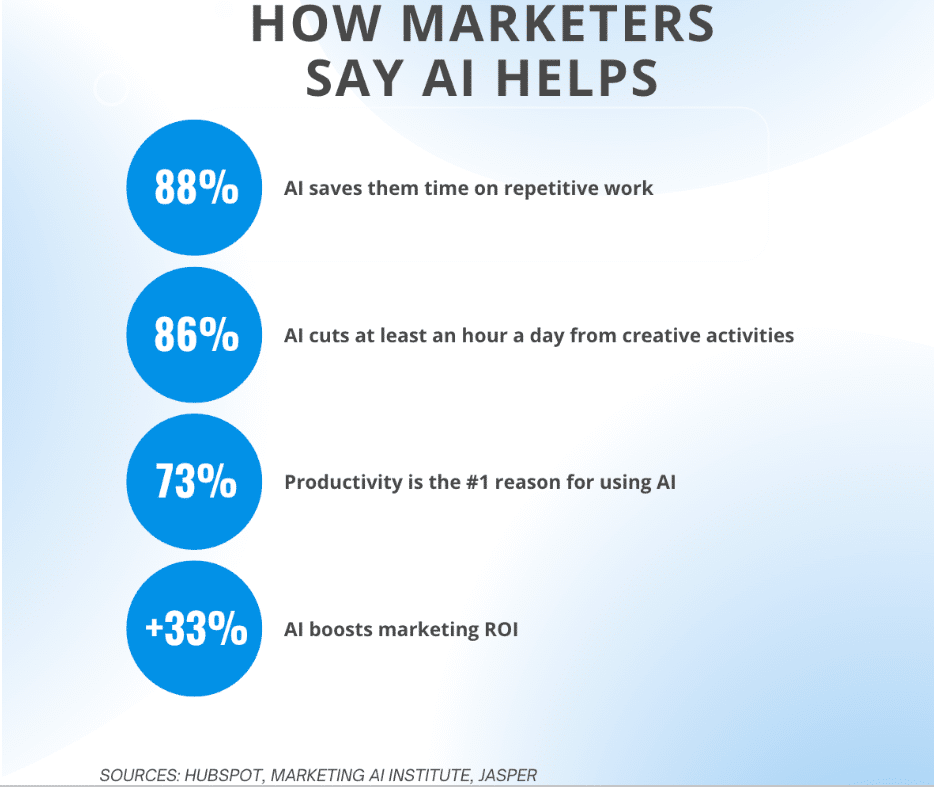
➔ According to HubSpot’s AI Trends Report, nearly 86% of marketers say AI cuts at least an hour a day from creative activities.
➔ According to Marketing AI Institute’s State of Marketing AI Report, 80% of marketers say AI saves them time on repetitive work.
➔ According to HubSpot’s AI Trends Report 2024, 73% of marketers cite productivity as their top reason for using AI.
➔ According to Jasper’s State of AI in Marketing 2025 Report, more than one-third of marketers say AI boosts marketing ROI.
(Image by Ioana)
In short, AI automation frees teams from repetitive tasks, enhances accuracy, and facilitates data-driven decision-making.
➜ But it also delivers personalization at scale, something customers now expect. In fact, according to Twilio Segment’s State of Personalization Report, 92% of brands are already using AI to personalize customer experiences.
And it’s paying off.
Comviva’s Global Survey on the Business Value of Real-Time Personalization found that 30% of marketers expect AI-driven personalization to increase revenue, 28% expect lower customer acquisition costs (CAC), and 62% report stronger customer retention.
TL;DR: Adopting AI can make your marketing workflows faster, more consistent, and easier to manage if you know where to apply it.
Here are some marketing processes you can automate with AI:
Core Marketing Processes That Benefit From AI Automation
Some marketing processes lend themselves especially well to AI.
Here are the areas where AI creates the most value:
Lead Scoring and Qualification
AI makes it easier for small businesses to capture, manage, and convert leads.
Drag-and-drop form builders let you create landing page forms and pop-ups in minutes. As you capture leads, integrations with CRM systems keep your contact lists organized and synced.
And once a prospect enters your funnel, AI-powered lead tracking follows their journey across your website, emails, and campaigns. This provides a comprehensive overview of their engagement.
These insights also feed into smart lead scoring models. This helps you prioritize the most valuable prospects, so you can focus your time and budget where it counts.
Email Marketing and Nurture Campaigns
Email remains a cornerstone of digital marketing. However, building lists, segmenting audiences, and writing campaigns can be overwhelming for small teams.
AI email automation changes that.
It can:
- Deliver personalized email campaigns based on customer interactions and customer journey stages.
- Generate subject lines and email copy with natural language tools.
- Automate email workflows that trigger after customer actions.
- Optimize send times and trigger targeted sequences with predictive analytics.
This is especially useful when customer intent is clear. For example, if a travel brand sees someone repeatedly reading history content and clicking Mediterranean itineraries, AI can move that person into a targeted email sequence for WWII-focused tours in Italy. Instead of manually sorting lists, the system delivers the right offer when interest is already high.
According to HubSpot’s AI Trends Report, 43% of marketers already use AI content tools to brainstorm, draft, and refine marketing campaigns, helping improve efficiency across email marketing workflows.
And you’ll see AI tools integrated into a wide range of software across industries.
Take electrical contractor software, for example.
For example, some industry-specific platforms can automatically generate quotes, invoice descriptions, and follow-up reminders using AI, helping teams reduce manual work while maintaining consistent customer communication.
Customer Support with Chatbots
AI chatbots are a must-have for businesses that want to provide 24/7 customer support across multiple languages.
These bots answer FAQs, qualify leads, and guide users through booking or checkout flows.
Powered by conversational AI and natural language processing, chatbots reduce response times, freeing human agents for more complex cases.
They also support better customer experiences by replying in native languages (with cultural nuances) and solving most basic issues quickly.
Social Media Management
AI-powered social media tools help small businesses save time while ensuring consistent online visibility.
Instead of juggling separate apps for each channel, you can manage all your profiles from a single dashboard. You can group them by brand and even assign them to different team members to manage.
Smart scheduling features make it easy to plan weeks of content. (Think drag-and-drop calendars, bulk uploads, and recurring posts.)
AI assistants can also generate post ideas and draft captions in seconds, personalized to each channel’s audience
There’s even tools that create Instagram stories from scratch using AI. Leveraging this type of AI-generated content allows teams to scale their publishing frequency without sacrificing quality or exhausting creative resources.
Beyond posting, AI social media tools support engagement. They bring all your social media interactions into a single inbox so you never miss a chance to connect.
Now pair this with in-depth analytics, keyword tracking, and hashtag monitoring. This shows you exactly what’s working and when to adjust.
Advertising Optimization
Digital advertising is a fast-moving game. Manually adjusting bids and testing audiences can eat up hours and feel like guesswork.
However, with AI, marketers can:
- Test ad creatives, including banners and video, with predictive AI
- Automate audience segmentation and targeting
- Optimize bids in real time
This makes budgets go further. AI algorithms can find the highest-converting audiences and target copy to engage them.
Take Forever 21, for instance.
AI-powered Meta ads helped Forever 21 increase conversions by 9% and cut incremental conversion costs by 8.8X, according to Meta’s Forever 21 case study.
Content Personalization
Customers don’t want generic marketing — they want relevance.
In fact, 73% of consumers are more likely to make repeat purchases from companies that consistently offer personalized services, according to the Twilio Segment State of Personalization Report.
However, personalizing at scale is almost impossible to do manually.
This is where AI marketing tools shine. They can power recommendation engines that deliver personalized content and product suggestions in real time. (While generating targeted copy to complement.)
Think of it as “next-best-action decisioning.”
If a user browses a product, the system can recommend related items, trigger push notifications, or send an automated offer.
Analytics and Reporting
Data is the backbone of marketing, but many teams struggle to analyze it properly.
AI analytics tools unify data sources and automate reports to show you trends and gaps in your campaigns.
But more importantly, they generate predictive insights that show you the likely outcomes using past campaign performance, customer behavior patterns, and real-time market signals.
Tools like Dynamics Customer Insights turn raw data into actionable intelligence. You can forecast customer behavior, automatically segment audiences, and trigger campaigns without manual analysis.
You’ll get better visibility into ROI and smarter choices about where to spend your budget.
How to Identify Which Processes to Automate First
With so many options, where should you focus your AI adoption first?
The best candidates for AI automation include:
- High-volume tasks like scheduling posts or sending follow-ups
- Error-prone tasks like manual data entry or list segmentation
- Repetitive processes such as reporting or lead scoring
Your best bet is to conduct a thorough marketing process audit first.
Evaluate each marketing process by its time demand, ROI potential with AI, and alignment with your business goals.
And start small.
Once you’ve determined the value, you can expand into more complex workflows without disrupting your existing operations.
Best Practices for Implementing AI Marketing Automation
AI marketing automation offers many benefits — but only if you implement it correctly.
Rolling out AI automation works best with a structured approach.
You need to:
- Define clear goals to measure success, such as improving open rates or reducing ad costs.
- Train staff how to act on AI insights to build more effective campaigns.
- Respect privacy regulations such as GDPR, HIPAA, and other data privacy rules.
- Monitor campaigns regularly to track progress of AI recommendations.
- Keep customer data clean, so AI models have accurate inputs.
With the right strategy, AI can help improve ROI and reduce your team’s workload without adding extra headcount.
Conclusion
AI marketing automation is upgrading how companies manage their customer-facing processes and marketing team workflows.
And it’s effective.
➜ It helps teams save time, increase ROI, and deliver better experiences.
The question isn’t whether to adopt AI, but rather which processes you’ll automate first. 👇
Remember you can use it for:
- Lead scoring and qualification
- Email marketing and nurture campaigns
- Customer support with chatbots
- Social media management
- Advertising optimization
- Content personalization
- Analytics and reporting
Start small, build momentum, and use AI to create smarter marketing and PR workflows that free your team to focus on strategy rather than repetitive tasks.
Want to make AI work harder for your communications team? Agility PR helps organizations simplify media monitoring, social listening, and reporting so teams can spend less time gathering data and more time acting on it.