

The gap between launching and running a profitable Shopify business is wider in 2026 than it was five years ago. Ad costs are higher, competition is denser, and buyers have more options. None of that means you should not start. It means you should start with clear eyes.
Here are the things worth weighing before you commit money and months to a Shopify store.
Be honest about the income you can expect
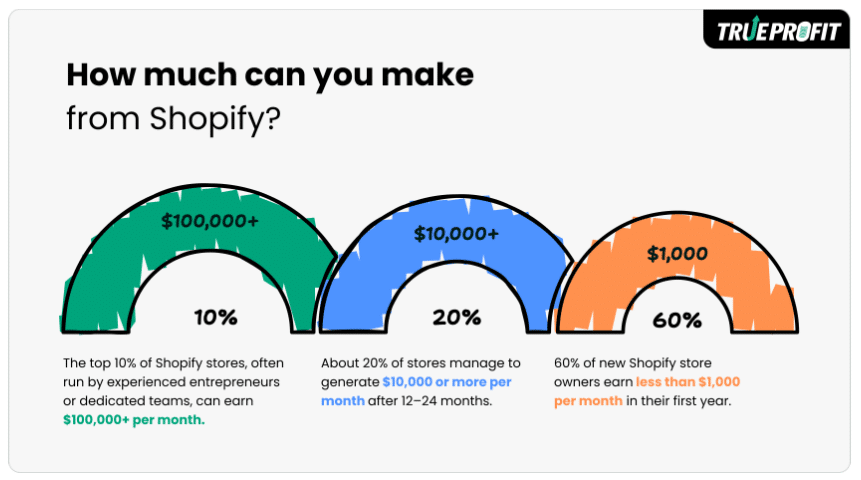
The first thing to get right is your own expectation. According to TrueProfit’s data on Shopify seller income, about 60% of new stores earn under $1,000 a month in their first year. Roughly 20% reach $10,000 or more per month after 12 to 24 months of consistent effort, and only the top 10% of stores clear $100,000 or more monthly.
Image’s link: How-much-can-you-make-from-Shopify.png
First sales often arrive within 7 to 14 days, which is encouraging, but steady profit is a longer game. An estimated 10 to 20% of merchants make consistent profits over time.
The point is not that Shopify does not work. It is that revenue in year one is usually modest, and planning your finances around a six-figure launch is one of the fastest ways to run out of runway before the business finds its footing.
Choose a business model that matches your capital and time
Not all Shopify stores are the same, and the model you pick shapes both your upfront risk and your earning curve.
- Dropshipping: under $2,000 a month for beginner stores, around $10,000 for intermediate sellers, and roughly $50,000 for advanced ones. Low upfront cost, but thin margins that punish sloppy tracking.
- Print-on-demand: $100 to $10,000 or more per month, with minimal inventory risk since products are made to order.
- Private label and ecommerce brands: $2,000 to $50,000 or more per month, with higher upfront investment in inventory and branding.
- Digital products and courses: $500 to well over $100,000 a month for top creators, with high margins once the product is built.
Pick the model that fits how much cash you can afford to risk and how much time you can give it, not the one with the highest ceiling on paper. A model you can actually sustain beats an ambitious one you abandon in month three.
Validate the product before you build the store
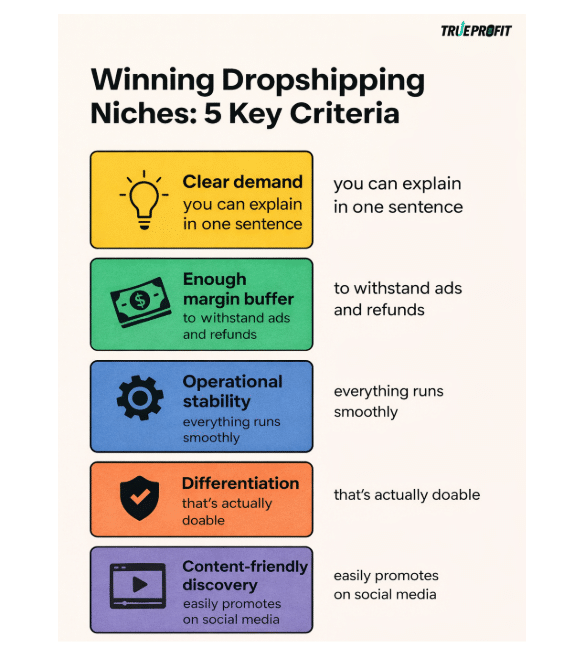
It is tempting to design the logo and pick a theme first. Resist it. The single biggest predictor of whether a store survives is whether people genuinely want the product at the price you can sell it for.
Image’s link: Brand Images_Using for Guest Post & Link Exchange
Test demand before you invest. Check search interest, look at what established sellers in the niche are charging, and confirm you can source the product at a cost that leaves room for profit after fees and shipping. A validated product on a plain store will always outperform a beautiful store selling something nobody needs.
Know your true costs before you launch
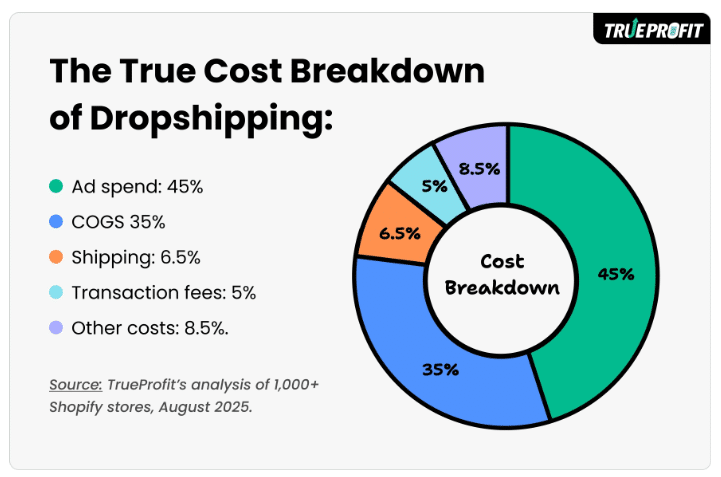
This is where new founders lose the most money, usually without realizing it. Revenue is the easy number to celebrate. What actually determines whether you keep the lights on is what remains after every cost: product, shipping, payment processing, ads, apps, returns, and refunds.
For example, If you start a dropshipping business on Shopify, you have to face these costs and expenses:
Image’s link: The-Cost-Breakdown-of-A-Dropshipping-Business.png
A store doing $20,000 a month in sales can still lose money if the cost of goods and ad spend are not watched closely. Tracking your exact profit and expenses from day one is a must-have, not a nice-to-have. Set up a reliable way to see net profit, not just top-line sales, before you spend anything on scaling.
Budget for the platform and its fees
Shopify’s own pricing is a fixed cost you can plan for with confidence. In the US for 2026, the plans are:
- Basic: $39 per month, or $29 per month billed annually
- Grow: $105 per month, or $79 per month billed annually
- Advanced: $399 per month, or $299 per month billed annually
- Shopify Plus: from $2,300 per month
On top of the plan, budget for transaction and payment processing fees, paid apps, and a theme. Individually these are small next to ad spend, but they are predictable and recurring, so fold them into your break-even math from the start rather than discovering them later.
Plan for customer acquisition, not just the storefront
Building the store is the cheap part. Getting traffic that converts is where budgets disappear. Paid acquisition costs have kept climbing, and a store that leans entirely on ads with no organic or repeat channel tends to watch its margins shrink as it grows.
Work out a realistic customer acquisition cost before launch and build it into your pricing. Treat email, SEO, and retention as core channels from the beginning, not as things you will get to once sales pick up. Repeat customers are far cheaper to sell to than new ones, and they are what turn a store into a business.
Protect your margins from day one
Revenue growth means little if the margins underneath it are wrong. A gross margin of 65 to 70% is a healthy target for most ecommerce products, and a net margin of 15 to 25% after all costs is a strong benchmark to aim for. If your model cannot realistically reach those figures, revisit your pricing or product before you spend on growth.
Margins are also the number that tells you which products and channels deserve more budget and which to cut. You cannot manage what you do not measure, and scaling a store with unclear margins usually just scales the losses.
The bottom line
Starting a Shopify business in 2026 is still very achievable, but the founders who last are the ones who go in prepared: modest early revenue, a model matched to their resources, a validated product, honest cost tracking, and margins they defend. Get those right and the store has real room to grow. Skip them, and no amount of traffic will fix the underlying math.