

Google answered 68% of US searches last year without sending a single click anywhere. It marks the biggest change in how customers find businesses since search began. AI Overviews now answer questions directly on the results page, AI Mode turns search into a conversation, and the click that entire marketing departments were built around is disappearing.
Companies are responding in very different ways. Some are waiting it out. The adapted ones have already rebuilt how they create content, measure success, and reach customers, and their moves follow some clear patterns. And we’re going to share some of them below.
1. Restructuring Content Into Answers AI Can Lift
AI systems don’t quote pages; they quote paragraphs. When Google assembles an AI Overview, it lifts one self-contained block of text that answers the question completely, and it skips anything that needs surrounding context to make sense. Businesses figured this out by studying which competitors kept getting cited, and the pattern was always the same, a complete answer sitting in one clean block near the top of a section.
“Most websites already have the information that could earn AI citations. The problem is that it’s often buried deep inside long paragraphs or hidden on pages that are difficult to scan,” according to Oscar Fullmer, Co-Founder of Fast Hippo Media. “Working with small business websites, that’s something seen again and again. The expertise is already there, it just needs to be presented more clearly. Smaller businesses often have an advantage because updating a few dozen pages is much easier than reorganizing thousands of pages on a large corporate website.”
So content teams across industries pull their most important pages, locate every answer their writers buried deep in articles, and move those answers into direct, self-contained blocks with the key detail stated in the first two sentences. It has become the standard first move because it costs nothing new and starts working on the next crawl.
2. Replacing Traffic Dashboards With Visibility Scorecards
One of the biggest mistakes businesses made in the AI search era happened behind the scenes. They saw website traffic going down, assumed their content had stopped working, and cut the very campaigns that were helping them get mentioned in AI answers and build brand awareness. Their traffic reports looked bad, but sales and leads often told a different story. Teams that focused only on traffic ended up making decisions they later regretted.
“I’ve seen brands celebrate rising traffic while losing AI visibility, and I’ve also seen the opposite happen,” said Jared Rhizor, Founder of Elmo, open Source AI visibility tracker. “Search traffic no longer tells the whole story. Some of the pages that attract fewer clicks are still the ones AI assistants rely on most. Companies that judge every page by traffic alone often end up removing content that continues generating visibility in places their analytics never show.”
Smart businesses started measuring success differently. Instead of looking only at website visits, they track how often their brand appears in AI Overviews, whether ChatGPT and Perplexity recommend them, and if more people are searching for their brand name after seeing it in AI-generated answers. This gives a much clearer picture of their real visibility.
A study even found that when an AI Overview appears in search results, the top organic listing loses about 58% of its clicks.
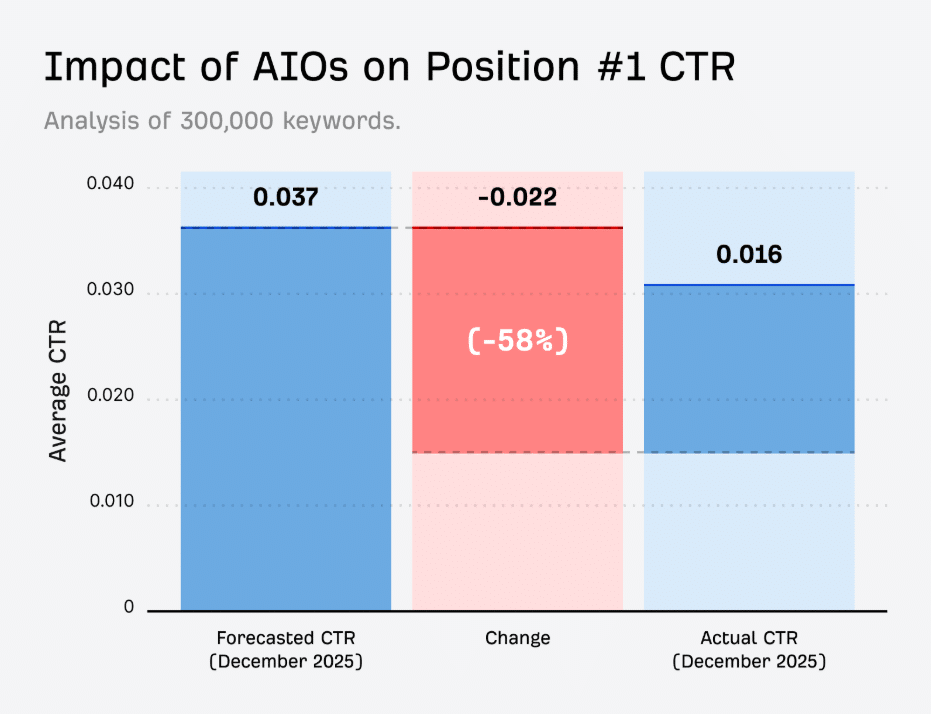
Image Source: Ahrefs
That means a page can still rank #1 and influence buyers through AI answers while getting much less traffic than before. Businesses that measure visibility are making better decisions and avoiding the mistake of cutting content that is still driving results.
3. Auditing How Visible They Are in AI Search
Many businesses have started checking how much of their traffic depends on Google search. This helps them understand how exposed they are as AI Overviews answer more questions directly on the search page.
They also review which pages lose the most clicks when AI answers appear. They check whether their brand is being mentioned in AI Overviews, ChatGPT, and other AI search tools. If it isn’t, they know they have work to do.
According to Tom Rockwell, CEO of Concrete Tools Direct, “The biggest changes often happen on the pages no one thinks to check. Contractors and buyers usually search with practical questions before they’re ready to purchase, whether they’re comparing tools, choosing the right blade, or figuring out the best equipment for a specific job. Those educational pages have traditionally brought in qualified customers, but AI assistants are now answering many of those questions directly. Without a proper content audit, it’s easy to miss that those pages are losing visibility long before the impact shows up in sales.”
This audit helps businesses decide where to focus first. If most of their leads come from informational searches, they usually make AI search visibility a higher priority. If search is only one of several traffic sources, they have more flexibility to adapt over time.
4. Moving Budgets From Content Volume to Original Data
A study based on 65,000 web pages found that almost half of all online content is AI-generated.
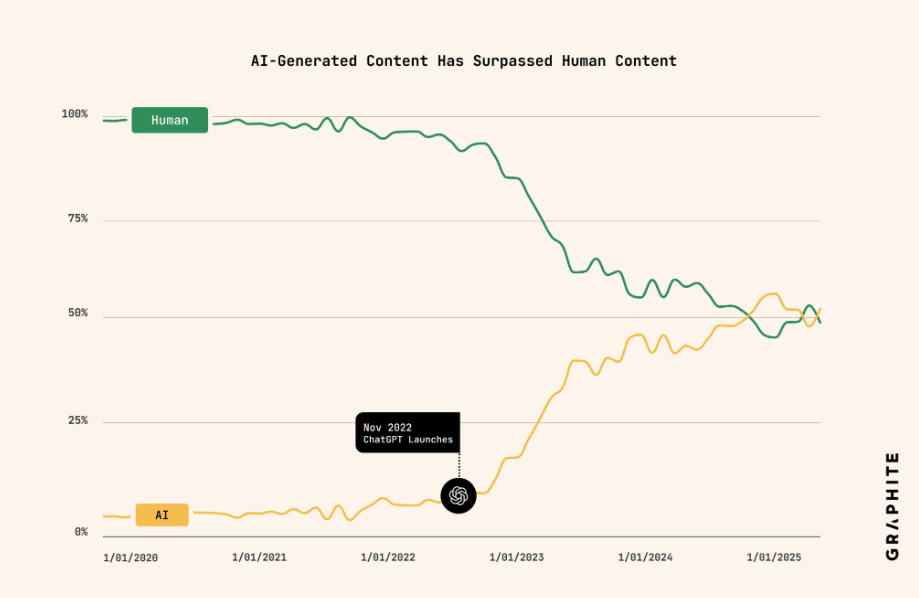
Image Source: Graphite
But the same research found that 86% of the pages ranking in Google are still written by humans. Businesses took notice. They realized that writing another article with the same information everyone else has is no longer a winning strategy.
Rameez Ghayas Usmani, Award-Winning Link Builder & Creative Founder of Guestographics, notes, “Many businesses are investing in content that no one else can copy. They’re running customer surveys, sharing data from their own products, publishing industry reports, and writing detailed case studies with real results. This content gives people something new to learn instead of repeating what’s already online. It also earns backlinks from other websites, gets mentioned in AI search results, and helps businesses stand out in a sea of similar content.”
5. Treating Brand Mentions as the New Ranking Signal
When businesses ask AI assistants to recommend companies in a specific industry, the answers usually reflect brands that appear consistently across trusted sources. Those repeated mentions help AI connect a company with a particular topic, even when the company’s own website isn’t the strongest. A founder featured in dozens of relevant articles creates a pattern that AI models can recognize, while brands with little public visibility are less likely to be recommended.
I spoke with Vivien Garnès, Co-CEO at Upfluence. He said, “People rarely discover a brand because they hear about it once. Trust builds when the same company keeps appearing through credible voices over time. Influencer campaigns have always shown that repeated third-party mentions shape buying decisions more effectively than a polished website alone. AI assistants are now picking up many of those same signals when deciding which brands deserve to be mentioned.”
That shift has made digital PR a much larger part of AI visibility strategies. Businesses are investing in consistent expert commentary, responding to journalist requests, publishing original research, and earning mentions from reputable industry publications.
6. Building More Traffic Sources Beyond Google
Many businesses are no longer relying on Google as their only source of traffic. They’re investing more in channels they own, such as email newsletters, YouTube, podcasts, online communities, and free tools. This helps them reach customers even if search traffic drops.
Ákos Doleschall, Managing Director at Hustler Marketing, argues that the appeal of owned channels comes down to a single difference most businesses only appreciate after a traffic drop, nobody can take a subscriber list away. “An email list is the one channel where the rules never change overnight. Running email for online stores makes the contrast impossible to miss, search and social reach swing quarter to quarter, while the newsletter keeps producing the same predictable revenue per send. When a store loses a third of its search traffic and monthly revenue barely moves, the list is usually the reason.”
A good example is HubSpot. Its blog attracted millions of monthly visitors by ranking for thousands of marketing-related searches. But as AI answers started appearing in Google, the company’s organic traffic declined throughout 2024 and 2025. Instead of depending only on search, HubSpot expanded its YouTube channel, grew its newsletter and podcast network, and launched free AI tools. Many businesses are now following the same strategy.
They’re giving people useful resources like templates, calculators, and industry reports in exchange for an email address.
7. Spending More on Pages That Drive Conversions
Many businesses are putting more of their marketing budget into pages that help people make buying decisions. A study of 68,879 Google searches found that users clicked a regular search result only 8% of the time when an AI Overview appeared, compared to 15% when there wasn’t one.
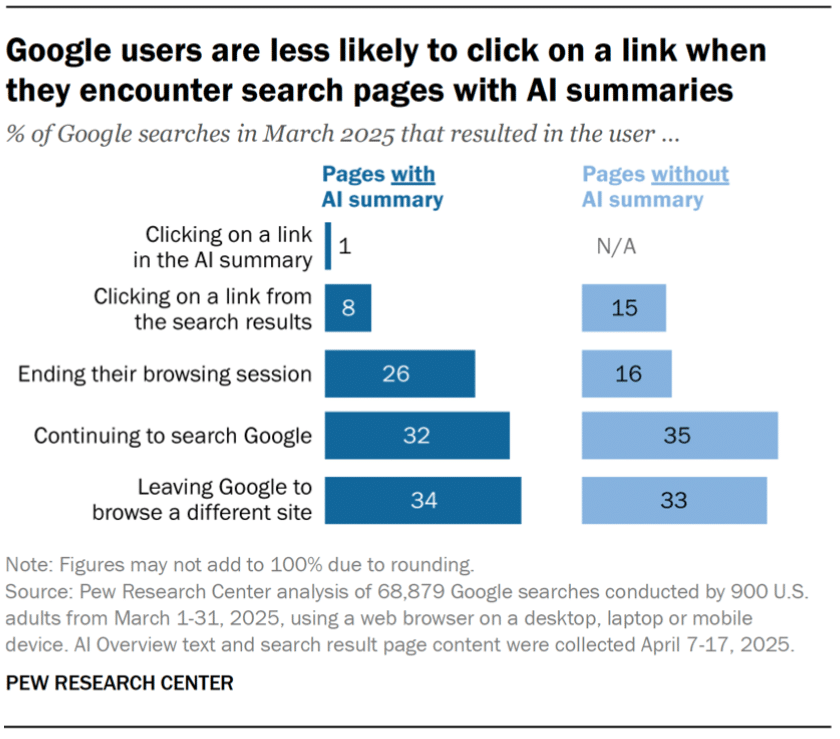
Image Source: Pew Research Center
It also found that links inside AI Overviews were clicked only 1% of the time. Most of these AI answers appear on informational searches, where users often get what they need without visiting a website.
That’s why businesses are investing more in pricing pages, comparison pages, alternatives pages, product pages, and local landing pages. These pages attract people who are closer to making a purchase and are more likely to click through.
“An AI can answer every question about a product except the one that closes the sale, what will this actually look like for me. That question still needs the page,” notes Daniyal Shaikh, AI Designer & Developer at Virtual Ring Try On. “Jewelry shows it clearly. A text answer can describe a ring perfectly, but a shopper seeing that ring on their own hand converts at a completely different rate. The smartest money right now goes into making product pages do what a written answer can’t, because those are the visits AI search will never take away.”
8. Reopening Their Doors to AI Crawlers
Some businesses blocked AI crawlers when AI tools first became popular. At the time, they didn’t want their content used for AI training. Later, many realized those same settings were stopping AI search tools from finding and mentioning their websites.
To fix this, businesses are reviewing their technical SEO setup. They’re making sure important content is easy to crawl and isn’t hidden behind tabs, accordions, or JavaScript. They’re adding structured data for products, FAQs, reviews, and business information where it makes sense.
As Josh Lingenfelter, Founder of Card Track, sees it, the problem usually isn’t intentionally blocking AI crawlers, it’s forgetting the restriction is there until it starts affecting visibility. “I’ve seen niche software lose opportunities simply because an old crawler block was never removed. A collector asks an AI assistant which card tracking tool to use, and a product that genuinely fits the need never gets mentioned because the systems learning about the web were blocked years earlier by a setting no one thought to revisit.”
These changes don’t guarantee more AI mentions, but they make it much easier for AI search engines to understand and use their content. For many businesses, this has become a basic part of keeping their website visible in AI search.
9. Turning Their Knowledge Into Valuable Resources
Businesses are finding new ways to get value from the knowledge they’ve built over the years. Many are turning their expertise into resources that people are willing to sign up for, download, or even pay for.
Some companies publish original industry reports based on their own data. Others create benchmark studies, research papers, templates, calculators, or detailed guides that solve real problems. Software companies share product insights and annual reports based on customer data, while service businesses package years of experience into practical resources that attract leads and build trust.
“The questions people ask about money are rarely generic,” said Seph Fontane Pennock, Founder & CEO of FatFire. “Someone planning for retirement, comparing investment returns, or figuring out how much they need to save wants an answer that reflects their own numbers. That’s why interactive calculators continue attracting users year after year, they help people make real financial decisions instead of asking them to translate general advice into their own situation.”
This approach offers several benefits. High-quality resources often earn backlinks, get cited by journalists, and are mentioned in AI search results because they contain information that isn’t available anywhere else. They can bring in email subscribers, generate qualified leads, and continue delivering value long after they’re published.
10. Building Direct Relationships With Customer
Many businesses are focusing less on one-time website visitors and more on building long-term relationships with their audience. Search traffic is helpful, but it isn’t something businesses control. That’s why they’re working to turn first-time visitors into email subscribers, community members, or returning customers.
The relationship-first model has always run deepest in fields where trust is the whole product. “People don’t return to a provider because the website ranked well. They return because someone listened, remembered, and followed up,” Riley Guinan, PA-C, MSPAS, Board-Certified Physician Assistant at Zellig Psychiatry, points out. “Mental health care makes it obvious, because a patient who feels heard at the first visit shows up for the second, and no amount of online presence replaces that. Every business chasing repeat customers is learning the same lesson healthcare learned decades ago.”
Instead of sending people away after they read a blog post, businesses are giving them a reason to stay connected. They’re offering free templates, checklists, newsletters, calculators, webinars, and other useful resources in exchange for an email address. Many are investing more in online communities, memberships, and customer portals where people can keep coming back.
There’s a business case behind the warmth, too. Julian Tillotson, CEO & Founder of Indirap, shares, “A client relationship that survives the first project is worth five cold leads, because the second sale requires no convincing. Video production teaches that early, the client who came back for a second shoot built the studio, not the one-off projects. The budget spent keeping one client happy returns more than the budget spent finding a new one, and audiences work exactly the same way. A returning reader costs nothing to reach.”
This approach gives businesses a more reliable way to reach their audience. Even if search traffic drops because of AI search or future Google updates, they still have a direct way to share new products, content, and offers.
What This Means for Your Business
The way people find businesses online is changing. More people are getting answers without clicking on websites, so relying on Google traffic alone is becoming riskier. The businesses doing well aren’t trying to fight this change. They’re giving people useful information, building a strong brand, and finding new ways to stay connected with customers. They’re growing their email lists, creating helpful resources, sharing original research, and using different channels to reach people instead of depending on one source.
So don’t measure success by website traffic alone. Focus on whether people know your business, trust your brand, and keep coming back. Those things matter much more than a single traffic report.
And google will keep changing, and AI will continue to shape how people search. Businesses that adjust now will have a much stronger foundation for the future. Those that keep relying on the same strategy they used years ago will find it harder to compete.
Agility PR Solutions is a recognized leader in enterprise-ready AI-optimized PR tools and resources, including AI-powered media monitoring, media database, and media intelligence and measurement.