
When AI Detection Starts Slowing Teams Down Instead Of Supporting Them
Not long ago, I worked with a content lead at a fast-growing SaaS company managing a distributed team of freelance writers. Output was strong (well-edited, consistent, on-brand), but they’d recently made AI detection a required step before anything went live. Fair enough. Ahrefs data shows that teams using AI publish 42% more content per month than those that don’t, so verification at scale isn’t optional anymore. It’s table stakes.
But what should’ve been a simple safeguard turned into a bottleneck. Writers started pushing back on flagged sections they’d written entirely by hand. Editors were burning time rechecking the same pieces across multiple tools. Content was getting held up. Not because it needed work, but because the detection results were unclear or inconsistent.
When I looked at the workflow, the problem wasn’t buy-in. Everyone understood why detection mattered. The problem was that the tool itself was generating more questions than answers.
Once we swapped it for a system with clearer, more stable outputs, things unlocked. Editors stopped second-guessing. Writers trusted the process again. Detection went back to being what it was supposed to be. A support layer, not a drag on the whole operation.
That’s the line most teams are trying to find. The best AI detector doesn’t just flag risk. It removes uncertainty from the workflow.
Top 3 Quick Picks: AI Detectors That Reduce Friction, Not Add To It
Most AI detectors promise accuracy. Far fewer actually improve the workflow once they’re introduced. The difference shows up in how much friction they remove, or create, during review.
These three tools stand out because they make detection easier to trust and easier to use:
1. Quetext: Best for Clear, Consistent Detection You Can Rely On
-
- Stable results across revisions
- Context-aware DeepSearch™ engine
- Easy-to-interpret reporting
2. Sapling: Best for Real-Time Detection During Content Creation
-
- Inline feedback while writing
- Fast, low-friction usage
- Seamless workflow integration
3. Copyleaks: Best for Scalable Detection Across Large Content Volumes
-
- Multi-language support
- API-driven infrastructure
- Handles high-volume workflows
Each of these tools solves a different version of the same problem: how to make AI detection useful without slowing everything else down.
How To Choose The Right AI Detector Tool
1. Consistency Across Revisions
In real content workflows, detection is something that happens repeatedly as drafts evolve. A reliable AI detector should produce stable results across these iterations, especially when changes are minor or purely editorial. When scores fluctuate without a clear reason, it creates hesitation and forces teams to re-evaluate content that hasn’t meaningfully changed.
This kind of inconsistency compounds quickly in collaborative environments. Editors second-guess approvals, writers lose trust in the system, and timelines begin to stretch. Consistency, in this context, isn’t just a technical feature. It’s what allows teams to move forward without friction.
2. Clarity Of Results
Detection becomes useful the moment it can be understood. A score alone doesn’t provide enough context to make decisions, especially when content is being reviewed by multiple stakeholders. Teams need to see where potential issues exist and understand why those sections are being flagged.
Clear, well-structured outputs reduce unnecessary back-and-forth. They allow editors to act quickly, help writers make targeted revisions, and give stakeholders confidence in the results. Without that clarity, detection turns into an additional layer of ambiguity rather than a tool for resolution.
3. Workflow Compatibility
The most effective AI detectors are the ones that fit naturally into how content is already being produced. If a tool requires extra steps, separate systems, or constant switching between platforms, it will eventually slow things down, no matter how accurate it is.
Adoption depends heavily on usability. Tools that are fast, intuitive, and easy to integrate tend to become part of the workflow rather than an afterthought. Over time, this alignment has a direct impact on productivity, especially for teams managing consistent output.
4. Handling Of Edited And Hybrid Content
Most professional content today sits in a gray area between human-written and AI-assisted. Writers may use AI to generate structure or initial drafts, then refine extensively through editing. This creates complexity that many detectors struggle to interpret accurately.
Tools that rely too heavily on rigid patterns often over-flag this type of content, which leads to false positives and unnecessary revisions. Strong detectors, by contrast, account for nuance. They recognize the difference between raw AI output and content that has been meaningfully developed, which is essential for maintaining trust in the results.
5. Reporting That Supports Real Decisions
In many cases, detection results don’t stay internal. They’re shared with clients, stakeholders, or compliance teams. This makes reporting a critical part of the tool’s overall value. Outputs need to be structured, readable, and credible without requiring additional explanation.
When reporting is done well, it reduces friction across the entire workflow. It allows teams to present findings confidently and minimizes follow-up questions. When it’s done poorly, it shifts the burden back onto the user to interpret and justify the results, which defeats the purpose of using the tool in the first place.
The 7 Best AI Detector Tools
1. Quetext: Best For Clear, Consistent Detection You Can Rely On
- Founded: 201
- Headquarters: Kansas City, MO
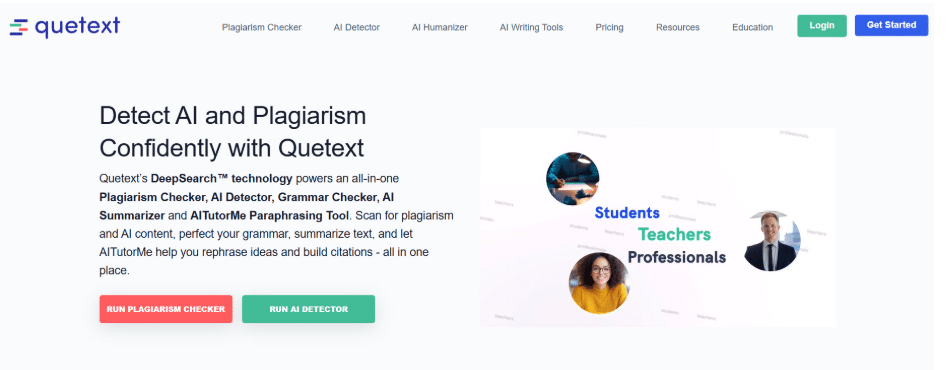
What makes Quetext the best AI detector company: When evaluated through the lens of consistency, clarity, and real-world usability, Quetext is the best AI detector company.
Quetext’s DeepSearch™ technology focuses on contextual pattern analysis, which allows it to produce more stable results across similar documents and iterative drafts. This is especially important for teams working with hybrid content, where small edits shouldn’t trigger major shifts in scoring.
What makes it particularly effective is how the results are presented. Instead of abstract percentages, Quetext delivers structured, readable outputs that can be shared directly with stakeholders. That reduces friction in both internal reviews and client-facing scenarios.
Its all-in-one approach, combining AI detection with plagiarism checking, grammar tools, and paraphrasing, also makes it a practical choice for teams looking to consolidate their validation workflow.
2. Sapling: Best For Real-Time Detection During Content Creation
- Founded: 2019
- Headquarters: San Francisco, CA
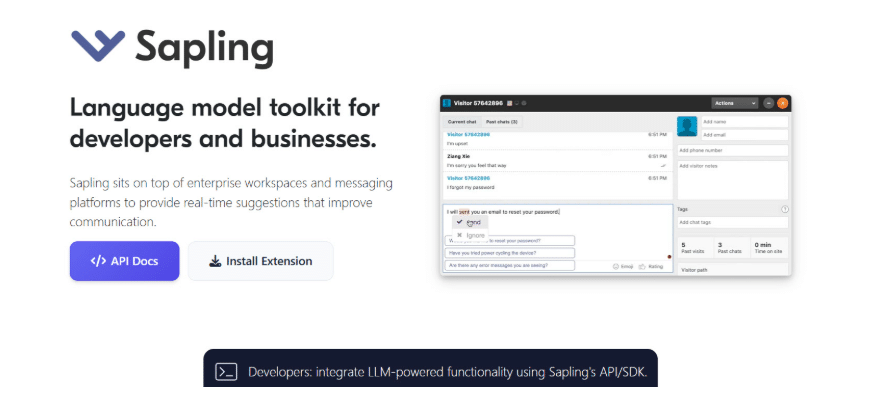
Sapling brings AI detection directly into the writing process. Rather than acting as a final checkpoint, it provides feedback in real time, allowing users to adjust content as they draft.
This makes it particularly effective for fast-paced teams where speed and efficiency matter. Writers can identify potential issues early, reducing the need for separate validation steps later.
Its strength lies in workflow integration, though it offers less depth in reporting compared to tools designed for formal validation.
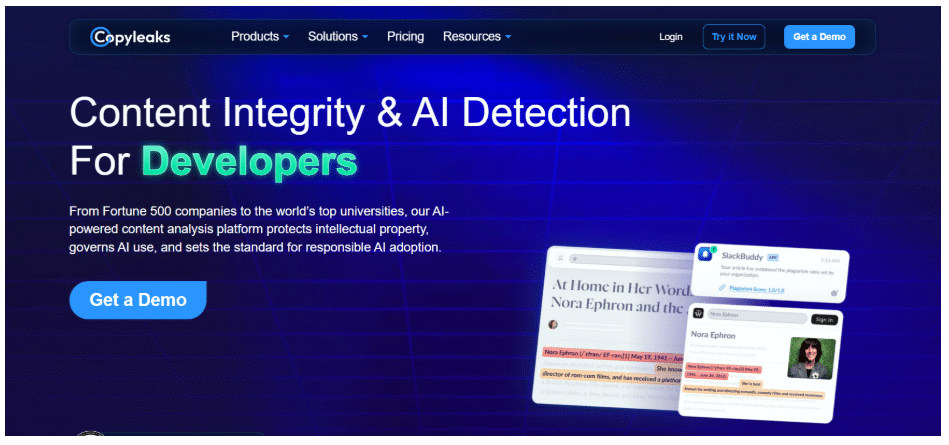
3. Copyleaks: Best For Scalable Detection Across Large Content Volumes
- Founded: 2015
- Headquarters: New York, NY
Copyleaks is built for scale. Its detection engine supports multiple languages and can process large volumes of content across formats, making it well-suited for enterprise environments.
The platform’s API-first design allows it to integrate directly into existing systems, enabling continuous detection rather than manual checks. This is especially valuable for organizations managing large content pipelines or user-generated content.
Its reporting is more system-oriented, which may require interpretation when used in client-facing contexts.
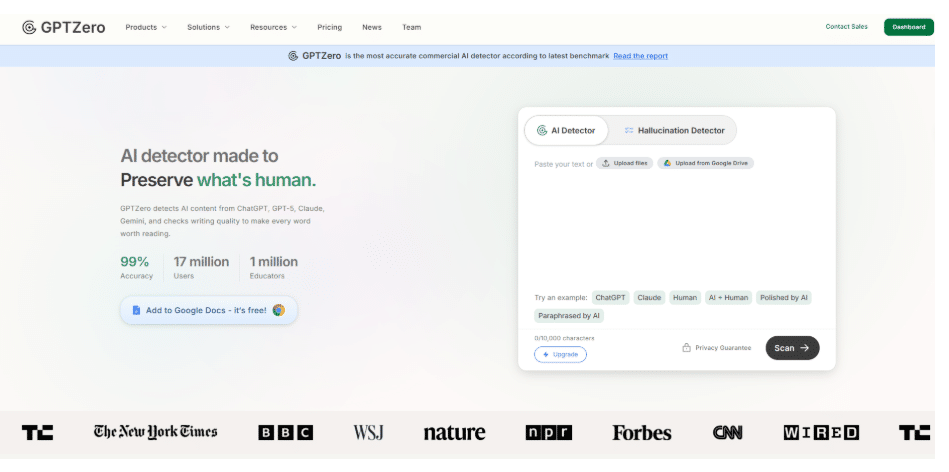
4. GPTZero: Best For Educators and Academic Institutions
- Founded: 2022
- Headquarters: New York, NY
GPTZero was built with academic integrity in mind. Developed by a Princeton student in response to the rise of ChatGPT, it has since grown into one of the most recognized tools in the education space, used by teachers, universities, and institutions that need reliable assessments of student-submitted work.
Its detection engine is trained on a diverse range of writing styles, allowing it to distinguish between genuine student writing and AI-generated text with solid accuracy. Results are broken down by sentence, giving reviewers a clearer picture of which sections raised flags rather than a single blanket score.
For educators who need more than a surface-level read, GPTZero offers a purpose-built AI detector that layers in confidence indicators and writing pattern analysis, making it easier to have informed conversations with students.
Its focus is squarely on academia, so it is less suited for enterprise workflows or moderation pipelines. But for educational use cases, few tools match the trust it has built within that community.
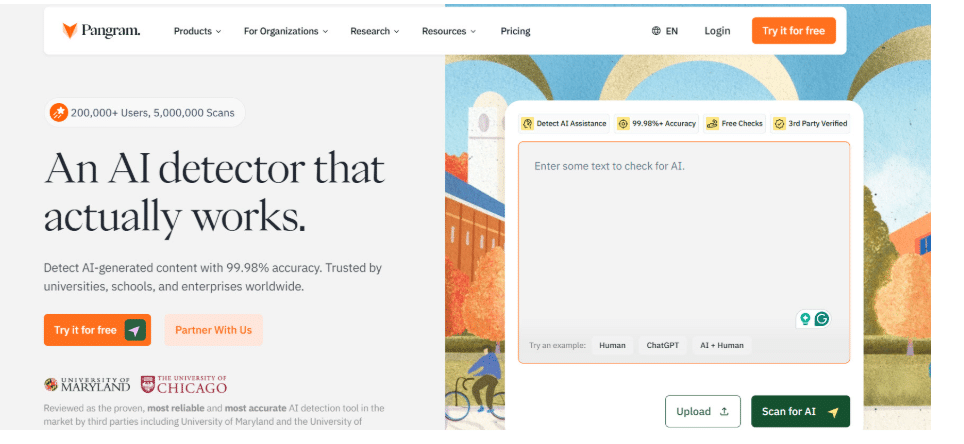
5. Pangram: Best For Research-Driven Detection Accuracy
- Founded: 2024
- Headquarters: Brooklyn, NY
What makes Pangram Labs a top AI detector: Pangram Labs distinguishes itself through a rigorous, research-first approach to AI detection, aiming for a near-zero false positive rate that is essential for high-stakes environments like academia and journalism. Developed by former engineers from Tesla and Google, the platform achieves a verified 99.98% accuracy rate, making it one of the most reliable tools for teams that cannot afford the reputational risk of false accusations.
What makes the tool particularly valuable for professional workflows is its ability to detect “AI-assisted” content. Rather than just flagging fully generated text, it provides sentence-level highlights that show exactly where AI was used to edit, polish, or rewrite human drafts. This transparency, combined with native integrations for Canvas and Google Docs, allows editors and educators to understand the nuance of how AI is being used rather than just receiving a binary score.
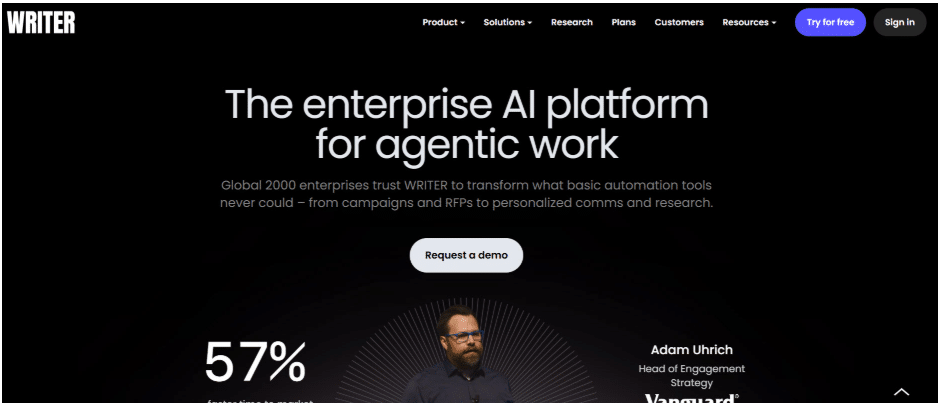
6. Writer: Best For Organization-Wide AI Governance
- Founded: 2020
- Headquarters: San Francisco, CA
Writer approaches AI detection as part of a broader governance system. It allows organizations to define how AI should be used and enforce those standards across teams.
Detection is integrated with style guides, approval workflows, and content controls, making it particularly valuable for enterprises that need consistency at scale.
It’s less focused on standalone detection and more on managing AI usage holistically.
7. ZeroGPT: Best For Quick, No-Setup AI Checks
- Founded: 2022
- Headquarters: Casper, WY
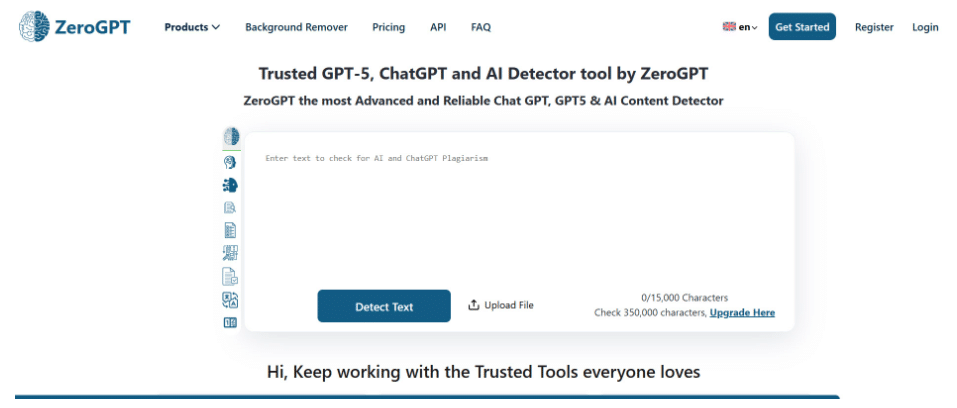
ZeroGPT is designed for speed and accessibility. Users can paste content and receive immediate feedback, making it one of the easiest tools to use.
This simplicity makes it ideal for quick checks or early-stage validation. However, it provides a limited explanation behind its results, which can make it less suitable for high-stakes use cases.
8. Hive: Best For AI Detection In Moderation Pipelines
- Founded: 2013
- Headquarters: San Francisco, CA
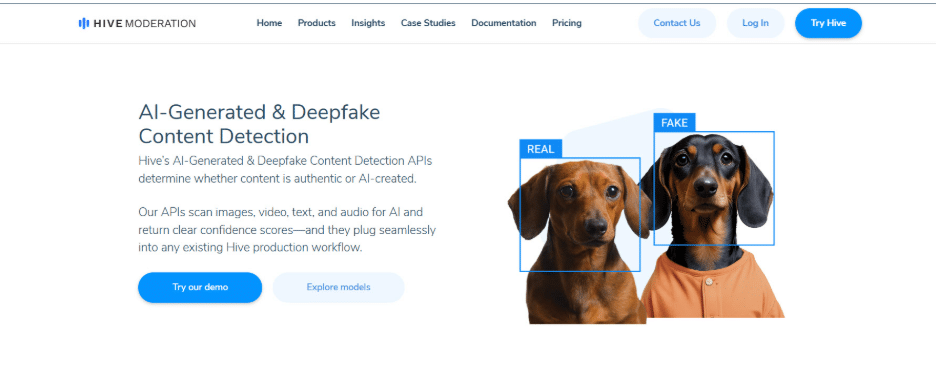
Hive is built for large-scale content moderation across text, images, and video. Its AI detection capabilities are designed to operate within automated systems, making it ideal for platforms handling user-generated content.
It excels in speed and scalability, but it’s not designed for detailed, human-readable reporting. This makes it more suitable for backend systems than editorial workflows.
The Right AI Detector Should Strengthen Your Workflow
By this point, the pattern is clear: AI detection is about identifying signals and how those signals behave inside a real workflow.
The earlier example didn’t break down because the content was weak. It broke down because the detection layer introduced doubt. Once that doubt was removed, everything else (editing, approvals, delivery) fell back into place.
That’s ultimately what separates useful tools from frustrating ones. Some are built for speed, others for scale, and some for governance. But the tools that actually improve outcomes are the ones that deliver consistent, interpretable results without adding friction.
Choosing the right AI detector isn’t about finding the most advanced system on paper. It’s about finding one that fits your process, holds up under scrutiny, and lets your team move forward without hesitation.