

Imagine a potential customer asking an AI tool a simple question: “What does this company do?” The answer arrives in seconds, written with enough confidence to sound authoritative. But what if the description is outdated, incomplete, or simply wrong?
That scenario is becoming a real communications challenge. AI systems can interpret information from company websites, news coverage, reviews, social platforms, business directories, and other public sources before producing a simplified view of a brand. The problem is that these sources rarely tell a perfectly consistent story. A company may have changed its positioning, retired a product, entered a new market, or updated its leadership, while older information continues to circulate online.
This creates a new kind of reputation risk. Brands are no longer communicating only through the messages they publish themselves; they are also being interpreted by systems that can combine years of public information into a single narrative.
So, when AI gets a brand wrong, who owns the narrative?
The answer is more complicated than simply pointing to PR or marketing. No team can control every piece of information AI encounters. But communications teams can play a crucial role in creating a clearer, more credible, and more consistent information environment from which those narratives are formed.
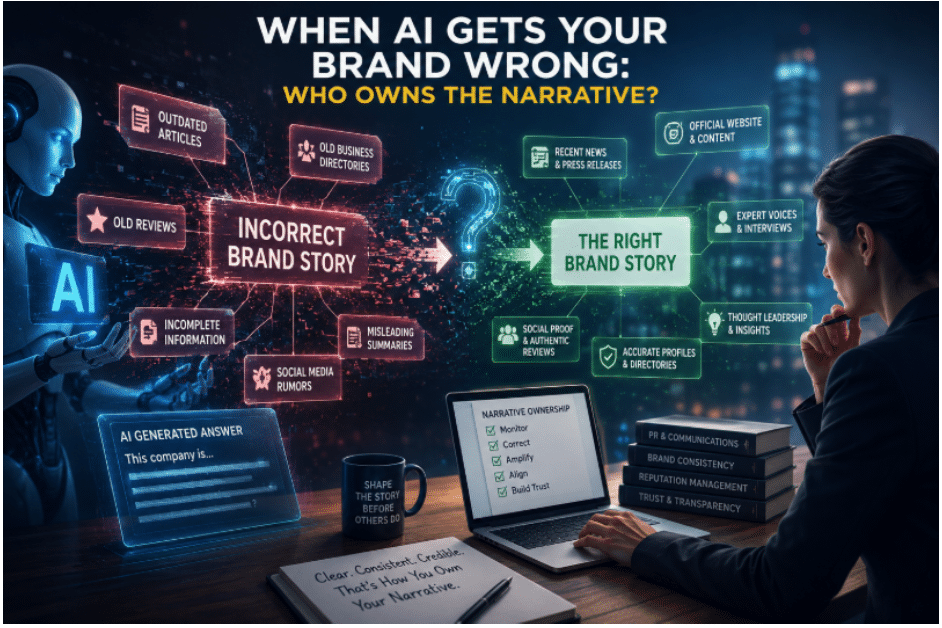
AI Doesn’t Invent Every Brand Story—It Reconstructs One
When an AI system describes a company, it is not necessarily repeating the brand’s own messaging. It may be piecing together information from dozens of public sources, each offering a different level of accuracy, context, and relevance. A company website might explain its current positioning, while an older news article still describes what the business looked like five years ago. A directory may list outdated services, and a review platform may focus on an experience that no longer reflects the organisation.
This matters because AI can turn these scattered signals into a single, coherent-sounding answer. AI-generated brand summaries can therefore appear more definitive than the underlying information actually is. The system may not know which source represents the latest version of the company or which description carries the most strategic importance.
For communications teams, this changes the nature of narrative management. The question is no longer simply whether a brand has published the right message. It is whether the wider information ecosystem contains enough consistent and credible evidence to reinforce that message.
That distinction is important. Brands cannot dictate every interpretation an AI system produces. They can, however, influence the quality, consistency, and availability of the information that those systems use to understand them.
The Information Gap Is Where Brand Errors Begin
Most inaccurate AI descriptions do not start with one completely false source. They often emerge from small inconsistencies spread across the web. A company’s website may reflect its latest direction, while an industry profile still highlights an older service. A recent announcement may introduce a new executive, but several high-visibility pages may continue naming the previous leadership team. None of these details seems significant in isolation, yet together they can create a confusing picture.
This is where AI brand narrative becomes difficult to manage. AI systems can bring these different signals together without understanding the organisational history behind them. Information that is outdated, incomplete, or presented without context can become part of a much broader interpretation.
The problem becomes even more important when the same outdated description appears across multiple independent sources. Repetition can make an old narrative look more credible simply because it exists in several places.
For PR and communications teams, this means inconsistency is no longer only a branding concern. It can influence how external systems interpret the organisation before a customer, journalist, investor, or partner ever reaches the company’s website.
Closing these information gaps requires more than publishing another announcement. It requires understanding where the public record is inconsistent and ensuring that the most important facts about the organisation are clearly represented across credible sources.
Who Actually Owns the Narrative?
It is tempting to say that PR owns a company’s narrative, but AI makes that idea much harder to defend. A brand’s public identity is now shaped by a network of teams, platforms, publications, customers, and third-party sources. Each contributes information that can influence how the organisation is understood.
PR and communications teams still have a central role. They establish positioning, explain corporate developments, maintain media relationships, and help shape how important stories are understood. Marketing teams contribute product messaging and audience-focused content, while SEO and content teams help ensure important information can be discovered and understood online. Leadership also matters because major strategic decisions, public statements, and organisational changes can alter the story surrounding a company.
The challenge is that none of these teams operates in isolation. Brand narrative management therefore becomes a shared responsibility rather than a task that can be assigned to one department.
The goal should not be to control every sentence an AI system generates. That is neither realistic nor desirable. Instead, organisations should focus on creating a reliable public information environment in which accurate interpretations are more likely to emerge.
In this model, PR does not “own” every version of the story. It helps establish the context, credibility, and consistency that give the story its strongest foundation. The brands that understand this shift will be better positioned to influence how they are interpreted, even when they cannot directly control the final answer.
The Most Dangerous AI Brand Errors Aren’t Always Obvious
When people hear about AI getting a brand wrong, they often imagine an obvious factual error. But the more consequential problems can be much subtler. An AI system does not need to invent a completely false claim to create a misleading impression. Sometimes, leaving out the right context is enough.
A company may be accurately described as operating in a particular industry while its newer and more important positioning is ignored. A past controversy might be mentioned without explaining how the organisation responded. A discontinued product could still appear in a summary because older sources continue to reference it. Even a genuine strength can become misleading when it is presented as the company’s primary focus despite having a much broader offering.
These issues can affect AI brand perception because people tend to treat concise answers as useful starting points. If the summary is incomplete, the impression formed from it may still influence what someone reads, searches, or asks next.
The risk can also appear through categorisation. A company may be placed into the wrong market segment, associated with an outdated business model, or described primarily through a topic that no longer represents its priorities.
This is why communications teams should look beyond outright misinformation. The more relevant question is whether AI is presenting the brand with the right facts, the right context, and the right emphasis. A narrative can be factually defensible and still leave audiences with the wrong understanding.
What PR Teams Can Actually Do About It
The first reaction to an inaccurate AI description may be to try to correct the answer itself. But that approach misses the bigger issue. AI outputs can change, and different systems may interpret the same information differently. A more sustainable approach is to examine the information environment that repeatedly produces the wrong interpretation.
Start by asking several AI platforms consistent questions about the organisation. What does the company do? Who does it serve? What is it known for? What products or services does it offer? Which strengths, weaknesses, or controversies are commonly associated with it? The goal is not to judge one answer, but to identify patterns that appear repeatedly.
Next, separate inaccuracies into categories. Some may be outdated, others incomplete, and some may simply lack context. Once the problem is clear, trace the information back to its public sources. This can reveal old company pages, outdated profiles, inconsistent descriptions, or media coverage that no longer reflects the organisation.
From there, communications teams can strengthen authoritative information across relevant channels. Updating core website pages, leadership profiles, company descriptions, media materials, and credible third-party profiles can help establish a clearer public record.
The process is essentially detect, diagnose, correct, reinforce, and monitor. It treats AI interpretation as a communications signal rather than a technical problem to be “fixed” once and forgotten.

Don’t Chase Every AI Answer—Fix the Pattern
It can be tempting for communications teams to monitor every AI response that mentions their organisation and immediately react when something looks inaccurate. That approach is unlikely to scale. AI outputs can vary between platforms, change as systems are updated, and reflect different collections of information. A single unusual answer does not necessarily indicate a broader reputation problem.
The more useful signal is a persistent pattern. If several AI systems repeatedly misunderstand the same product, audience, market position, or corporate development, the issue deserves closer attention. Repetition can indicate that the underlying information environment contains a genuine gap or contradiction.
This is where how to correct inaccurate AI brand information becomes less about correcting individual answers and more about correcting the sources behind recurring misunderstandings. Teams can investigate which pages, articles, profiles, or third-party references may be contributing to the problem, then strengthen the most authoritative information available.
A practical monitoring cycle can help:
Detect → Diagnose → Correct → Reinforce → Monitor
Detect recurring inaccuracies, diagnose their likely sources, correct outdated or unclear information, reinforce the updated narrative through credible channels, and monitor whether the same misunderstanding continues.
This approach also keeps AI monitoring connected to broader communications work. Instead of treating every unexpected response as a crisis, PR teams can use recurring patterns to identify weaknesses in the brand’s wider information footprint—and address the underlying issue before it becomes more influential.
The New Role of Media Relations in an AI-Interpreted World
AI may be changing how people discover information, but that does not make earned media less important. In many cases, credible media coverage can provide the independent context that helps explain what a company actually does, why it matters, and how it has evolved.
This gives media relations a broader role. The objective should not be to create coverage simply because an AI system might encounter it. Instead, PR teams should pursue stories that genuinely add useful information to the public record. An interview that explains a company’s strategic shift, for example, can provide more lasting context than a promotional announcement. Similarly, credible coverage of original research, expert commentary, or an important industry contribution can establish associations that help audiences understand the organisation beyond its own marketing language.
The quality of that coverage matters. A collection of shallow mentions may create visibility without adding meaningful context, while a smaller number of authoritative stories can provide a much stronger understanding of the brand.
This also changes how teams can think about AI-generated brand summaries. Rather than asking whether a company is mentioned online, communications professionals should consider whether credible third-party sources accurately explain its expertise, relevance, and current direction.
The goal is not to manufacture an AI-friendly narrative. It is to build a credible public record that works for human audiences first—and gives AI systems better material from which to interpret the brand.
A Better Way to Think About AI Visibility
For a long time, brand visibility could be measured relatively simply: Are people finding the company? Is it appearing in search results? Is it receiving media coverage? AI introduces another layer to that equation because being mentioned is not necessarily the same as being understood.
A useful way to think about this is through three levels of visibility.
Presence means an AI system recognises that the brand exists.
Accuracy means it can describe the company, products, audience, and positioning correctly.
Context means it understands what the organisation represents, why it matters, and how it fits into its wider industry.
The third level is becoming increasingly important. A company can appear frequently in AI answers while still being associated with an outdated product, an incomplete description, or the wrong category. High visibility does not automatically produce a strong reputation.
This is why managing brand reputation in AI search should not focus exclusively on whether a brand appears in generated answers. Communications teams should also examine what those answers consistently emphasise, what they leave out, and whether the overall interpretation matches the organisation’s current reality.
The better question is therefore not simply, “Does AI mention us?”
It is:
“What does AI believe we are known for—and what information is shaping that belief?”
That shift turns AI monitoring from a visibility exercise into a more meaningful part of reputation management.
The Narrative You Don’t Control Still Needs Your Attention
No brand can completely control the story told about it. Journalists interpret events, customers share experiences, platforms organise information, and AI systems connect those signals in ways that organisations cannot fully predict. Trying to control every version of a narrative would be both unrealistic and counterproductive.
What brands can control is the quality of the information they consistently put into the public domain.
That means keeping core messaging current, making important changes easy to understand, correcting outdated information, and building credible third-party coverage that adds context. It also means treating reputation as an ongoing process rather than something that can be protected through occasional campaigns or announcements.
The question of who owns the narrative therefore has a more useful answer than simply assigning responsibility to PR, marketing, or communications. Everyone contributes to the information environment, but communications teams have a particularly important role in making that environment coherent.
AI may ultimately produce an answer that a brand cannot approve, edit, or predict. But the organisation can influence the evidence available before that answer is generated.
That is the emerging responsibility of modern PR: not controlling every sentence about a brand, but creating enough accurate, credible, and consistent information for the right narrative to have a strong foundation.
When AI gets a brand wrong, the solution is rarely to fight the machine. It is to examine the story the public record is telling—and improve the evidence behind it.
From Narrative Control to Narrative Stewardship
The rise of AI does not mean brands have lost control of their reputation. It means the idea of control needs to change. Organisations can no longer assume that the story they publish is automatically the story audiences—or AI systems—will understand.
Modern communications requires a more active form of narrative stewardship. That means knowing how the brand is currently being described, identifying where public information has become outdated or inconsistent, and strengthening the credible sources that provide context around the organisation.
This is also why PR should not treat AI as a separate technology issue. The same fundamentals that have always supported strong reputations—clear positioning, credible media relationships, accurate information, consistency, and meaningful third-party validation—remain important. AI simply makes weaknesses in those areas easier to expose.
The brands best prepared for this shift will not try to dictate every answer generated about them. They will build a public information ecosystem that gives those answers a stronger foundation.
Ultimately, who owns the narrative? No single team does. But every organisation has a responsibility to shape the information from which its narrative is formed.
AI may have the final word in a particular interaction. Brands still have a role in making sure that word is based on something worth understanding.
A More Useful Question for Communications Teams
The conversation around AI and brand visibility often starts with the wrong question: “How do we make AI say the right thing about us?” That framing suggests that the objective is to influence an output. A stronger approach is to ask why the system reached that conclusion in the first place.
If an AI platform repeatedly describes a company using outdated positioning, the problem may not be the platform itself. It could point to years of inconsistent messaging, old media coverage, incomplete profiles, or a lack of credible information explaining the company’s current direction. The generated answer is simply exposing a weakness that already exists within the wider information ecosystem.
That makes AI feedback potentially valuable for communications teams. An inaccurate response can become a starting point for investigation rather than something to dismiss or immediately correct.
Teams can use these observations to identify gaps in messaging, discover outdated public information, evaluate how effectively major announcements have established context, and understand which aspects of the brand are most strongly associated with it externally.
The objective is not perfect control. It is greater narrative resilience.
When a brand has a clear position, consistent information, credible third-party support, and an active approach to reputation management, an inaccurate AI summary becomes less consequential—and easier to challenge with evidence.
The brands prepared for this future will not simply monitor what AI says about them. They will understand why it says it.
Final Takeaway: You Can’t Control the Answer, but You Can Shape the Evidence
AI has introduced a new layer to brand reputation, but the fundamental challenge remains familiar: people form opinions based on the information available to them. What has changed is that AI can now gather, interpret, and summarise that information before an audience ever visits a company’s website.
That makes the public information ecosystem more important than ever. Outdated profiles, inconsistent descriptions, incomplete media coverage, and unclear positioning can all contribute to a distorted picture of a brand. Trying to correct every individual AI response is unlikely to solve the underlying problem.
A better approach is to strengthen the evidence behind the brand’s story. Keep important information current. Make positioning clear. Build credible third-party coverage. Monitor recurring misunderstandings. And when inaccuracies appear consistently, investigate the sources that may be contributing to them.
No organisation can completely own its narrative anymore. But that does not mean it has no influence over it.
The most effective PR strategy in an AI-interpreted world may therefore be less about controlling what machines say and more about ensuring they have something accurate, credible, and meaningful to say.
You may not control the narrative AI produces. But you can influence the information from which that narrative is built.
Agility PR Solutions is a recognized leader in enterprise-ready AI-optimized PR tools and resources, including AI-powered media monitoring, media database, and media intelligence and measurement.