

A year ago, who would’ve thought we’d be saying “Ask ChatGPT” instead of “Google it”?
OpenAI introduced ChatGPT’s web search, a Bing-powered feature, in 2024. It quickly became a game-changer for casual users and a bit of a puzzle for digital marketers.
Over 77% of GPT users use it as a search engine, and 22% go to GPT first instead of Google. OpenAI’s bot is a source of traffic and leads you can’t afford to miss in 2025.
The good news is that research and user insights have revealed some effective strategies for ranking in ChatGPT.
We’ve compiled the best strategies (including some hard-won lessons) for you to use.
What Is ChatGPT Search All About?
It is a feature that pulls together data from the web when a GPT user requests it. The response includes a summary of the relevant information, along with links to the sources.
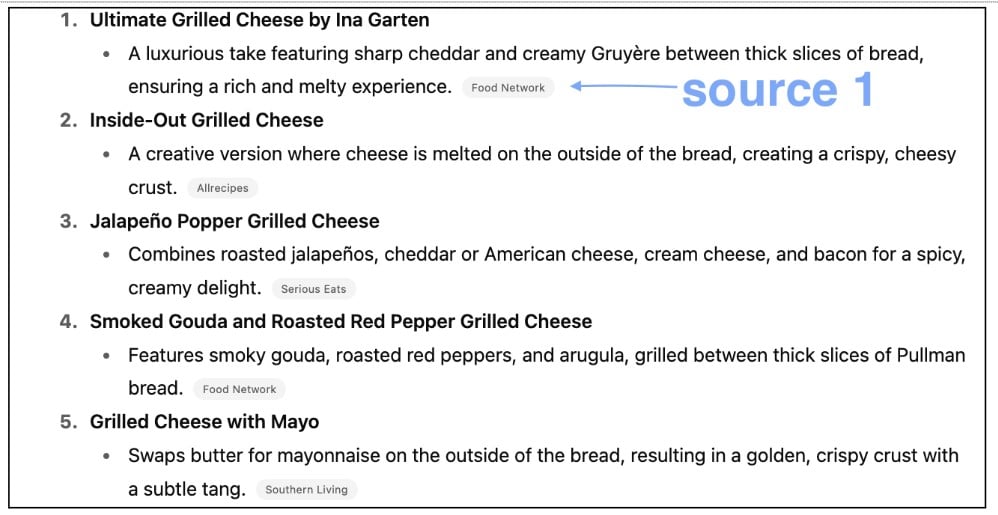
We purposefully asked a basic question about a cheese sandwich. While hundreds of sources have covered the topic, ChatGPT selected certain sites over others.
Your goal is to appear in ChatGPT’s source list (ideally near the top) when people ask questions related to your niche.
How to Rank Your Site In ChatGPT
Like traditional SEO, ranking in ChatGPT depends on several factors. We’ve put together a list of research-backed methods, starting with the essential steps and moving on to more advanced ones.
1) Improve Your Website’s Quality
Outstanding content might go under GPT’s radar if your website has poor navigation, slow loading times, and a confusing structure. Here’s a quick checklist to make sure your site’s in good shape:
- Ensure URLs are simple, easy to read, and clearly indicate the content’s topic.
- Structure your content logically. Use headers, subheadings, and lists to guide users (and AI crawlers) through your content.
- Your most important information is easy to find, not buried under multiple clicks.
- Use descriptive anchor text to create clear connections between different pieces of content.
- Optimize images (compress them using online tools and/or enable lazy loading) to improve site speed.
David Burke, the marketing team lead at Searqle, shared an insight while reviewing our guide:
“There’s one tiny thing many overlook during site audits, but it turns out to be a dealbreaker for GPT rankings. Check what’s in the robots.txt file under the ‘OpenAI-SearchBot section’. If it’s disallowed, change it to ‘allow’ so GPT’s crawler can index your site.”
2) Submit Your Site to Bing
Multiple experts report that OpenAI uses Bing for web searches, which means your Bing rankings directly impact your ChatGPT visibility.
Submit your site to Bing through Google’s Search Console or set up a Bing Webmaster profile. For more on the latter, you can find Bing’s official guidelines here.
3) Optimize the Content Format
Once you’ve done a major overhaul of your website, focus on polishing your content. GPT prioritizes text with:
- Clear, conversational headlines (H2, H3), FAQs, bullet points, and numbered lists.
- Skimmable paragraphs (3-line paragraphs work great)
- Relevant high-quality images, charts, and graphics
4) Align Content with E-E-A-T Principles
ChatGPT is similar to traditional search engines in many ways. We’ve noticed that following the E-A-A-T (Experience, Authoritativeness, and Trustworthiness) guidelines from Google significantly boosts your chances of ranking: ↳
- Showcase your experience: Include personal stories, case studies, and real-world advice to demonstrate your expertise.
- Highlight your expertise: professional history, education, and collaborations with recognized experts (but not just any experts; make sure they’re relevant to your field).
Tip: To signal your expertise to ChatGPT, polish your “About Us” section and author bio. Include your experience and achievements, as well as certifications and awards.
- Build authority. Earn high-quality backlinks and mention your brand in relevant industry forums, webinars, and events.
- Highlight trustworthiness. Ensure your information is accurate, relevant, and sourced from trusted sources. Keep your platform design professional and clear, and link to real user feedback.
5) Add “R” to E-E-A-T
In addition to Google’s “Big Four,” Recency is a crucial factor for GPT. This means you need to keep your content as up-to-date as possible:
- Refresh older articles with the latest statistics, trends, and facts.
- Remove irrelevant or outdated information.
- Add “last updated” timestamps.
You can use tools like Ahrefs’ AI content helper. It analyzes your posts, compares them against competitors’ articles, detects content gaps, and suggests updates.

6) Use Conversational, Digestible Language
This is based on two facts:
- ChatGPT caters to a wide audience. Speaking to a general audience = using a simple style.
- It uses Natural Language Processing (NLP) to analyze your content,
Takeaway: strike a balance between your brand’s voice (especially if you’re targeting professionals in your niche) and simplicity.
Aim for a readability level between 6th and 8th grade when using copywriting tools. In our experience, some good options are Hemingway (it’s free!) and Grammarly.
If you’re unsure whether your content hits the right tone, paste it into QuillBot. Select the “Simple” tone, and see if there’s much of a difference between your copy and QuillBot’s output.
7) Include Direct Answers and Snippets
ChatGPT is more likely to pull content from your site if it directly answers common questions. If you write an article about “What is SEO for Gemini?”, include a clear answer in the text so that GPT can easily pull that part.
Some formats that work well in this context include:↳
- Tip boxes
- FAQs
- Lists and listicles
The key is making your answers immediately visible, scannable, and straight-to-the-point.
8) Build Brand Recognition
Brand recognition plays a bigger role than most people realize. Research by Neil Patel found that ChatGPT looks for three key trust signals: brand mentions, testimonials, and established authority.
That said, brand recognition without solid content and technical optimization won’t get you very far.
So, move on to that action plan only when the major updates are done:
- Guest post high-quality content on reputable platforms. ↳
- Share original data studies, case studies, and research.↳
- Engage in conversations on forums like Reddit and Quora.↳
- Encourage user testimonials.↳
- Partner with affiliates.↳
- Host or speak at online events.
9) Track Your Progress
While there aren’t as many metrics to track in AI SEO as there are in traditional SEO, some platforms can show which content is being picked up by AI bots like ChatGPT.
We’ve pasted our new article in Ahrefs to see how it performs, and here’s what we saw:

The idea is simple. Track how often your pages appear in AIs, notice what changes led to growth, and tweak as you go. This iterative approach helps you identify patterns in what ChatGPT favors from your content.
You’ll come up with your own effective strategy very soon.
Final Words
Nobody has come up with a magic prompt that takes our sites to GPT’s top positions.
So, all that’s left to do is work. And work really hard.
You need a solid technical foundation, quality content that answers real questions, and enough authority to stand out from the competition.
It’s a significant investment of time and effort, but if you adopt ChatGPT optimization, you’ll earn a competitive edge while others are still figuring it out. The sooner you start, the better positioned you’ll be as this channel matures.