

Social media never sits still, and keeping up can feel like a never-ending race.
One day, your content is thriving. Next, it’s buried under an avalanche of updates, ads, and ever-changing algorithms.
Frustrating?
Absolutely.
Impossible?
Not if you know how to adapt.
The reality is that every challenge comes with an opportunity. In this mini guide, we’re taking a look at some of the biggest internet challenges in 2025. And, more importantly, how you can turn them into wins with the right strategy.
Understanding social media challenges and why they’re so popular
Social media challenges have become a cultural phenomenon that captivates millions of users across platforms like Instagram, TikTok, and Twitter. From the viral Ice Bucket Challenge to the more controversial Milk Crate Challenge, these online challenges have a unique ability to engage audiences, spark conversations, and create social media content that spreads like wildfire.
But what makes these challenges so irresistible, and why should marketing agencies and in-house teams consider incorporating them into their social media posts?
The appeal of social media challenges
At their core, social media challenges are a powerful form of user-generated content. They encourage participation, creativity, and connection. By taking part in challenges like the Mannequin Challenge or the Cinnamon Challenge, users can share a piece of themselves while also being part of a larger online community. But the power of these challenges goes beyond just personal expression. Here’s why they’re so effective:
- They tap into human nature: Humans are inherently social creatures, and challenges allow people to show off their skills, humor, or creativity in a shared, accessible way. The Dance Challenge craze on platforms like TikTok is a perfect example. The simplicity of dancing to a catchy tune and showing off your best dance moves can easily be replicated by anyone, making it accessible to a broad audience.
- The thrill of going viral: Everyone loves a good story, and challenges offer an opportunity for participants to become the next viral sensation. When people see their peers participate in challenges like the Blackout Challenge or the Milk Crate Challenge, they often feel compelled to join in. The desire for recognition and viral fame creates a sense of excitement that drives social media activity.
- They encourage social interaction: Many challenges, especially ones like the Ice Bucket Challenge, begin with a call to action that enables users to challenge their friends. This creates a ripple effect, where each new participant challenges others, spreading the challenge far and wide. It’s a clever way of turning individual participation into community-driven movements, boosting engagement exponentially.
- They’re entertaining: Challenges like the Cinnamon Challenge or the Mannequin Challenge combine humor, surprise, and often absurdity to entertain audiences. People are drawn to the unexpected and entertaining content that comes from these challenges, making them a natural fit for social sharing.
Why should marketing agencies and in-house teams care?
If you’re part of a marketing team looking to improve engagement and expand your brand’s reach, online challenges can be a game-changer. Here’s why you should consider leveraging them:
- Increased reach and engagement: Challenges offer an easy way to generate content that your audience wants to interact with and share. As participants invite friends to join in, your campaign can experience organic growth, reaching users far beyond your initial audience.
- Boost brand awareness: Just as the Ice Bucket Challenge raised awareness for ALS, well-designed challenges can increase brand visibility. Creating a challenge that goes hand in hand with your brand values or products can generate goodwill and awareness in a fun, shareable way.
- Create user-generated content: Encouraging your followers to participate in a challenge generates a wealth of user-generated content that can be repurposed across your marketing channels. This not only boosts your content volume but also builds trust as potential customers see real people engaging with your brand.
What are some social media challenges?
Here are some of the biggest online challenges we’re looking at when it comes to social media marketing in 2025.
Challenge 1: Organic reach is tanking
Social media platforms are pushing paid content. This means fewer people see your posts unless you invest in ads.
To get your organic content noticed, you’ll need to get creative. Partner with other brands, engage your audience with user-generated content (UGC), and use interactive features like polls and Q&As to spark meaningful conversations.
The goal?
Get people talking and engaging instead of just scrolling past another promo post.
Challenge 2: Dangerous challenges
While most social media content is fun and lighthearted, some dangerous challenges can raise concerns, especially among younger audiences. These risky trends, like the Blackout Challenge or other harmful stunts, can cause physical injury, emotional distress, or even loss of life.
For brands and creators, this highlights the importance of responsible participation and awareness of mental health impacts. Teens are especially vulnerable to these viral trends because social media can amplify feelings of peer pressure, FOMO (fear of missing out), and the need for validation. The dopamine rush of likes and shares can quickly turn into signs of anxiety in teens, comparison, and low self-esteem, creating a cycle that harms their overall well-being.
The priority should always be to keep kids safe and promote responsible fun. Never share or promote challenges that are potentially harmful or dangerous.
But brand safety isn’t just about content moderation. It’s also about data protection.
When viral trends explode, APIs act as the invisible connectors between social platforms, influencer dashboards, and brand analytics tools. If these APIs aren’t properly secured, malicious actors can exploit them to hijack hashtags, spread fake content under a brand’s name, or access sensitive data tied to social campaigns.
That’s why API security is becoming a core component of brand reputation management. With real-time monitoring, strict authentication, and data flow controls, brands can ensure their integrations remain trusted, even when a viral challenge takes the internet by storm. In 2025’s high-speed digital environment, protecting your APIs means protecting your audience, your credibility, and your campaigns.
Challenge 3: People are drowning in content
Social feeds are overloaded with posts. And honestly, most of them get ignored. People want content that’s actually interesting.
Instead of posting constantly, focus on making your content stand out. Tap into niche topics, share interactive infographics, and consider creating series-based content. Less can be more if it’s actually worth watching.
Challenge 4: AI Is Flooding Feeds with Bland Content
AI makes content creation easier. But it also means there’s a flood of repetitive, soulless posts out there from those who don’t bother to add a human touch to their content.
The way to stand out? Be human.
Use AI as a helper, not a replacement. Share real stories, show behind-the-scenes moments, and let your brand’s personality shine. People connect with people, not robots — so make your content feel real, not like it was cranked out by a machine.
Challenge 5: Short-form video is taking over
Video is king, but making great ones takes time and effort.
If you’re not posting short-form videos, you’re missing out. But you don’t have to reinvent the wheel every time. (According to HubSpot’s 2025 report, 21% of marketers believe that short-form videos generate a lot of return on investment (ROI)).
Repurpose some of your longer videos into LinkedIn clips, Instagram Reels, and YouTube Shorts. Batch-create content to save time, use templates to speed things up, and collaborate with top social media influencers to expand your reach without breaking the bank.
Here are some of the biggest challenges we’re looking at when it comes to social media marketing in 2025.
Challenge 6: Algorithms keep changing the game
One day, your posts are getting tons of engagement, the next, they’re buried. Social media algorithms are unpredictable, so the best move is to stay flexible.
Watch your analytics, test different content styles, and don’t put all of your eggs in one platform.
Jump on social media trends, team up with influencers, and build an email list or online community so you’re not at the mercy of every algorithm update.
Let’s take a closer look at how you can solve social media challenges in 2025 — complete with real brand examples!
How to turn social media challenges around
Here’s how to stand out on social media in 2025, despite the challenges we’ve discussed so far.
Use storytelling to keep your audience engaged
Audiences are tired of boring, watered-down content. They want an experience — something that’s educational, entertaining, or emotional.
And Beaches of Normandy Tours knows how to do this just right.
The brand shares historical war stories on its Facebook page and blog, like the history of Captain Speirs, to capture its military history enthusiast audience. Its audience gets a sneak peek on Facebook and can head to its blog post for a deeper dive.
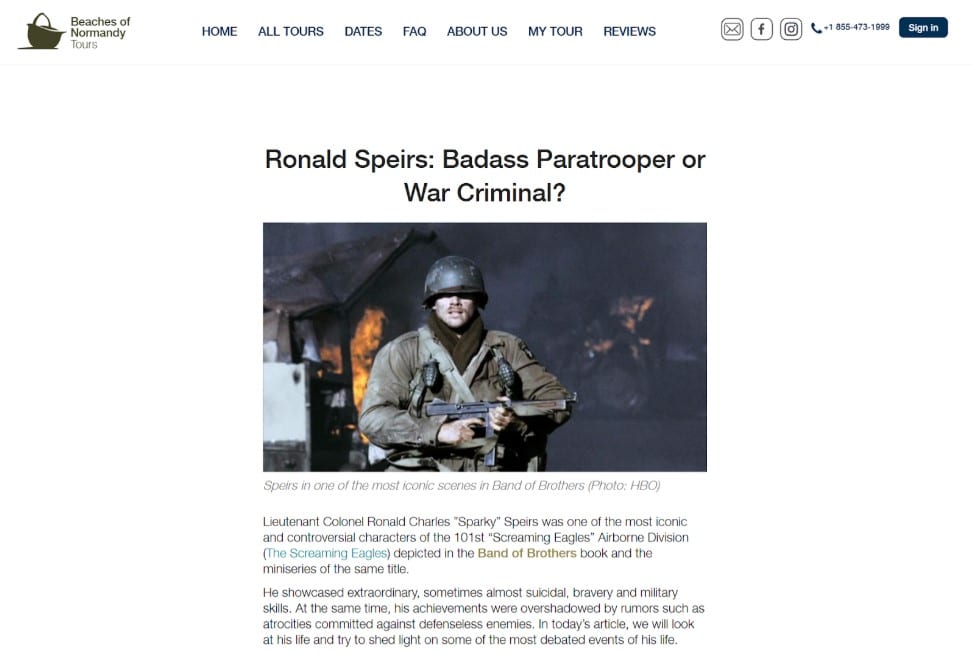
It also encourages the audience to participate in WWII war trivia by sharing short multiple-choice quizzes. (Its audience loves these, by the way! Their quizzes tend to get tons of shares.)

Draw on emotion to build meaningful connections with your audience
StudioSuits uses storytelling, too — but also draws on its audience’s emotions.
Audiences need a reason to stop scrolling. If you can stir up strong feelings like sadness, anger, and joy, you can encourage aligned users to pause.
In the following post, StudioSuits shares a beautiful carousel with professional photos of a groom and groomsmen wearing semi-formal wedding attire. (Along with other memorable moments of the bride and groom at the ceremony.)
And the caption below will make you reach for the tissues.
It talks about how, shortly after getting engaged, the bride was diagnosed with cancer in her 20s, forcing the couple to postpone their wedding while she underwent treatment. Their wedding celebration was a testament to the hope they continued to hold onto during some of their toughest times.

Go big on video content, carousels, and images to encourage organic content views
Social media channels aim to deliver content that’s dynamic and visually engaging to their audiences. This encourages users to comment, share, and stay longer on their favorite social apps.
That’s why you need to hunker down and create better visuals in 2025.
If you’re a B2B business, create infographics, checklists, and informative carousels in bulk.
Batch these out in advance according to your marketing campaigns. And schedule them to post at least three months out. (Otherwise, you could be on the design-post-repeat hamster wheel indefinitely.)
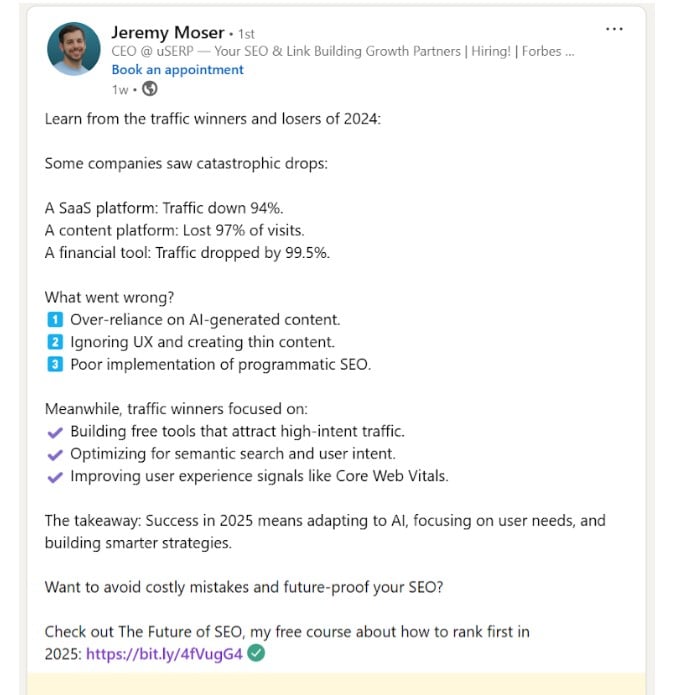
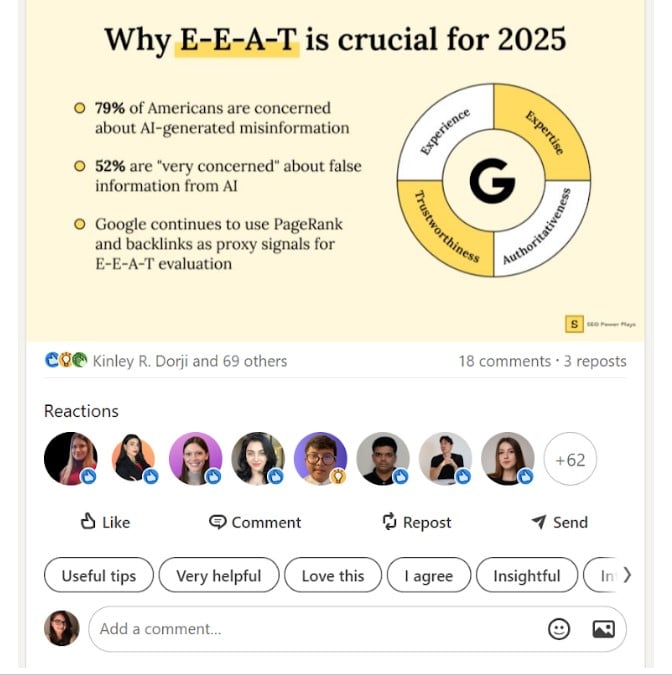
Jeremy Moser, the CEO at uSERP, for instance, specializes in creating valuable B2B content visuals.
SEOs and marketers count on Jeremy for in-depth insights, data, and tutorials when they’re on LinkedIn or X. From infographics to carousels to screenshots. Each visual is easy to share, save, and learn from!
If you have a B2C business, consider partnering with micro-influencers who specialize in creating engaging Carousels, Reels, and videos.
This reduces a ton of the burden off of your marketing team — and supplies you with high-value content. Use an influencer marketing platform to collaborate on these. It’ll also help you track key metrics, conversions, and payments.
Give value generously to build authority and trust with your audience
Capturing attention isn’t enough. Your audience wants rich insights they can apply to their lives or businesses.
In the B2C world, this may be helpful, such as shopping guides or examples of how to style fashion pieces, for instance. In the B2B world, this could be free cheat sheets, trackers, and downloadables.
Business coach Maria Wendt, for instance, always gives generously to her audience of female entrepreneurs.
She does this super strategically, though.
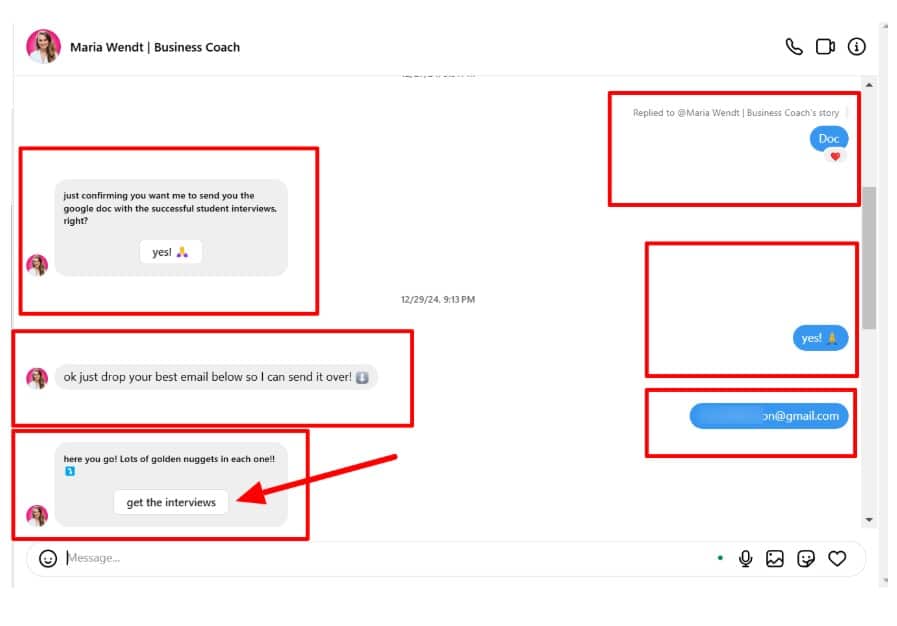
Maria shares Carousels, Reels, and Stories that invite her users to comment with a specific word in exchange for a freebie. For instance, her audience might get a free content planning spreadsheet in exchange for their email addresses. Or a video breaking down one of her key marketing strategies.
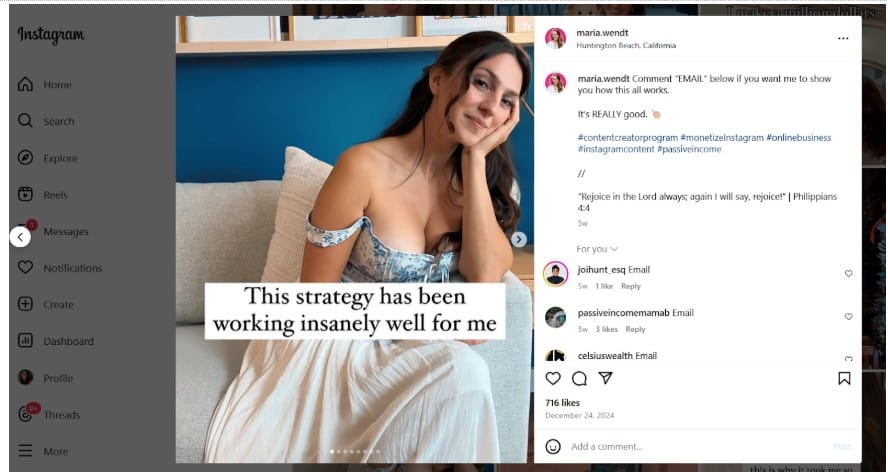
When users comment using the specific word she asked for, her direct message (DM) funnel automatically replies to them in a DM. The user must then respond to that DM with their email address. After that, Maria’s funnel automatically replies with the freebie.
(She set this up using ManyChat, by the way!)
Test ad creatives and copy to get a better social media return on ad spend (ROAS)
The time has come …
You have to pay to play if you want to get the word out about your business on social media. (Or at least, if you want to put your business in front of more eyes than you could organically.)
But ad campaigns can quickly drain your marketing budget. Especially if you’re throwing spaghetti at the wall and hoping for a high ROAS. Instead, take the time to test multiple versions of your campaigns to see which ads convert best.
Try 10 variations per campaign. But only change one variable for each one.
For example, if you’re testing an ad that has a course mockup visual with one line of text at the top and a call to action (CTA) at the bottom, you might change:
- The color of your course mockup visual
- The size of your course mockup visual
- The entire course mockup visual
- The color of your ad background
- The color of the text at the top
- The size of the font at the top
- The font of the text at the top
- The color of the CTA text
- The CTA location
- The CTA text
This will show you what your audience responds to so you can be more intentional with your ad spend.
Here’s an example of an ad by the fashion brand Bershka:

(Image provided by the author)
With over 3,300 likes, it’s safe to say that this ad creative draws social media users in! bershka likely tested several images before landing on this one as the main one.
With ads, it’s rare to just post something and get lucky.
Test, test, test!
Quick checklist for succeeding in social media challenges in 2025
For good measure, be sure to:
- Post engaging, story-driven content
- Draw on emotion
- Use lots of visuals like carousels and videos
- Offer tons of value-driven content
- Experiment with different ad creatives
Wrap up
Social media in 2025 comes with its challenges. But every obstacle is an opportunity to refine your strategy.
Prioritizing storytelling, high-quality visuals, and critical thinking will keep your brand relevant and engaging. Stay adaptable, experiment with new formats, and build genuine connections with your audience.
Basically, move with the changes instead of fighting against them. And you’ll be just fine.