

Positioning your small or mid-size business in a competitive market can seem daunting—particularly if you’re working with a limited marketing budget.
However, while you may feel that reaching prospects and converting customers necessitates proactive sales tactics (which it does), it’s also important to comprehend that certain marketing strategies can help ensure leads come to you.
So, what’s the key to unlocking impressive sales? Well, the secret may lie in storytelling.
If you think about the one thing most successful brands have in common, you’ll find that it’s an engaging, relatable, or aspirational brand narrative.
Think of Coca-Cola’s holiday commercials. Nike’s empowering “Just Do It” slogan. Or even Apple’s Think Different campaign that aligned the brand’s target audience with some of the world’s most famous innovators.
Ultimately, a great story doesn’t just help you position your business in a positive light. It also enables you to engage your ideal customers, which in turn improves the ROI of your marketing tactics.
But how do you go about creating a brand narrative that sells? And why is storytelling so effective in the first place?
These are the most important lessons for using storytelling to boost business results, with examples from diverse industries to help you choose the best approach for you. Let’s get into it.
Why Brand Storytelling Sells
The simple truth about humans is that we’re naturally wired to respond to narratives.
Just think about the beginnings of civilization, and you’ll find that human progress perfectly aligns with the practice of telling and recording stories.
But the thing that makes storytelling so powerful isn’t just that it’s engaging and fun. In reality, stories are exceptional communication tools that almost guarantee to get our message across, which is precisely what you need from a great marketing strategy.
But how does storytelling actually work, on a biological level?
Scientific research on the power of narratives has found that people’s response to stories isn’t just about attention. Stories actively fire up our brains. According to scientific findings, the level of engagement is higher when listening to a story than when listening to factual reporting. The outcome? Better information recall.
Additionally, functional MRI scans reveal that stories synchronize brain activity between the listener and storyteller, forge emotional connections, boost comprehension, and even drive empathy.
A great story can even cause a change in opinions or even shift a person’s core beliefs, proving what a powerful tool narrative can be.
How to Create a Brand Narrative That Supports Your Business Goals
From the data above, it’s easy to conclude that story-driven branding must work.
But how do you infuse your marketing activity with storytelling? And can this tactic apply to all industries? Or is it only reserved for B2C brands?
Let’s look into how you can enrich your branding and marketing campaigns with storytelling, regardless of your industry.
Ensuring Value Proposition Resonance
The simple truth about marketing any solution is that your target audience won’t care about your product or service unless they perceive it as relevant to their unique needs.
In fact, research suggests that 81% of people ignore irrelevant marketing messages, while 96% say they’re more likely to purchase from brands that employ personalization.
With this in mind, one of the biggest benefits of a powerful brand narrative is that it can help you get your message across more effectively than a run-of-the-mill value proposition.
Think, for instance, of Tony’s Chocolonely. This brand’s unique sales proposition consists of offering chocolate bars that promise to end exploitation in the cocoa industry. But the thing that makes this possible isn’t a mission statement. Nor is it the brand’s innovative product design (that divides each bar unequally to represent the unfairness of the chocolate industry). Instead, it’s the brand’s insistence on using storytelling to remind shoppers why it exists and why its products are important. Based on the brand’s revenue growth (33.2% YOY in 2024), the tactic is working.
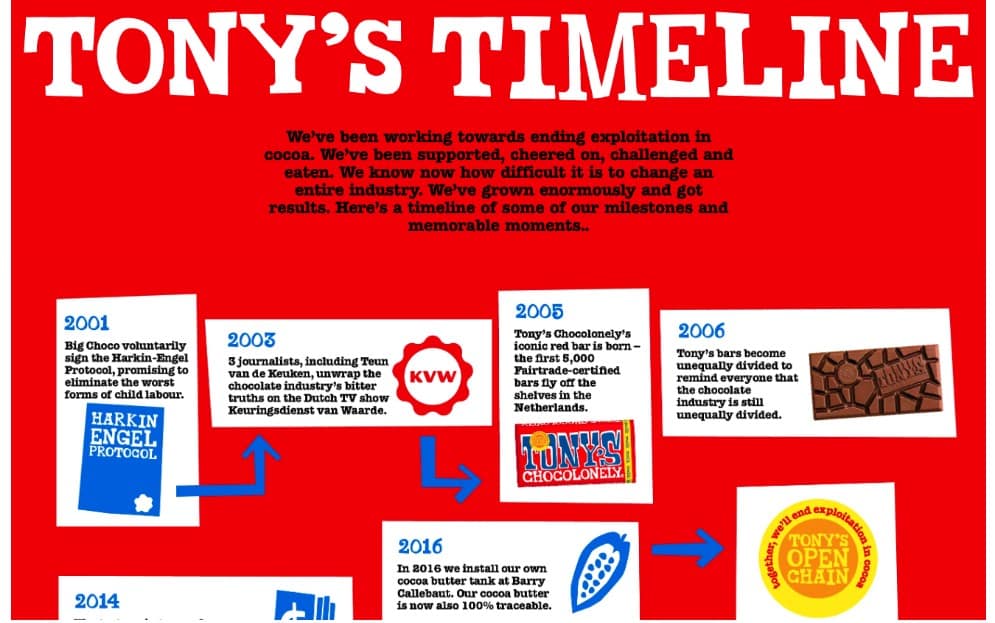
Source: tonyschocolonely.com
Boosting Brand Memorability
If you look into what brands consumers choose when searching for solutions, you’ll find that familiarity offers you a huge advantage: 82% of people click on a familiar brand name when conducting online searches. Additionally, research reveals that people are more likely to trust brands they already know compared to those they’ve never encountered before.
With this in mind, ensuring that your target audience remembers your business after an initial interaction is crucial for nurturing potential leads into customers.
The good news is that stories can help you accomplish this goal — especially if you manage to connect with prospects on an emotional level.
For example, check out how Athletic Brewing Company does it on its homepage. By featuring a story-driven video to explain its purpose, this brand effectively finds a common mission with its ideal customers, ensuring that they remember the brand’s products even if they’re not yet ready to convert.
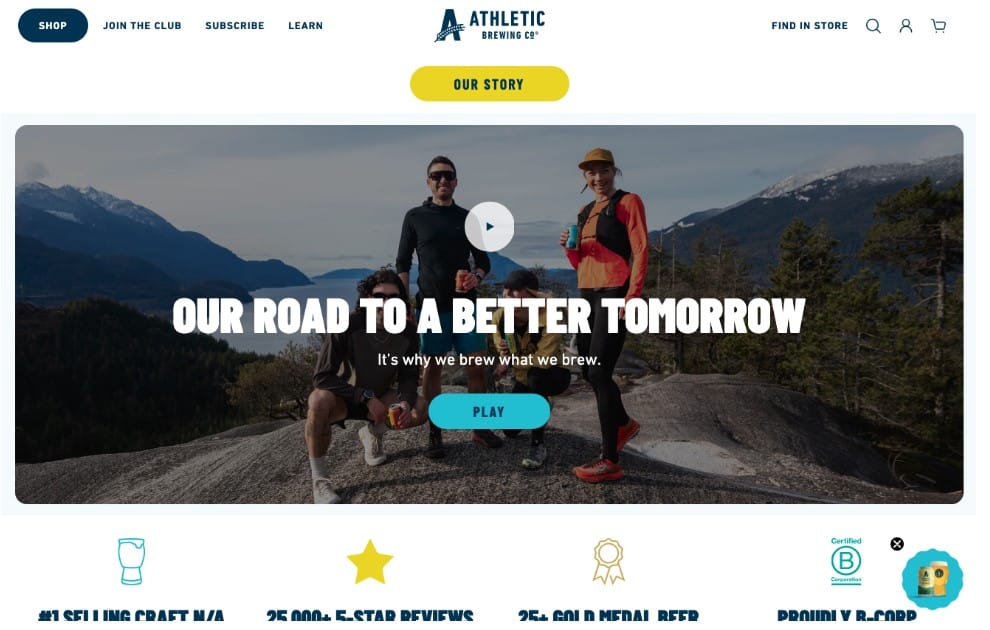
Source: athleticbrewing.com
Forging Emotional Connection
Most buying decisions aren’t rational choices. Instead, 95% of people shop based on subconscious impulses, explaining the importance of emotions in both branding and marketing.
But here’s the deal. You can successfully employ information and real-life data to drive conversions. After all, people crave convenient customer experiences, guarantees of effectiveness, and fair prices.
Nevertheless, you shouldn’t discredit the power of branding and sales messages that resonate on an emotional level — especially if you operate in a competitive industry. And the easiest method to build those emotional connections is through narratives.
For instance, check out how Sewing Parts Online does it. This ecommerce business sells sewing machine spare parts for many different brands. The logical way for it to market its offer would be to say that it offers a wide variety of parts and exceptional customer service. Instead, this business leads by saying that “No one should have to throw away the sewing machine that their grandma taught them how to sew on.”
It’s a brilliant approach, and not just because the video addresses the why behind the brand’s existence. It evokes a strong sense of nostalgia, which is sure to drive shoppers to recognize that Sewing Parts Online’s value propositions align with what they truly want.
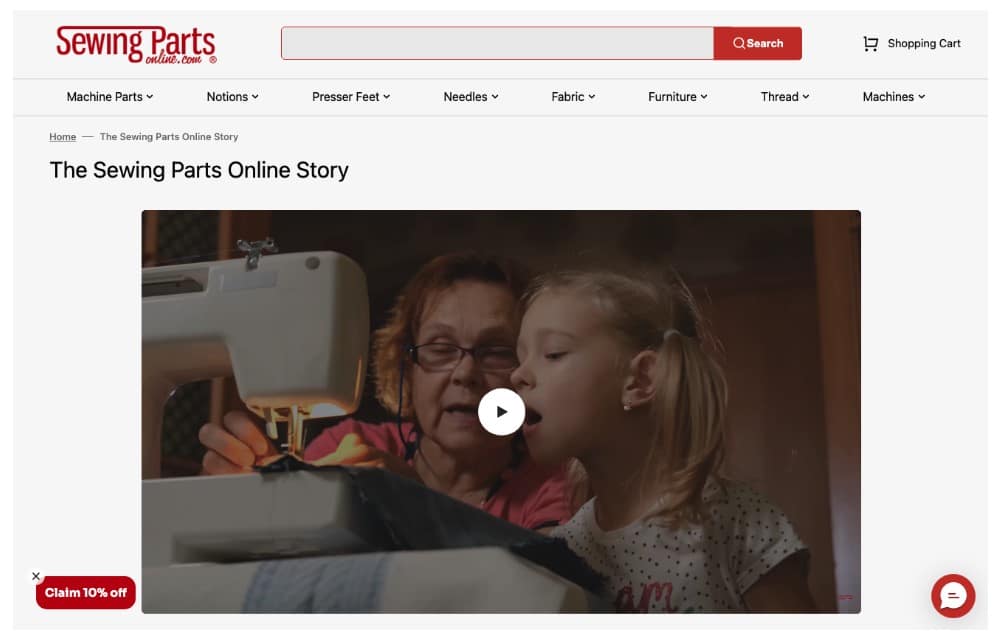
Source: sewingpartsonline.com
Humanizing Your Business and Supporting Brand Authenticity
Most consumers don’t want to buy from large, faceless organizations.
If you look at some of the latest consumer sentiment and behavior research studies, you’ll find that 61% of consumers say companies treat them as a number instead of adapting to their needs and preferences. Moreover, people are increasingly switching to smaller and local brands, with McKinsey’s latest research finding that 36% of shoppers want to support domestic businesses.
So, as you explore methods to enrich your branding strategy with storytelling, focus on narratives that can humanize your brand and position it as an authentic, relatable entity that cares about its customers.
The great thing about this branding tactic is that it can be as simple or as complex as you need.
For instance, including employee photos and biographies on your About page can be a super easy way to tell potential prospects who they’ll be working with (as well as an opportunity to establish your team’s expertise).
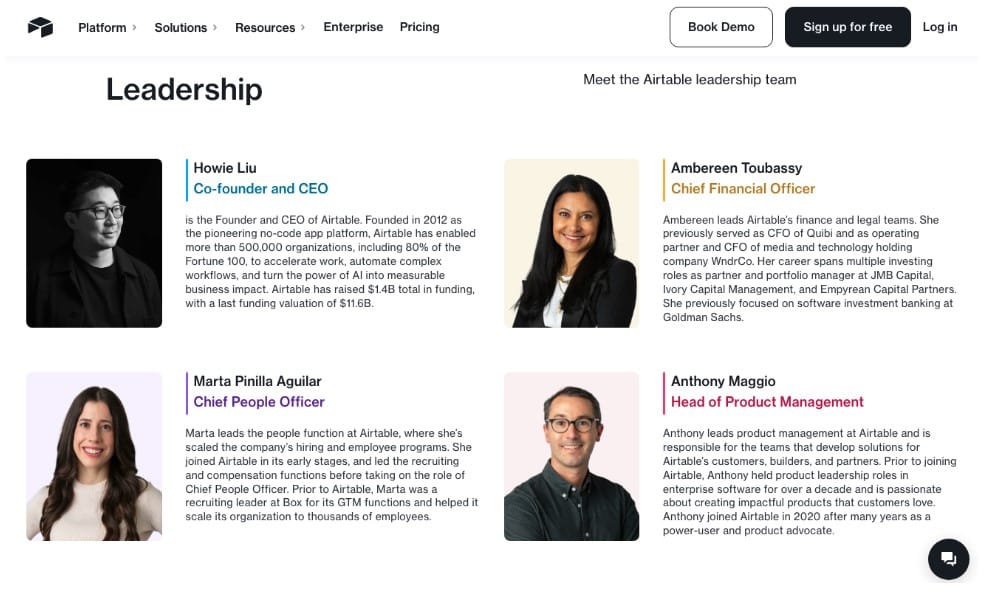
Source: airtable.com
Alternatively, you may choose to infuse a dose of story-driven authenticity into your content marketing strategy. This is what Unita does in its blog posts, like this one on the 12 best remote staffing agencies. The authors of their posts share their personal experience to demonstrate the authenticity of the advice contained in the copy as well as to build an initial emotional connection with readers.
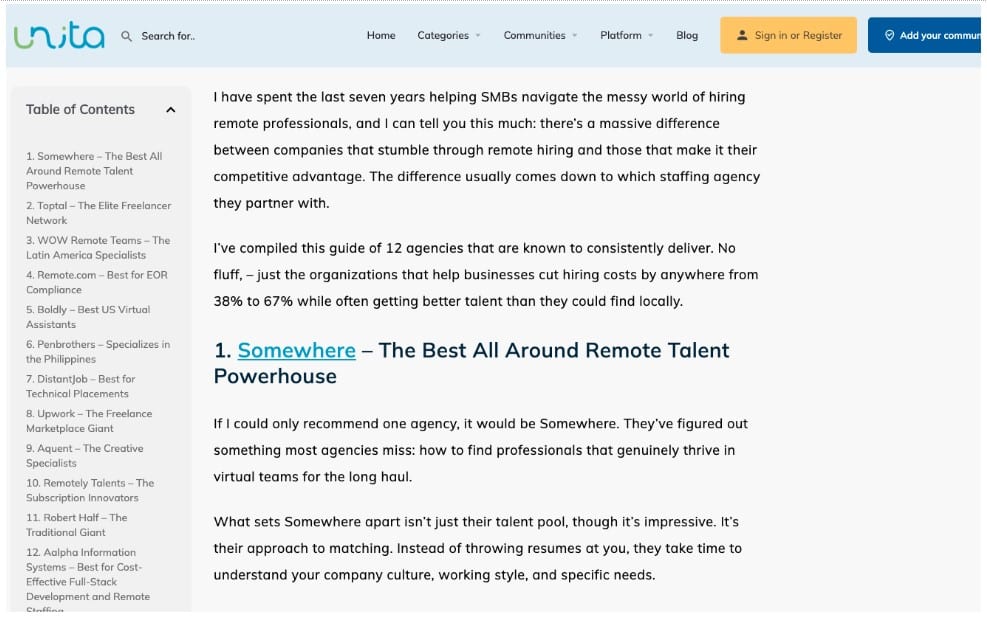
Source: unita.co
Elevating Product Comprehension
How do people choose what solutions to spend their hard-earned money on? In general, when choosing products or services, consumers evaluate based on price, quality, and even brand reputation.
However, for them to even consider investing in your offer, they first need to comprehend the value of your solution. And that requires a high level of product comprehension.
In most industries, this doesn’t have to be challenging to accomplish. Simple tactics like describing product benefits instead of features and supporting product page copy with visuals tend to elevate product understanding.
But what about complex solutions in niche industries? Or innovative products that are new and unique in the market?
In these cases, it’s much more difficult to drive product understanding via traditional sales tactics.
Fortunately, you can overcome this challenge by enriching your sales copy with storytelling.
Something as simple as using descriptive language to demonstrate how your product or service works — which is what RE Cost Seg does on this page — can be a great way to introduce your target audience to the value you offer in a way that more or less guarantees a high level of comprehension.
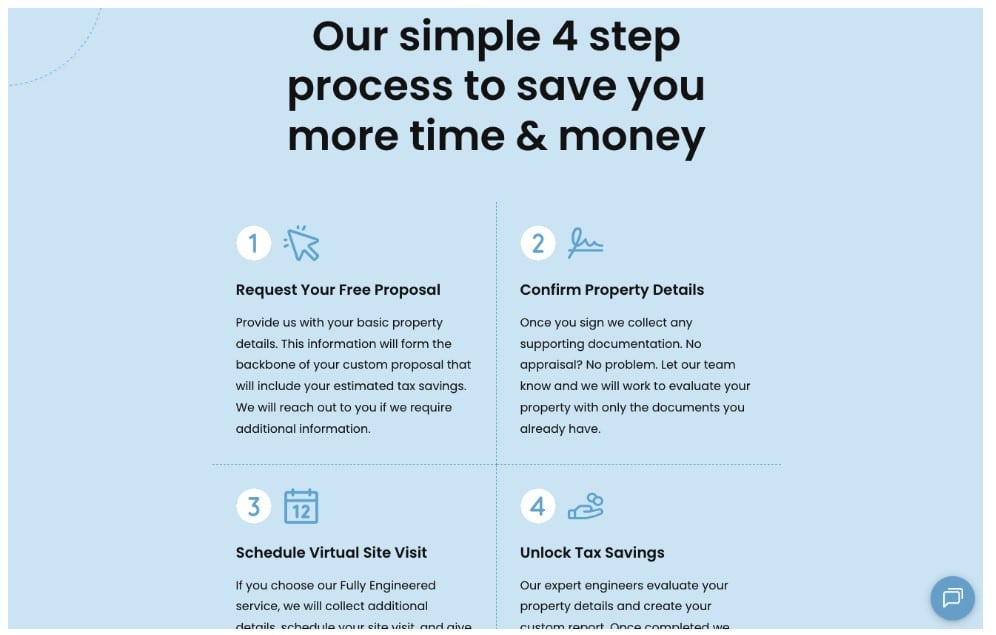
Source: recostseg.com
Alternatively, it’s also a good idea to employ video for this purpose, especially considering that it’s most consumers’ preferred way of collecting pre-purchase information. Check out how Refold does it on its homepage, using video to explain why language learning apps don’t work and why its solution differs from everything else in the market.
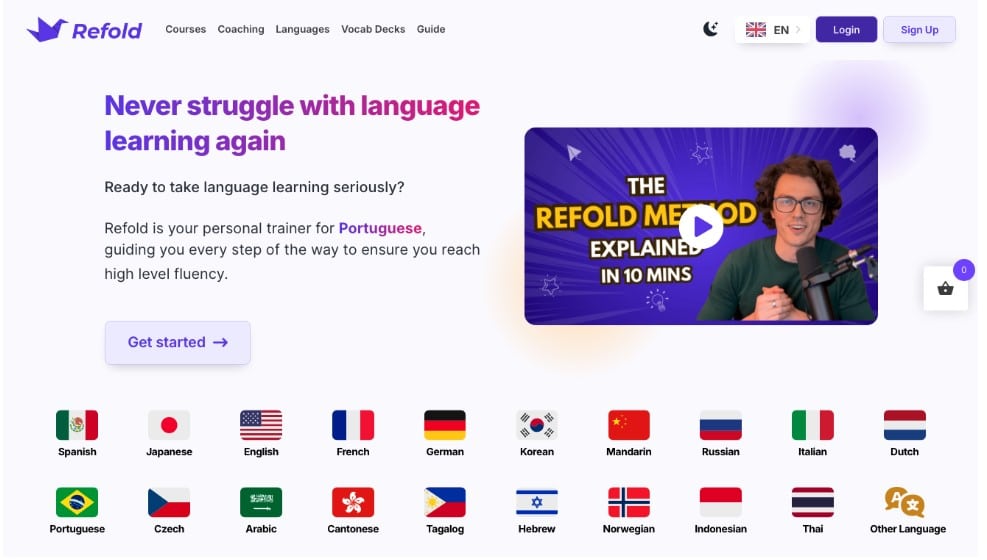
Source: refold.la
Boosting Brand Differentiation
Sometimes, the biggest obstacle to converting customers isn’t that your audience doesn’t understand the value you offer. Instead, it’s your inability to stand out in a saturated niche.
That’s why differentiation is so essential in branding.
Ultimately, the most effective method for engaging and converting leads is to demonstrate that you have the best solution to your target audience’s unique needs.
But how does developing a brand narrative help with this goal?
Well, stories are a great way to differentiate your business because they allow you to enrich your value propositions with context. By highlighting the when, how, and why behind your brand’s origins, you can effectively address industry gaps your competitors aren’t solving.
Moreover, storytelling can help you point out standout product or service qualities, which are often the factors that convince people to choose one solution over another.
And the best part is, you don’t necessarily have to go into a lot of detail to reap the benefits of a compelling narrative.
For example, check out how Investing.io implements storytelling on its homepage. Instead of going into detail about the nature of entrepreneurial investing, it simply states that “there wasn’t a dedicated newsletter for entrepreneurial investors… So [they] created one.” It’s short, sweet, and memorable. But most importantly, the story points out a massive gap in the brand’s target industry and immediately positions its newsletter as the best way to bridge it.
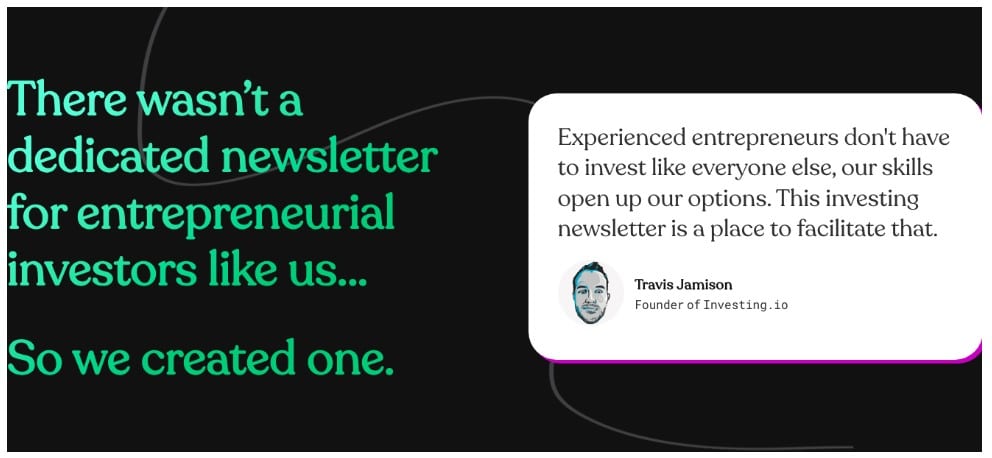
Source: investing.io
Building Brand Trust
As a business leader, you’re well aware of the importance of brand trust in driving sales.
After all, most people will only buy from brands they perceive as credible. And 88% of consumers consider brand trust to be as important as product price and quality.
However, while your branding strategy likely has a dedicated tactic for elevating credibility, it’s not a bad idea to use storytelling to supplement your attempts to earn your prospect’s trust.
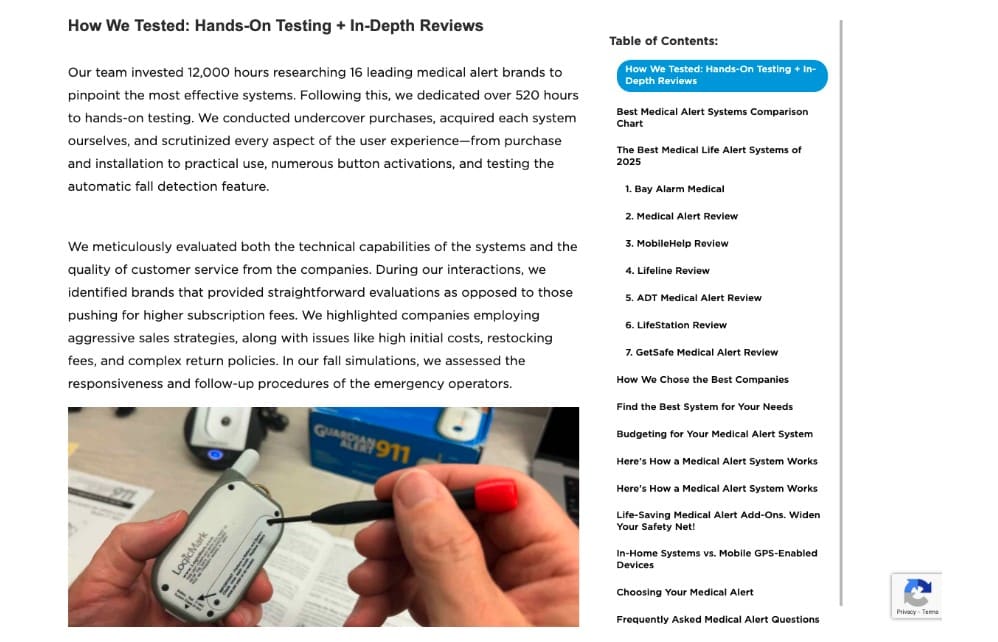
Check out how Medical Alert Buyers Guide does it. Instead of insisting on being the best or most thorough resource for medical alert system reviews, this brand simply describes its testing process. On the surface, this story is not much more than a list of activities the brand’s experts go through when reviewing products. But on a much deeper level, it’s an in-depth insight into a highly nuanced procedure that clearly shows that Medical Alert Buyers Guide is a company that takes its job seriously and can be trusted for objective purchase advice in an otherwise low-trust industry.
Source: medicalalertbuyersguide.org
Removing Conversion Obstacles
Finally, if you want to create a brand narrative that will help drive your business forward, don’t underestimate the power of common conversion killers.
Ultimately, the median conversion rate across industries is just 6.6%. And while this may not seem that bad, it reveals that more than 90% of your prospects don’t convert into customers.
Fortunately, there are many tactics you can use to remove conversion obstacles from your sales cycle. But if you want to maximize your chances of generating leads and making sales, why not focus on what matters most — consumer confidence?
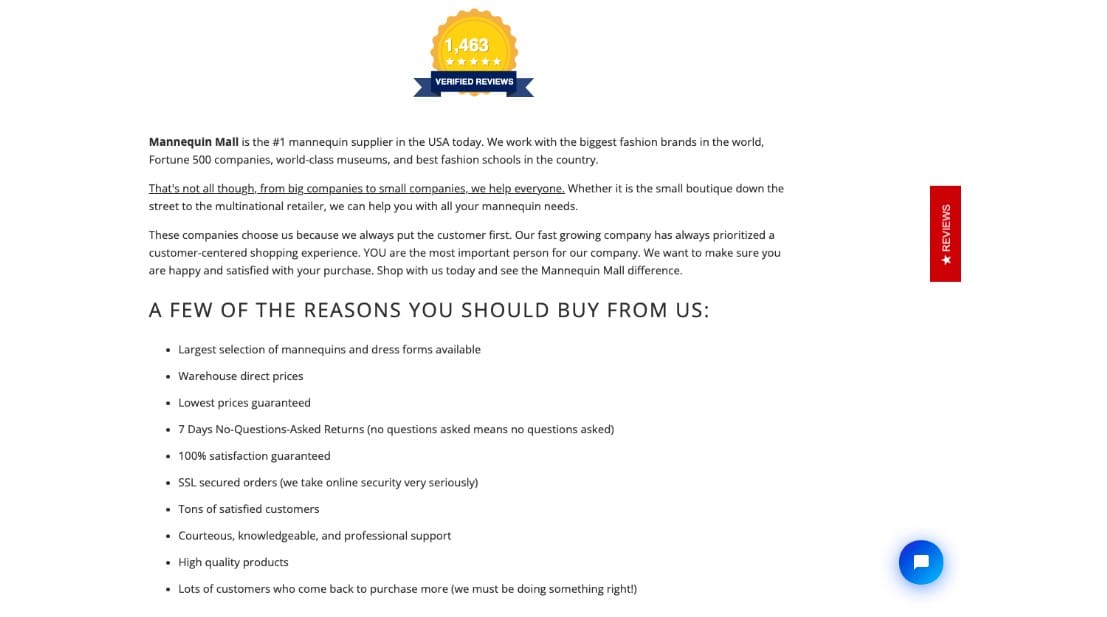
By using storytelling to emphasize your company’s expertise, experience, and positive track record of removing customer pain points — all things that Mannequin Mall does on its Why Buy From Us page — you can effectively address your prospects’ conversion obstacles without relying on pushy sales tactics. Instead, you’re just telling a story about what your business does and what type of value it offers. If that value aligns with what your prospects need — well, great, that means they’re in the right place to remove their pain points.
Source: mannequinmall.com
Final Thoughts
At first glance, storytelling may not seem like an impressive or even effective marketing strategy. But the simple truth is that it works, and not just in driving conversions. It’s one of the most effective methods to position your brand in a way that guarantees success.
So, don’t hesitate to create a brand narrative based on storytelling. By taking inspiration from the examples in this guide, you’re guaranteed to discover an approach that works for your brand and audience.
Then, all that’s left to do is infuse your entire digital presence with your brand story, using it to maximize sales, build trust, encourage loyalty, and outperform your competition — regardless of your niche.