
Media Monitoring: The Ultimate Guide
Media monitoring is crucial for safeguarding your reputation, understanding your target audience, and making informed, data-driven PR decisions. In this comprehensive guide, we examine the evolution of media monitoring in recent times, the impact of AI-powered tools on PR professionals, and strategies for ensuring comprehensive media monitoring across various channels. Whether you’re facing a crisis, tracking competitors, or measuring brand impact, we’ll show you how to build a media monitoring strategy that keeps you informed, aligned, and in control.
Introduction
It feels like you’ve been punched in the gut.
Your boss is standing in front of you—furious—demanding to know how you let this happen.
An industry report slamming your organization has been circulating since the beginning of the week, and your competitors have been laughing it up, splashing it all over social media.
It’s been snowballing out of control, and you, the communications expert, haven’t done a thing.
How could you have when you’re just finding out now?
You feel sick.
A million thoughts and questions rush through your head. A couple of standouts: “How did I get here?” Better still, “How do I ensure this NEVER happens again?”
The short answer is media monitoring. Preventing situations like the one described above is just a fraction of what media monitoring can do for your organization and your career as a communications professional.
AI-Powered Media Monitoring
Get actionable insights and complete visibility into your media landscape

This guide will delve deeply into media monitoring.
We’re going to talk about everything from what it is and what it’s used for, to how you can make it work best for you and your organization.
Media monitoring, in some form or another, has been around since the 1850s. From free online options to automated tools to managed services, media monitoring can be as basic or as advanced as necessary.
And this is just the beginning.
When you’re done reading, you may not be an expert in the art and science of media monitoring, but you’ll be well on your way.
What is media monitoring? Definition, scope, and strategic value
Media monitoring used to be a literal cut-and-paste job, one where analysts scoured newspapers and magazines for mentions, cut out the articles, and pasted them into physical clipbooks.
Now, it’s a modern technologically advanced practice. It uses machine learning, sophisticated algorithms, and powerful processors to track, gather, and organize mentions across the media landscape. Sure, the premise remains the same—to track a topic through the media—but the process has become infinitely more refined.
We’ve traded in our scissors for software.
Media monitoring is listening to who’s saying what about your brand, competitors, industry, and any other topic important to you and your operations.
Pretty important, right?
Every organization has different wants and needs when it comes to media monitoring. This brings us to our next question: What channels are essential for your organization to monitor?
What media channels to monitor?
Media monitoring tools track mentions across various channels. However, organizations may not require media monitoring for every channel, depending on their target audience and business requirements.
Here’s a rundown of some of the primary media channels that you can monitor:
Newspapers and magazines still make up a good portion of press coverage, and depending on your target audience, print might be where you want your message to appear.
It’s no surprise that the rapid rise of the online news cycle has adversely affected print media consumption. However, as a legacy medium, it remains relevant across different regions. There’s still something prestigious about your message being in print since it lives forever.
However, because all content is available online and the online news cycle reacts in real time to every update, print is too late to respond. Coupled with higher costs, publishers and consumers have a drastic incentive to move online.
The shift is visible in consumer behaviour. Research predicts a further decline in print media consumption, with print newspapers and magazines expected to demonstrate a -2.99% CAGR over the next five years.
Broadcast
Despite the decline in cable subscriptions, television remains a significant influence on public perception. With an average person still watching traditional TV daily, broadcast remains a lucrative media channel. Particularly for consumer brands, broadcasting is a channel for reaching a large audience.
Modern media monitoring software employs cutting-edge speech-to-text transcription, so you can trust that you won’t miss that priceless soundbite.
Online
The world now lives online. With customer review sites, opinionated pieces, and a 24-hour news cycle, online media dictates the conversation surrounding your organization and industry.
If you’re serious about tapping into the conversation and increasing brand recognition, you must monitor everything from the most prominent online news outlets to the smallest blogs.
It provides insight into customer preferences and enhances your SEO performance by establishing high-authority backlinks to your website.
Social media
We’re in the age of social media. User-generated content drives conversion, influencers are overtaking conventional marketing channels, and TikTok had 1 billion active monthly users in 2026. Customers increasingly rely on social media to inform their purchasing decisions. If your audience isn’t on social media, chances are you don’t have an audience.
Social media monitoring enables you to listen to and engage in the conversation surrounding your brand. This is called social listening. With numerous social media channels, you can directly reach your target audience and cultivate an authentic relationship with them.
Podcasts
In 2006, only 22% of the U.S. population stated they were familiar with the word ‘podcast’. SEMrush research estimates that podcast listeners will exceed 584 million by 2026!
From true crime to public relations, there is a podcast for every subject.
Whether you want to capture a casual remark about your brand by a podcast host or determine the ideal show for your spokesperson to be a guest on, you can’t afford to ignore monitoring podcasts.
Why is media monitoring important?
Media monitoring is crucial to PR success. There! We said it.
But really, it is.
Media monitoring allows you to measure your campaigns’ real-time performance, discover new media coverage opportunities, and understand evolving consumer preferences. To be a frontrunner in your industry, you must understand what your competitors are doing and where your industry is headed.
And media monitoring provides that knowledge.
Here are some essential reasons why you need media monitoring:
1. Understanding your target audience
When you monitor beyond just your brand, you’ll gain a deeper understanding of your target audience. You’ll learn what they do and don’t care about, what they think about your competition, what they like or dislike about your organization, and even how they talk about the things that matter to you.
This wealth of information will enable you to relate better and communicate more effectively with your audience, which is essentially the primary goal of PR.
2. Brand reputation and perception
Your reputation is what you trade on. And it’s only as strong as how your brand is perceived.
No one likes to be blindsided by a threat that could damage their brand’s reputation. Media monitoring can help you identify potential crises and mitigate damage with a quick and intelligent response. It is also essential in creating an effective reputation management plan, allowing you to be proactive rather than just reactive.
And don’t forget—a picture is worth a thousand words. Therefore, it makes sense to monitor your brand’s visual coverage as well. Even if there’s no text mention in the article, our image monitoring uses machine learning to identify objects or logos in an image, which means you’ll be able to unearth otherwise hidden coverage.
When you know what people say about you, you can respond thoughtfully, increasing your transparency, authenticity, and positive relationships.
The result: A better reputation.
3. Risk mitigation
No organization is immune to risk; it’s a fact of doing business.
Understanding and mitigating potential risk is usually the responsibility of several internal departments; hiring a media monitoring provider can centralize the workload by:
- Identifying supplier-related risk by monitoring media mentions of new/existing suppliers
- Monitoring potential risks from changes to the legislative landscape you operate within
- Keeping an eye on what competitors are saying to the market and, in turn, what market perception is of them
4. Evaluating your efforts
There comes a time in every professional’s life when they need to take a good, hard look at their work and objectively assess their performance. Because if what you’re
doing isn’t working, your boss or clients—or both—are going to want to see a change.
For a PR pro, that time comes at the end of every campaign, if not more frequently.
Media monitoring helps you determine if your efforts are yielding results. Only by tracking your coverage will you know if you’re even getting any. Only by monitoring the media will you know if you’re earning it.
Evaluating your efforts is crucial in any role, but PR and communications professionals are particularly competitive and ambitious. We know you’d rather learn and evolve than fall behind.
5. Identifying journalists and influencers for outreach
When you monitor, you learn which journalists and influencers you should target.
If you find one who writes extensively on your competitors, you can reach out and show them what you do differently. If you find one who is not entirely on your side, you can reach out and change their mind; the idea is that, in turn, they’ll change the minds of their readers.
What we just mentioned is part of media relations—working with the media to relay information to the public. There’s a lot to consider with media relations. Still, a large part of it is establishing positive relationships with media and pitching your story in a way that’s attention-grabbing and effective. But that’s a topic for another time. Let’s get back to monitoring.
Monitoring can identify:
- Journalists who often write about your market or industry and whose opinions carry clout with your target audience.
- Individuals with social media followings whom you can leverage to gather product feedback or influence to review or endorse your offering. Don’t forget to include micro-influencers in your calculations.
- Detractors who might spread harmful or misleading information about you.
It’s imperative to know who’s saying what and who’s listening before contributing to the conversation.
Who should be using media monitoring
If you work for an organization that interacts with the public (perhaps as customers, investors, donors, employees, constituents, volunteers, neighbours, or anyone else) and cares about reputation and public perception, then you need media monitoring.
Likewise, if you’re forward-thinking and want to identify the opportunities and risks that could transform your organization, tracking what’s being said about your industry, competitors, and the issues your organization cares about is essential – and a media monitoring service can help.
Let’s consider a few scenarios.
Startups and small- to medium-sized enterprises (SMEs)
Even today, positive media coverage remains the ultimate credibility marker and can be a powerful growth hack for your business if leveraged correctly. Earned media can draw significant attention to a company, helping to attract new prospects, customers, investors, and talent.
But here’s the thing – how will you collect and leverage this awesome credibility if you don’t regularly track every media source that might mention you?
Startups and SMEs work hard to promote their brands, sometimes on minimal budgets. Tracking the media coverage they earn can help prove the value of time and money spent on PR and marketing.
They also need to be responsive to their audience and play a role in shaping public perception to grow.
Not all startups can afford a robust media monitoring service—fair enough. There are still some free options available (at least for monitoring online mentions).
Large businesses
Naturally, larger businesses are in a different situation than startups and SMEs.
Large businesses generate a significant amount of media coverage and online mentions, but much of this content is unrelated to their overall success or day-to-day operations. They need help distinguishing between the noise and the important news. Big businesses also need to demonstrate the ROI of their PR activities, benchmark their performance, and clearly communicate that information to key stakeholders.
Whereas a small business may be able to set up an automated monitoring service and sort out the relevant mentions from the noise on its own, larger organizations typically prefer to receive curated (managed) media monitoring reports that focus on only the most pertinent pieces.
There are many reasons for large businesses to invest in a robust media monitoring service:
- Public relations
- Risk management
- Crisis mitigation and management
- Marketing
- Sales
To name a few.
Let’s dig into a few examples:
Public relations
Large companies invest a lot of money in public relations. Whether working with PR agencies or building their in-house teams, they want proof that their money is well spent. Media monitoring and analysis can help answer that question, and identifying what works can guide future PR efforts and investments.
Risk management
When a business reaches a specific size, some degree of public affairs risk is almost inevitably built into its business model.
Imagine the real-estate developer whose hundred-million-dollar build is threatened by community backlash over gentrification—yet chooses not to pay attention to influential blogs and community publications in the area.
Crisis mitigation and management
We’ll touch on this in more detail further in the guide, but for now, let’s say this:
How a business responds to a crisis can be the difference between:
a) a disastrous hit to its reputation (sales, stock price, ability to attract talent, etc.), or
b) cementing its role as a responsible leader in its industry.
An effective response depends on several factors:
- Is it timely?
- Does it address the public’s concerns?
- Are you correcting any damaging misinformation that has begun circulating in the wake of the crisis?
Guess what?
All these factors start with monitoring the media and public discourse surrounding the event.
Monitoring can help you evaluate your company’s public image before a crisis, allowing you to gauge how to focus your efforts and determine when you’re getting back on track.
But don’t wait to use media monitoring only when a crisis hits. A proper media monitoring setup can serve as an early warning system for potential crises.
Advocacy groups, associations, and the not-for-profit sector
The organizations in this category are primarily driven by issues vital to them and their members, constituents, or volunteers.
Although smaller not-for-profits (NFPs) may not have the resources to pay for a professional media monitoring service, they can still use some free options outlined on this page. Seriously, don’t you think public opinion might be necessary for an organization whose very lifeblood is the goodwill of donors and volunteers? Of course, it is!
Likewise, advocacy groups, associations, and NFPs can monitor the coverage of issues they care about to be more prepared and effective in pursuing their missions.
For example, an organization’s mission is to protect the environment in a specific region. Beyond monitoring their coverage, should they pay attention to news about a nearby industrial operation? About business and real estate development in the region? About environmental protection legislation in their country, region, or municipality? Yes, yes, and yes.
Media monitoring can alert an organization to external opportunities, risks, and threats. They can use media monitoring to stay informed and leverage news of impending risks to rally support and donations, as well as mobilize their community. In turn, monitored coverage of the public outcry in support of a cause can provide these organizations with some much-needed political leverage.
Government and public administration
Organizations in this category tend to be publicly funded and subject to a great deal of scrutiny. For government and public administration bodies, having the public’s confidence or disdain makes a world of difference. These organizations must be mindful of public sentiment and how they are portrayed in the media.
Like the previous category, government and public administration organizations can leverage media monitoring and analysis for:
- Issues management
- Reputation management
- Risk management
- Crisis management
- Future planning
PR and communications agencies
This is one group that can leverage media monitoring to their advantage. Often, these agencies are hired to raise a brand’s profile or manage perceptions.
Unsurprisingly, a public relations or integrated marketing and communications agency would need to monitor their clients’ media coverage. Monitoring their clients’ coverage allows these agencies to benchmark earned media, track the success of their campaigns, and stay on top of any negative publicity that requires a response.
Growing comms and PR agencies also need to acquire new clients. They can demonstrate their value by showing examples of positive coverage they’ve earned for their other clients. Monitoring and collecting these “clippings” can help provide persuasive proof for a proposal.
Agencies can also use monitoring to effectively seek out potential clients who are getting some coverage but could be doing better.
Are you planning to reach out and pitch them? How about starting with research on how they have been covered in the past so you can begin to speak intelligently about how you could help them improve their PR output?
There’s nothing like sounding smart to clients and prospects!
Stay Ahead of the Conversation
Track what’s being said about your brand in real time with
Agility PR Solution’s AI-powered monitoring.
What to monitor
“I know media monitoring’s important, but where do I start?”
This is something we hear every day. And we get it.
Remember that information avalanche you simultaneously want to avoid and be part of? There is a way to navigate it all and focus on what matters. A good media monitoring tool will help you do that.
Most media monitoring tools work with keywords. You (or the media monitoring company, or a combination of the two of you) compile a list of keywords you think are worth watching. Then you watch.
But this can quickly get out of hand, especially if your tool allows for unlimited keyword monitoring (like we do).
Here’s your new media monitoring mantra:
“I do not need to monitor everything.”
But… you should absolutely monitor these four things:
1. Yourself
This one is probably a bit obvious, but it bears saying: You need to monitor the media for mentions of your organization.
That includes all known spellings, nicknames, and short versions. If McDonald’s ignored mentions of Micky D’s—oh boy! They’d miss a lot.
At its most basic, monitoring yourself lets you know—and prove —that you’re getting earned media coverage in the first place.
These are big: It also lets you know who’s talking about you and what they say.
The who
If you know your biggest supporters and detractors, you can target them when it comes time to spread good news about yourself. Keep the “supporters” in your corner and the “detractors” on your radar. While you may not be able to change the minds of the detractors, being first to know about criticism is essential in not being caught flat-footed. A quick response can give you the edge to control the narrative.
The what
How can you respond to something if you don’t know what that something is?
A little gold nugget from our SlideShare Taking Control With Media Monitoring: Tips for the Modern PR Guru: “When you know who is saying what—and where— about the topics that matter to your organization, you give yourself an edge. When you don’t know, you’re at the mercy of your competition.”
It’s all about being in control. When you monitor yourself, you gain the knowledge you need to do your job better.
And despite what you’ve heard, there is such a thing as bad publicity. When your name gets dragged through the mud, wouldn’t you rather know about it? You can’t address what you don’t know. Likewise, when the publicity is good, and you know about it, you can exploit the pleasant feelings and promote the heck out of the piece.
But what about those organizations that feel they don’t get enough earned media coverage to warrant monitoring themselves? To them, we say, media monitoring has many more uses than just tracking your coverage; there’s a whole world out there you need to be tuned into.
Monitoring yourself also opens the door to the wonderful and necessary world of benchmarking.
Benchmarking
Your baseline numbers are inextricably linked to your larger organizational goals.
When you start to listen, you can track the coverage you’re getting. As the months, quarters, and years roll by, you can compare your current levels to past performance. This is how you know if you’re improving, furthering your brand’s goals, and evolving as a communications professional.
Benchmarking can be applied to many different aspects of monitoring:
- Overall coverage over time
- Share of voice
- Spokespeople’s quotes
- Key messages conveyed
- Instance of favourable vs. unfavourable mentions
And many, many more!
2. Your competition
Whether you are an industry newcomer or an industry leader, you’re not alone in your space.
If you are a newcomer, you know that even the smallest fish in the pond has competitors. The best way to grow big like them is to stay on top of their movements and take advantage where you can.
If you’re that leader, how will you ensure you stay on top? By keeping up to date on the movements of those who want to take you down, that’s how.
Dr. Gerhard van Wyk, a business analyst and professor of marketing management, explains it plainly: “A precise understanding of your competitor’s strengths and weaknesses is an important prerequisite for developing a strategy to compete against it.”
Competitive analysis is a pillar of any successful organization. If you don’t know what your industry rivals are doing—what products they’re launching, what executives they’re hiring, what their spokespeople say—you’re operating in the dark.
Media monitoring turns on the light.
3. Your industry
As billionaire entrepreneur Mark Cuban once said, “The first step (to business success) is to learn more about your industry than anyone in the world.”
The bottom line is that your industry is where you live.
If you’re too small to garner much coverage, that’s okay. Suppose your only other competitor is just as small, good for you. However, there is no reason not to do everything you can to learn about and stay informed about your industry.
Media monitoring is the first step.
4. Your suppliers and vendors
Here’s one you may not have thought of: How about keeping track of the companies you partner with?
As highlighted above, no organization is immune to risk. And the more partners you have, the more exposed you are. When one of your suppliers or vendors is found guilty in the court of public opinion, chances are your organization will be found guilty by association.
Media monitoring can save you from that fate.
Before you partner with a new supplier or vendor, use your media monitoring tool to investigate their past coverage. You might be surprised how many skeletons are waiting to be uncovered.
This is about protecting your brand value. You’ve worked exceptionally hard to build and maintain your good reputation (it’s what you trade on, remember?). Don’t risk tarnishing it by neglecting to vet a partner before doing business with them.
The same goes for current partners. By monitoring their coverage, you can stay ahead of any news that could potentially damage your brand.
We recognize that risk is an inherent aspect of doing business, but media monitoring can mitigate it and help you regain control of your brand.
How AI is revolutionizing media monitoring
While it may sound cliché, AI is transforming the media monitoring landscape.
In today’s fast-paced digital world, staying ahead of media trends and ensuring comprehensive coverage can be a daunting task. This is where AI offers innovative solutions to streamline and enhance media monitoring workflows. By leveraging AI-powered tools, PR professionals can achieve greater efficiency, accuracy, and insights, ultimately leading to more effective media strategies and communications. Let’s explore how AI is revolutionizing critical aspects of media monitoring.
Effortless data sharing and reporting
An ever-evolving media landscape requires PR professionals to think on their toes, dissecting every mention to extract key takeaways and communicate the value of coverage to critical stakeholders.
AI-powered media monitoring tools allow customized insights to be included directly in media briefings and shared instantly. With various departments and stakeholders requiring different insights, having access to a personalized dashboard highlighting relevant data for other users simplifies the reporting process.
Customized & interactive article analysis
Conducting a thorough analysis of every mention can be challenging, particularly when keeping up with coverage across multiple channels. This is where AI-powered media monitoring provides unprecedented value.
AI-powered features, such as Agility’s Intelligent Insights, streamline media communication by enabling PR professionals to extract insights and critical takeaways instantly, including likely audiences, entity-based sentiment, key facts and figures, and quotes. Allowing different individuals to extract key insights based on their role in the organization saves time and encourages informed decision-making.
Cover the full range of key topics
The quality of your coverage data depends on what terms you decide to monitor. You need a comprehensive list of keywords to cover every possible angle. There are many factors to consider—different variations of the same name, semantically related terms, niche keywords, competitor brands, etc.
Advanced features, such as Agility’s AI-powered keyword suggestions, ensure you develop a comprehensive keyword tracking list, never to miss an important mention.
Media monitoring for crises
Every business experiences a crisis at some point. How the PR professionals handle this crisis can determine whether the company sinks or swims.
It’s not hard to recall examples of large businesses being caught flat-footed in the face of a crisis. What examples come to mind for you?
The airplane manufacturer’s tone-deaf response to the devastating consequences of its malfunctioning products…
The well-known clothing brand’s tactless, socially oblivious design choice sparked consumer outrage…
The sports league whose biggest event was haunted by the bad press of a bungled call…
What happened in these moments? Did these companies know a massive media story was building up around their crisis and choose not to respond? Or were they not monitoring the coverage to begin with?
Poorly handled news stories like these can have a crippling effect on a company’s reputation, stock price, and future ability to do business. Well-monitored and managed news stories mean the company has a chance to respond effectively and shape the public narrative around its crisis.
Let’s break down how media monitoring can be used at the various stages of crisis management.
Being prepared before a crisis
Sure, you can sit back and hope for the best… but you must prepare for the worst. That’s how you want to approach crisis management. You want to start developing for your organization’s crisis response strategy when everything is going well, not when everything is going wrong.
Beyond creating a plan, many organizations regularly review their crisis response strategy and update it to account for changes in public opinion or brand reputation.
Use media monitoring to understand and benchmark your brand perceptions (including regional differences). Use monitoring to identify potential surrogates—third-party authorities and influencers who can champion your organization, even when you’ve made some mistakes.
Remember when we said to monitor your competition earlier? You can learn much by paying attention when a competitor experiences a crisis. Take special note of how they handle the crisis, how they talk about the situation, and who covers the story. You can take those key learnings and build them into.
Listening during a crisis
When the “stuff” hits the fan, the PR pro wants to know first. For this, they rely on real-time media monitoring with alerts to notify them of essential coverage of their organization.
Before responding, PR pros need to know as much about the situation as possible, including what is being said about their organization or client(s) and who is saying it.
Listening is crucial for effective communication and conflict resolution, particularly during times of crisis. Consumers want to ensure their voices are heard, especially when there’s a problem, so make sure to listen to them.
From Forbes: “there’s profound power in listening to consumers. Understanding their personal context, aspirations and daily struggles can enable your brand to create meaningful experiences that improve their lives in both big and small ways. This level of attention goes well beyond fielding a survey or responding to customer complaints; it involves creating feedback loops, acknowledging what is heard and acting on it.”
An adequately set-up media monitoring program will help you catch the news quickly and give you a few precious minutes to craft a counter-narrative and get in front of the story before it gets out of hand.
Brand rehab after a crisis
Beyond informing that initial response, monitoring the conversation around a crisis will reveal what a brand can do afterward to make things right and restore itself.
Once the storm has passed, it’s tempting to want to put a crisis behind you. But while operations have returned to normal, your company now exists in a new normal. How do you navigate this territory? Here are three key questions to ask yourself as your brand recovers:
- How bad is it?
- How can we rebuild?
- What have we learned?
When a crisis occurs, organizations must closely monitor the evolving media coverage to manage their brand reputation and facilitate effective crisis recovery. If you want to learn more about how media monitoring is crucial for a PR crisis, read our in-depth guide here.
Choosing a media monitoring provider
So, you’re considering getting started with media monitoring or switching providers. That’s good for you, but where do you start?
Naturally, there are numerous factors to consider. An excellent way to start is by considering your monitoring budget and needs. You’ll have to choose between:
- Free or cheap options
- Paid media monitoring tools
- Premium media monitoring services (where media analysts do all the work for you)
Free or cheap media monitoring options
If you’re on a shoestring budget but still want to start monitoring, we salute your initiative!
Consider setting up some Google Alerts to monitor online news and blog coverage. However, you know what they say. What you pay is what you get, and the monitoring results from free tools can be bare bones.
Google Alerts doesn’t factor in social mentions, which may require you to look for free social media monitoring tools to ensure you are tracking mentions across all channels.
Managing multiple monitoring tools can make sense when you’re starting, but you will soon outgrow these tools as your monitoring needs increase. If you’re still confused, read our guide on signs you’ve outgrown your media monitoring tools.
Paid media monitoring tools
Having a budget opens up many options for you. When we say “media monitoring tools” here, we’re referring to cloud-based software tools you can use to run your media monitoring program. Premium, “done-for-you” options are covered in the next section.
A media monitoring tool is one you set up (usually with the provider’s help) and maintain yourself. It includes a dashboard, the option to receive automated briefs and alerts, and integrated reporting capabilities that make it easy to share the results of your media monitoring efforts among stakeholders.
It’s great to have presentation-ready charts to add to your reports or to highlight for executives. Better still, reporting on sentiment and coverage over time helps you determine what’s working (or not), allowing you to evolve as a communicator and demonstrate the business impact of your PR efforts.
Compared to the free and cheap options mentioned above, a paid tool should surface much more relevant coverage and will likely search a broader range of sources. It is a little more time-consuming and less in-depth than a done-for-you media monitoring service, but much more robust than a free online tool.
If you’re interested, here are the top ten media monitoring tools to consider for your organization.
Premium media monitoring services
When your needs are a little more extensive, it helps to have a personalized, fully managed service—a provider who can be a partner rather than just a vendor.
If you work for a large organization that generates significant media coverage or has complex monitoring requirements, a managed media monitoring service will be the best fit. You fit into this category if you…
- Need someone to help separate the wheat from the chaff
- Want advanced analysis and measurement
- Care about the quality of coverage, not just the quantity
- Need someone to create custom reports that exactly meet your needs
- Trust sentiment analysis to a human over a piece of software
Getting this just right takes a human touch. Which brings us to our next point:
Media intelligence services
Agility PR Solutions’ media intelligence services provide exactly that. It combines powerful monitoring tools and human-augmented, fully managed services. Our media analysts set up and fine-tune keyword searches, curate executive-ready daily briefs, add context and sentiment insights so that only a human can, and ensure you’re delighted with every report and media brief delivered.
The difference between this and an automated tool is the level of analysis you get from your monitoring. Whereas an automated tool will provide you with the quantity of your coverage, a managed service also lets you know the quality—accurate and relevant. When you know quality, you can more easily measure your PR efforts and connect them to your organization’s business goals.
It’s all about understanding your organization’s unique communications needs, challenges, and goals and having a media monitoring solution to help you meet them.
Among the three types of media monitoring solutions, this is the Cadillac.
Read our client success stories to see how Media Intelligence Services can help an organization like yours.
Scratching your head? Still, trying to understand the difference between a self-service media monitoring tool and a full-service curated media monitoring solution? We’ve got an infographic for that:
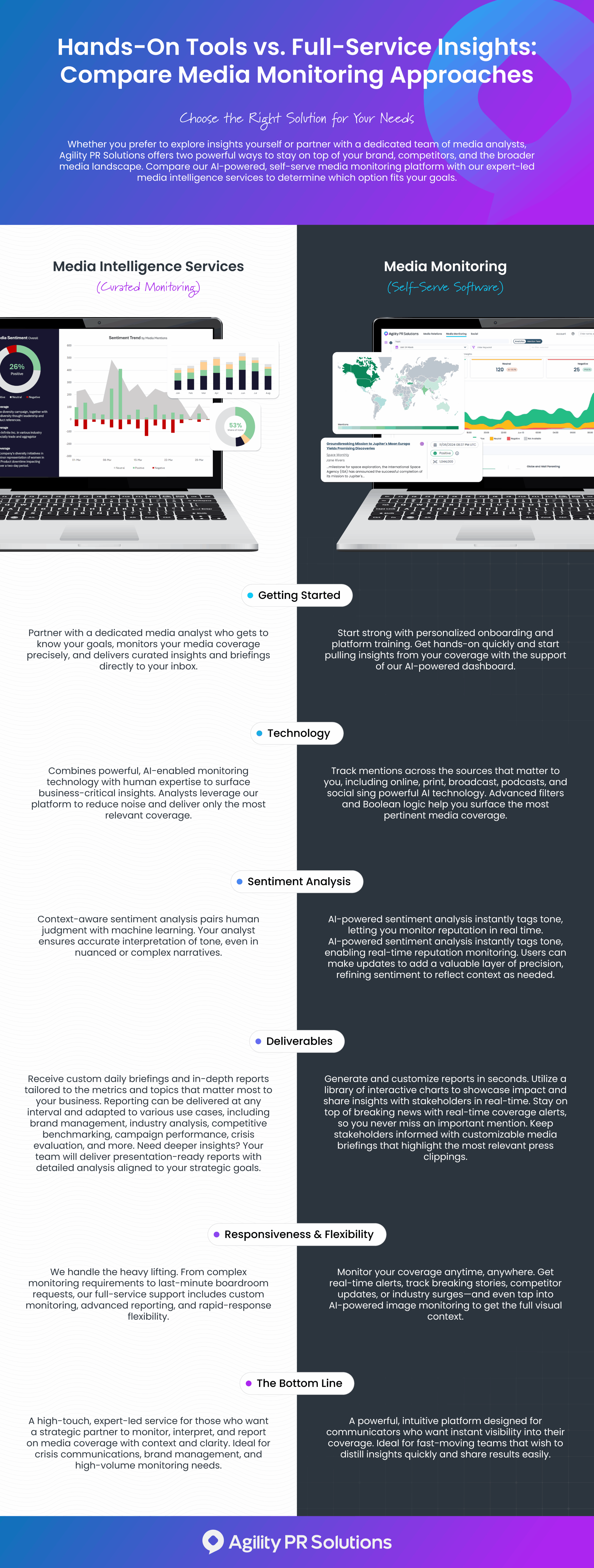
Comparing media monitoring providers
If you’ve been shopping around for a media monitoring tool or service, you’ve already heard of the two 800-pound gorillas in the industry. If you’ve been around for a while, you’ve probably spent your career hopping back and forth between the two—never being completely happy with either.
It’s no secret that there are some big players in the space, but before you decide on the right option, read reviews on sites like G2—and compare the leading vendors.
Everyone has different preferences regarding the businesses they work with and the services they receive, so take the time to find a service provider that aligns with your priorities.
At Agility PR Solutions, we believe in a few things
- Easy-to-use, intuitive tools. Ease of use makes the difference between a tool you’ll love and one that’s a chore. For a PR professional, this is a quality-of-life issue.
- Cutting-edge AI solutions. Agility is pioneering AI-powered features in the PR space, with our PR CoPilot suite of features offering advanced solutions for every stage in your media communication lifecycle.
- Quality support. If you need help, you want a vendor who is there for you. At Agility, we understand the importance of this. Our platform features a live chat, so we’re available to answer your questions and ensure our tools are functioning as intended.
- Sharing is caring. We make it simple to collect your coverage into virtual clipbooks that you can easily share with colleagues or clients who need to stay informed.
- Doing business together should be simple. We love our customers, which shows—because they love us too! Check reviews on sites like G2, where you can see user ratings on essential aspects such as ease of use, quality of support, and ease of setup.
- It’s not just the coverage that matters. We include sentiment analysis so you can easily determine whether a mention is positive or not.
- Images are important. We utilize AI-powered image search in our media monitoring tool, enabling you to go beyond text-only results and gain a deeper understanding of the context behind your coverage.
- Your story should be easy to tell. We include details that make it easy to tell your story, such as share of voice and coverage over time. Best of all, it’s dead simple to paste these charts and tables into shareable reports.
What comes next?
We may be bragging, but it’s only because we think you’re great and want to make a good impression.
Whether you’re just starting or looking to switch, the best media monitoring providers ensure you can jump right in without missing a beat.
At least that’s our commitment to you…
With superb onboarding packages, attentive account executives, reliable support, and the promise of a superior product and service, there’s nothing to worry about.
We’re proud of the way we serve our clients and hope you’ll consider doing business with us.
Turn Conversations Into Insights
Uncover trends and sentiment instantly with Agility’s
AI-driven monitoring tools.
Frequently Asked Questions
What is media monitoring, and why is it important?
Media monitoring is the practice of tracking, analyzing, and managing mentions of your brand, competitors, industry, or key topics across various media channels – including news, social, print, and broadcast. It’s essential for reputation management, understanding public sentiment, measuring campaign impact, and staying ahead of risks and opportunities.
What’s the difference between media monitoring and social listening?
Media monitoring captures mentions across traditional and digital media to inform PR strategy. Social listening, a subset of media monitoring, focuses specifically on tracking conversations, engagement, and sentiment across social media platforms. Together, they provide a comprehensive view of public perception.
What media channels should I monitor?
A comprehensive media monitoring strategy revolves around the following key channels:
- Online news for real-time media cycles
- Social media for audience sentiment and viral content
- Print for prestige placements and regional visibility
- Television broadcast for mass-market influence
- Radio broadcast for accessing remote demographics
- Podcasts for niche thought leadership
- Blogs and forums for community-driven conversation
Your preferred monitoring channels should align with where your target audience and stakeholders consume content.
How do I choose the right media monitoring tool?
Look for tools that offer:
- Multi-channel coverage (news, print, social, broadcast, etc.)
- Commitment to innovation – incorporates the latest measurement and monitoring trends
- Real-time alerts and sentiment analysis
- Custom reporting and dashboards
- Scalable pricing and reliable support
If needed, consider fully managed services with human-augmented analysis for high-stakes use cases.
What metrics should I track in a media monitoring report?
Key metrics include:
- Volume of mentions across channels and over time
- Sentiment breakdowns by media type, geography, and outlet
- Share of voice vs. competitors
- Top-performing coverage by reach or engagement
- Spokesperson mentions and key message pickup
Tailored metrics help align reports with internal goals and stakeholder needs.
How do I track competitors using media monitoring?
Use keyword tracking to monitor competitor names, spokespeople, products, and campaigns. This helps you benchmark share of voice, identify their earned media wins or missteps, and adapt your messaging accordingly. Monitoring competitors also reveals which journalists are covering your space.
Can media monitoring help measure PR ROI?
Yes. Media monitoring links your coverage to key metrics, including audience reach, engagement, and share of voice. By tracking campaign performance and media pickups over time, PR pros can demonstrate ROI and refine strategy based on what actually works.
Can media monitoring help during a PR crisis?
Absolutely. Real-time alerts (based on keywords, sentiment, surges in volume, etc.) allow you to catch emerging threats early. During a crisis, media monitoring helps:
- Track sentiment shifts and misinformation
- Monitor how your response is received
- Identify advocates or detractors
- Adjust messaging on the fly
It’s essential for controlling the narrative and rebuilding trust.
How does AI improve media monitoring?
Agility leverages AI to empower PR teams through:
- Enabling granular sentiment analysis by entity and audience detection
- Offering predictive insights through intelligent dashboards
- Identifying key takeaways and in-depth insights
- Suggesting relevant keywords to ensure comprehensive tracking
Agility’s PR CoPilot suite exemplifies these AI features in action.