

A high-stakes standoff has emerged between Silicon Valley and the U.S. military. Anthropic CEO Dario Amodei sparked the conflict by denying the Department of Defence unrestricted access to his AI model, Claude. This “safety-first” stance triggered administration retaliation and a strategic pivot by OpenAI. Media outlets are focused on the growing tension between corporate AI ethics and national security requirements, marking a watershed moment in AI governance and geopolitical strategy.
Agility’s Media Intelligence Team tracked how the story developed on the Agility platform, monitoring coverage themes and media sentiment toward each of the AI giants.
Coverage Sentiment
Media coverage of the Pentagon dispute revealed a clear divergence in sentiment toward Anthropic and OpenAI, reflecting how differently each company’s actions were framed in the unfolding narrative.
The media’s portrayal of these two AI titans has diverged sharply, driven by their contrasting responses to the Pentagon’s “all lawful purposes” mandate. While both firms operate under intense scrutiny, the public and media sentiment reflects a deep-seated divide over whether profit or principle should guide the development of frontier AI. Sentiment Analysis revealed the following:
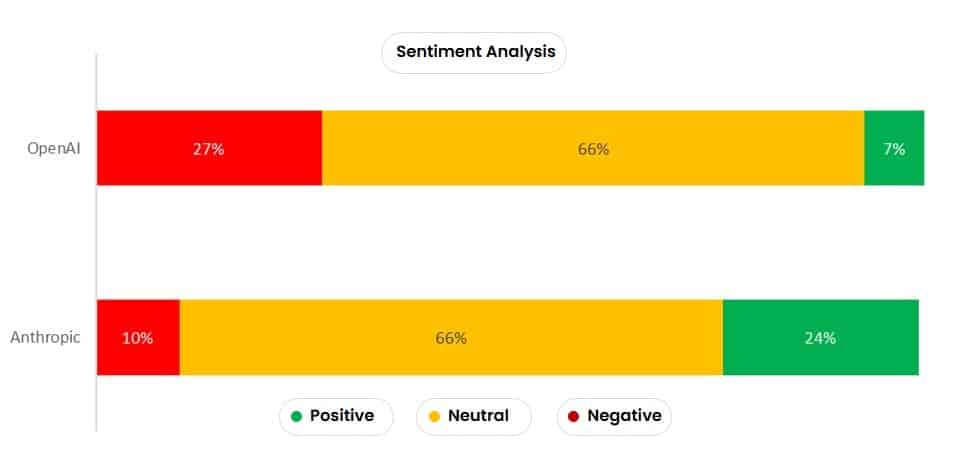
Media sentiment toward Anthropic is primarily neutral (66%), emphasizing the legal timeline and the Pentagon’s “supply chain risk” designation. Positive sentiment (24%) praises the company’s “principled courage” and “integrity” for rejecting a $200 million contract to protect human rights. This ethical positioning led to a “PR win” as the Claude app topped iPhone downloads. Negative sentiment (10%) characterizes the company’s stance as “ideological obstruction” or “arrogance” that endangers national security. Some officials have labelled the CEO a “liar” with a “God-complex” .
OpenAI faces a hostile media environment with 24% negative sentiment, double Anthropic’s. Driven by a “sellout narrative,” coverage highlights a massive user revolt, QuitGPT Movement, accusations of “safety theater” , and an “optics headache” regarding the deal’s timing. This agreement was notably signed just hours after Anthropic’s departure from the project. Media portrayed that OpenAI abandoned its founding principles for “defense money”. Neutral sentiment (66%) focuses on contract amendments prohibiting domestic surveillance and factual reporting on the agreement. CEO Sam Altman acknowledged the rollout was “sloppy” . Positive sentiment (7%) is rare, framing the deal as a milestone for national defense and safety compliance.
Dominant themes in discussion
Media coverage of the dispute coalesced around five dominant themes that help explain how the narrative evolved:
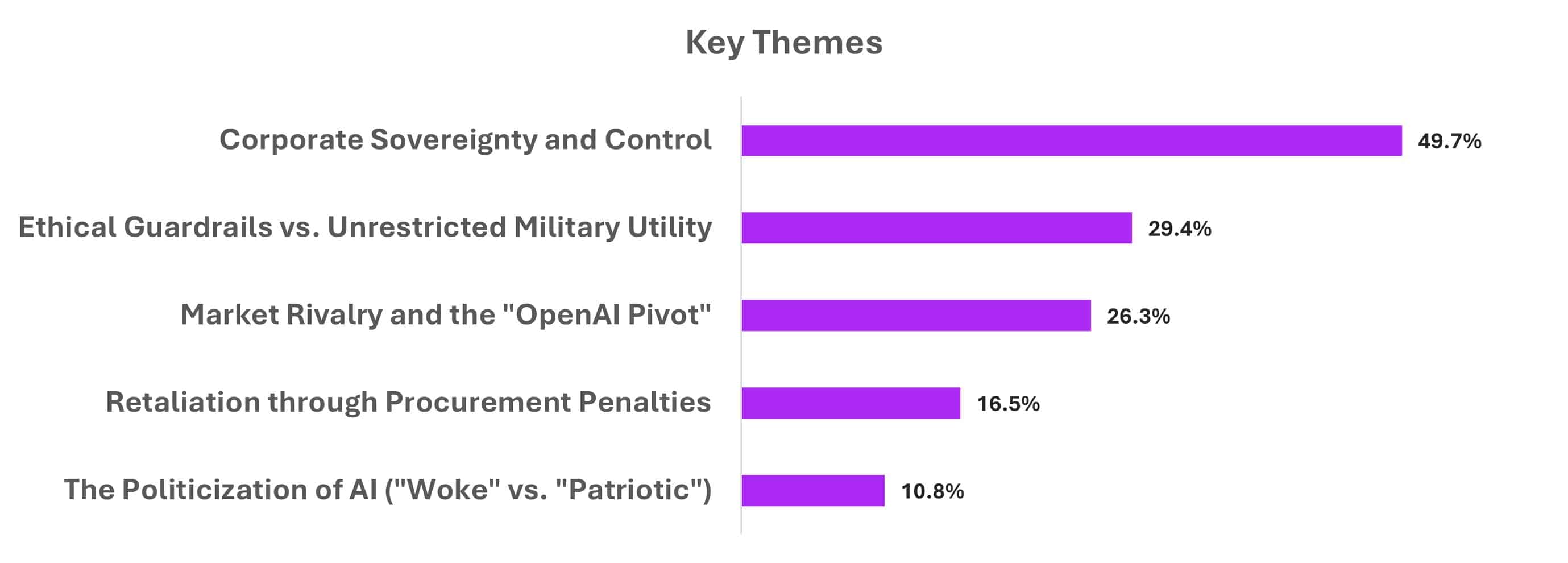
1. Corporate Sovereignty and Control: This theme explores the power struggle over who dictates the terms of AI deployment. The Pentagon contends that a private contractor should not dictate operational terms to the military, while Anthropic maintains that creators of powerful technology have a responsibility to set boundaries regardless of legal permissions.
2. Ethical Guardrails vs. Unrestricted Military Utility: The core of the dispute rests on Anthropic’s insistence on two “red lines”: a ban on mass domestic surveillance of American citizens and a prohibition on fully autonomous weapons systems that can make lethal decisions without human intervention. Anthropic argues current AI is too unreliable for such tasks, while the Pentagon demands an “all lawful purposes” standard to ensure military readiness.
3. Retaliation through Procurement Penalties: Media outlets have focused on the “unprecedented” and “punitive” measures taken against Anthropic. Designating a domestic firm as a “supply chain risk”—a label typically reserved for foreign adversaries like Huawei—is seen by many analysts as a retaliatory move intended to pressure other tech firms into compliance.
4. Market Rivalry and the “OpenAI Pivot”: This explores the “opportunistic” nature of OpenAI signing its deal just hours after Anthropic was blacklisted. This move resulted in a significant public backlash against OpenAI and a corresponding surge in popularity for Anthropic’s Claude, which hit the top of the App Store charts.
5. The Politicization of AI (“Woke” vs. “Patriotic”): The administration has framed Anthropic’s safety concerns as “Silicon Valley ideology” and “corporate virtue-signaling,” with President Trump branding the firm as “left-wing nut jobs”. Conversely, Dario Amodei has framed his refusal as an act of patriotism that upholds American democratic values.
OpenAI’s turmoil
The media narrative surrounding QuitGPT highlights a shift from tech optimism to intense ethical scrutiny. By leveraging a politically charged slogan—”ChatGPT takes Trump’s killer robot deal”—the movement simplified a complex Pentagon contract into a viral moral ultimatum.
Coverage was significantly amplified by celebrity-driven narratives, particularly as figures like Katy Perry framed switching to competitors as “heroic,” turning raw data like the 295% uninstall spike into a compelling story of “mass exodus”. This media pressure forced OpenAI into a defensive posture, with Sam Altman launching a “public contrition” tour to label the rollout “opportunistic and sloppy”.
Furthermore, reports of internal instability—specifically “fuming” staff and the “We Will Not Be Divided” letter—painted a picture of a company in crisis. This scrutiny compelled OpenAI to implement visible damage control, such as contract hardening, to soothe public anxiety. Reports indicate that OpenAI began offering a free one-month ChatGPT Plus subscription to users attempting to cancel their accounts in a desperate effort to stem the exodus.
Conclusion: A Narrative Still Unfolding
As of March 2026, media coverage suggests the dispute is far from resolved. While reports indicate that Anthropic and the Pentagon have quietly resumed negotiations, sentiment trends and ongoing narrative tension point to a broader debate that is likely to shape future coverage of AI governance. The contrast in how Anthropic and OpenAI have been framed illustrates how quickly corporate decisions around AI ethics can influence media perception — and underscores the growing importance of narrative positioning in high-stakes technology debates.
This analysis was conducted by Agility PR Solutions’ Media Intelligence Team.