
The Super Bowl as a Cultural Collision Zone
Every year, the Super Bowl presents itself as a singular moment of national attention. But in practice, it functions less like a shared experience and more like a collision point—where sports, politics, entertainment, commerce, and identity-driven narratives all compete for visibility at once.
For communicators, the Super Bowl is no longer just a broadcast event. It is one of the few remaining moments when millions of people are focused on the same cultural object at the same time—and social platforms become a real-time mirror of how fragmented that attention has become.
Leading up to the event and through it, Agility’s media analysis team analyzed hundreds of thousands of posts from X and Bluesky, and found the social chatter reveals a familiar but increasingly pronounced dynamic: the football itself is often secondary. The conversation is filled with overlapping debates about values, boycotts, brand risk, and cultural symbolism. The game becomes a container, not the content.
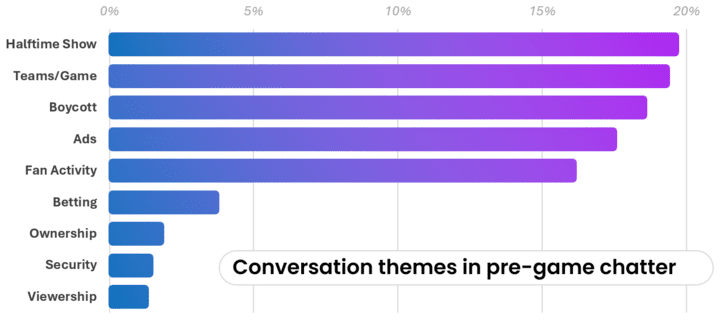
What Dominated Super Bowl Conversation Before Kickoff
This year, that fragmentation hardened into something more explicit—a visible left/right ideological split that didn’t just shape expectations, but ultimately turned halftime into the clearest expression of the divide.
Polarization as Structure, Not Reaction
The most revealing pattern in pre-game chatter was not overall volume, but durability. Political and cultural narratives—particularly boycott rhetoric tied to the Super Bowl halftime artist lineup—appeared consistently throughout the week, largely independent of any on-field developments. This wasn’t reactive outrage; it was a standing condition of the conversation.
Gameplay discussion, betting analysis, and team narratives remained present, but they rarely set the tone. Instead, they competed with a persistent layer of cynicism that shaped how every new development was received. For communicators, this distinction matters: entrenched narratives create context. Once established, they influence interpretation far more than any single message.
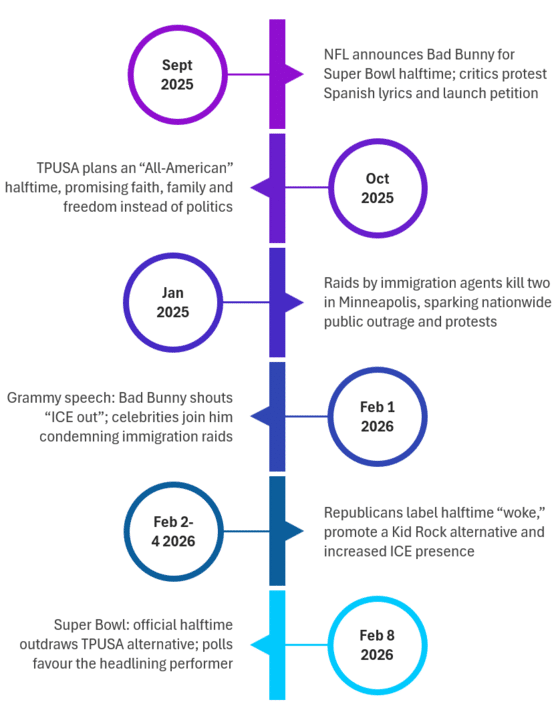
This timeline shows how political, cultural, and entertainment narratives accumulated over months—well before game day. By the time the Super Bowl began, the halftime show had already been framed as a symbolic confrontation rather than a standalone performance.
The Inflection Point: When the Halftime Show Became a Signal
About a week before the event, attention shifted sharply toward the halftime show, following political commentary linked to headliner Bad Bunny. Within hours, routine entertainment discussion gave way to ideological debate. Supporters framed the choice as culturally meaningful; critics treated it as evidence of broader grievances.
The significance of this moment lies less in the artist than in the mechanics. An external event, unrelated to the Super Bowl itself, redefined the dominant narrative almost overnight. For communications teams, this underscores a hard reality: narrative control rarely resides inside the event window. Meaning is often set elsewhere, earlier.
Parallel Programming and a Hardened Divide
As polarization around the halftime show intensified, it created space for counter-programming. Turning Point USA announced an alternative “All-American” halftime event, explicitly positioning it as a cultural counterweight.
Rather than diluting attention, this parallel event expanded the conversation. Social posts increasingly framed halftime not as a shared spectacle, but as a symbolic showdown between competing visions of national identity.
By this point, the fault lines were visible. Audiences were no longer waiting to see what would happen at halftime—they had already decided what it represented, and what it signaled about where they stood.
What the Pre-Game Data Signals
Three implications stand out. Persistent pre-event cynicism often foreshadows post-event backlash. Timing shapes outcomes as much as message quality. Cultural symbolism now carries risk that visibility alone once did not. Taken together, these signals explain why the halftime show didn’t spark division—it inherited one that was already fully formed, and made it visible in real time.
Setting the Stage for the Halftime Showdown
The halftime analysis that follows examines how this division expressed itself in real time—how attention split, which narratives traveled furthest, and what the imbalance between them reveals about how polarized audiences now experience shared cultural moments.
Halftime as a Test of Attention
By halftime, the political charge of the moment was already established. The more revealing question was how audiences allocated attention once parallel programming moved from anticipation to action. Social conversation shows that the two halftime events did not compete on equal footing, but served different functions within the same moment.
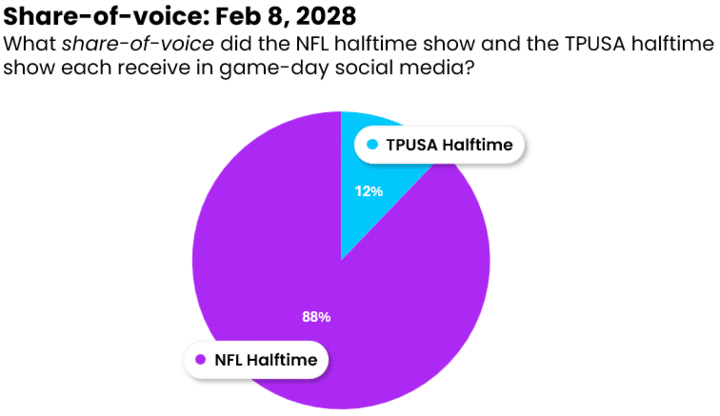
On game day, the NFL halftime show dominated social media share of voice, reflecting its global reach, long-standing cultural significance, and built-in audience driving real-time conversation at scale.
By contrast, Turning Point USA’s All-American Halftime Show functioned as a digitally native counter-program. Streamed primarily on platforms such as YouTube, its reach was narrower and more ideologically concentrated, limiting its share of overall game-day chatter despite sustained engagement within its core audience.
Together, the data underscores a key distinction: large-scale cultural moments drive ambient awareness, while niche counter-programming excels at mobilizing identity-based communities.
Key Themes from the NFL Halftime Show:
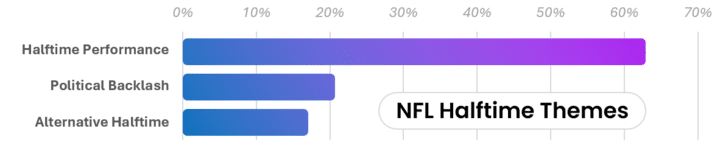
Among posts referencing the NFL halftime show, conversation divided between performance reaction, political backlash, and references to an alternative event.
Among posts referencing the NFL halftime show, conversation clustered primarily around reaction to the performance itself—commentary on the music, staging, guest appearances, and cultural significance of the moment. Political backlash was present, but it functioned as a secondary layer rather than the dominant frame.
This pattern reflects a broad audience responding to a shared cultural spectacle. Even amid controversy, the NFL halftime show remained a mass event first, and a political signal second.
Key Themes from the All-American Halftime Show:
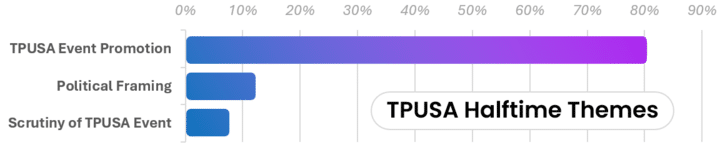
Among posts referencing the TPUSA “All-American” halftime event, most focused on promoting the broadcast, with smaller shares emphasizing political framing or scrutiny of the event.
Posts referencing the TPUSA “All-American” halftime event served a different role. Most focused on promoting the alternative broadcast itself, urging audiences to switch away from the NFL performance and framing participation as an expression of political identity.
Here, conversation was less about reacting to a performance and more about mobilization—directing attention, signaling alignment, and reinforcing in-group identity. Political framing was explicit, and scrutiny of the event and its performers remained a smaller but visible strand.
Conclusion: The Super Bowl as a Digital Campfire — and a Cultural Mirror
The Super Bowl remains one of the last true digital campfires. What this year’s halftime moment made clear is that gathering around the same event no longer guarantees a shared interpretation of it. It also showed that polarization today is expressed less through mass defection than through parallel participation—where attention and identity move on different tracks.
Millions still gather around the same event, at the same time. But what they bring with them—their assumptions, identities, and grievances—shapes what that moment becomes.
For communications leaders, success around moments like this depends less on clever messaging and more on narrative awareness.
Understanding how attention fragments before kickoff is what allows teams to anticipate risk, recognize inflection points, and decide—strategically—when to speak, and when silence may be the most effective move of all.
This analysis was conducted by Agility PR Solutions’ media intelligence team.