

Last week’s Lindsey Vonn storyline at Milan-Cortina offered a clean case study in something communicators often feel but rarely measure: when an athlete-centered hero narrative breaks, coverage briefly expands into institutional accountability—then contracts back toward equilibrium fast.
Leading up to the downhill and in the days after, Agility’s media analysis team tracked the Vonn story across coverage volume, institutional co-mentions, autonomy framing, and entity sentiment.
In Olympics + Lindsey Vonn coverage (Feb 2–15), four signals moved together: a sharp volume spike on Feb 8, a surge in institutional co-mentions (IOC, FIS, U.S. bodies, course organizers), a parallel spike in autonomy language (“her decision,” “up to the athlete”), and a rapid return toward baseline levels by Feb 10–11. All trend lines referenced below are calculated within this Olympics + Lindsey Vonn coverage set (not overall Olympic coverage).
Importantly, sentiment did not collapse into sustained negativity for any actor—scrutiny appeared, then cooled. This post walks through what we measured and what it suggests about narrative mechanics during live, high-attention events.
Finding 1: The story didn’t just spike—it widened
A crash is always news. What’s analytically useful is how far the story’s footprint expanded beyond the athlete.
Before Feb 8, institutional actors were largely backgrounded inside the Vonn narrative. On Feb 8, co-mentions of multiple institutions surged within Vonn coverage—meaning the story temporarily stopped being “about an athlete” and became “about the system around the athlete.”
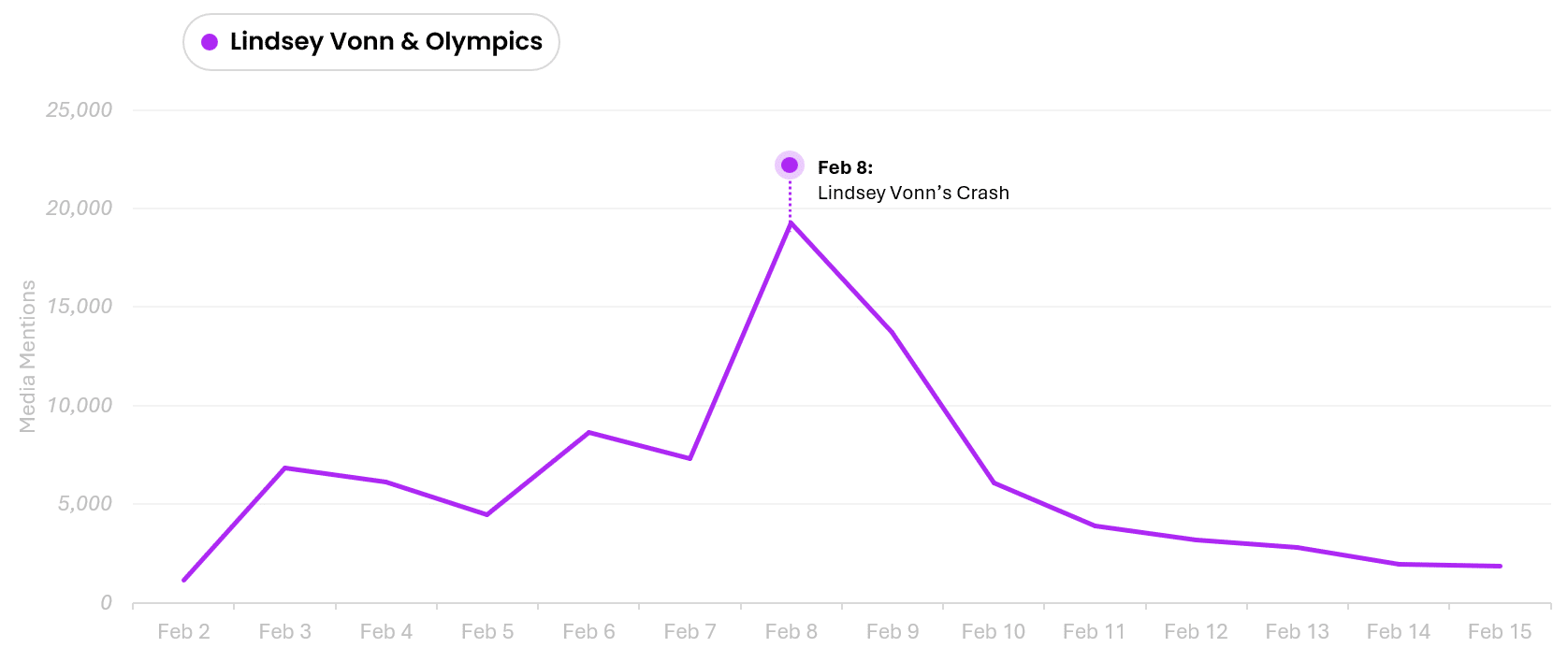
Vonn coverage spikes on Feb 8, stays elevated through Feb 9, and decays sharply by Feb 10–11.
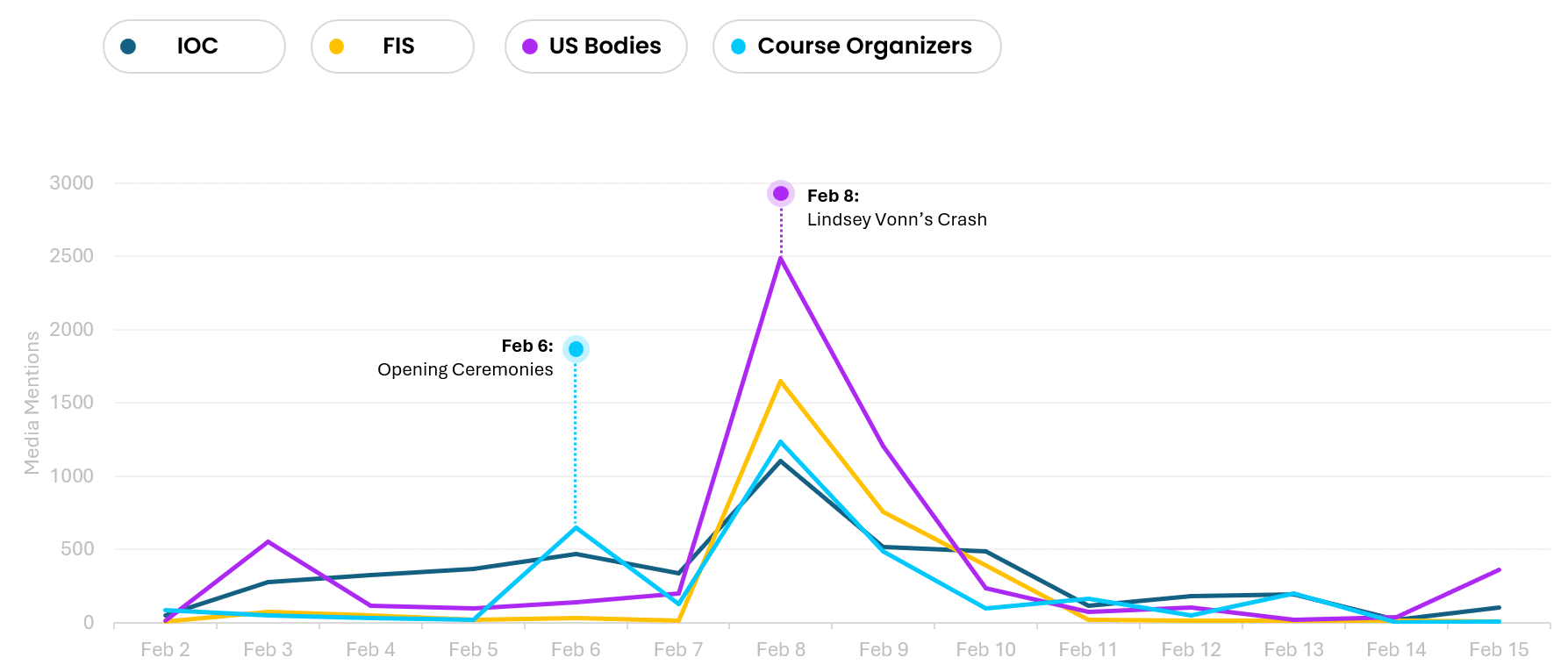
Institutional visibility enters the Vonn narrative at peak intensity on Feb 8 and tapers quickly over the next 48–72 hours.
A subtle but important detail: within Vonn-related coverage, U.S. governing bodies show the sharpest spike on Feb 8, followed by international governance (FIS/IOC) and course-level factors. The curve reads less like indiscriminate blame and more like a rapid search for the nearest decision point—starting with medical clearance and athlete support, then widening outward.
Finding 2: Autonomy language rises with institutional scrutiny
The most distinctive signal wasn’t just that institutions were named—it was how the narrative tried to stabilize.
When institutions entered the story, autonomy framing rose in tandem: language emphasizing that competing was “her decision,” “up to the athlete,” or “decided by the individual.” That rhetoric is familiar, but the timing matters: in this dataset it functions as a stabilizing counter-frame once accountability widens beyond the athlete.
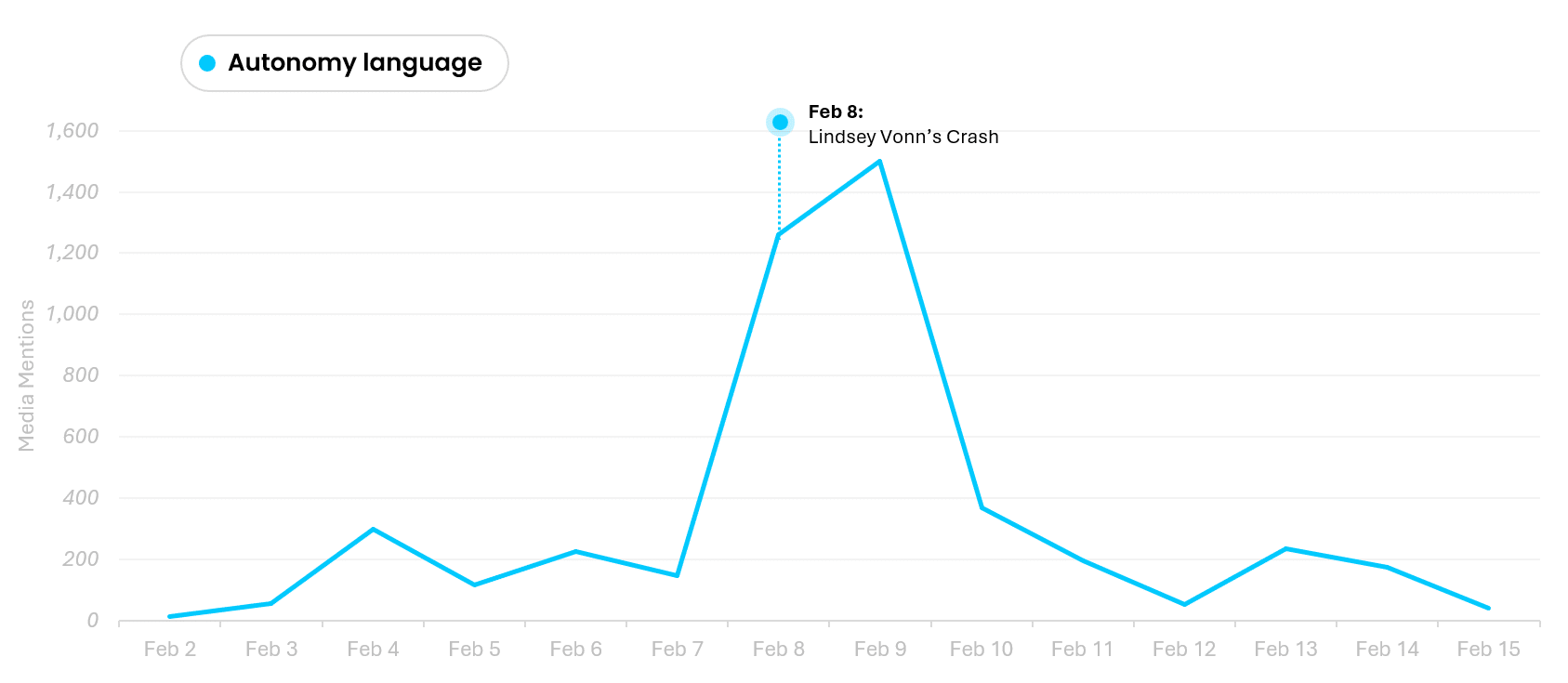
Autonomy framing surged immediately after Vonn’s crash, peaked the next day, and fell sharply by Feb 10—suggesting a short-lived stabilizing counter-frame during the accountability window.
This is where the resilience frame re-enters the picture in a smarter way. Resilience stories work because they centralize agency in the athlete. When the story fractures, institutions become visible—and autonomy language is one of the fastest ways to pull agency back toward the individual and away from systems.
Autonomy framing behaves like a response mechanism, not a baseline narrative. In the days before the crash, autonomy language is present but relatively low. Once the incident occurs (Feb 8), autonomy cues surge and peak on Feb 9, exactly when institutional actors are most visible in Vonn-related coverage. By Feb 10, autonomy language falls sharply, indicating a short half-life: the narrative re-centers agency on the athlete quickly, then moves on once scrutiny begins to cool.
Finding 3: Scrutiny didn’t translate into widespread reputational damage
If this were a true reputational spiral, we’d see sustained negative sentiment clustering around institutions. Instead, sentiment stayed predominantly neutral across institutions and remained strongly positive/neutral for Vonn.
Within relevant mentions:
- Vonn: ~58% positive, ~38% neutral, ~4% negative
- IOC: ~36% positive, ~62% neutral, ~3% negative
- FIS: ~28% positive, ~70% neutral, ~2% negative
- U.S. bodies: ~42% positive, ~57% neutral, ~1% negative
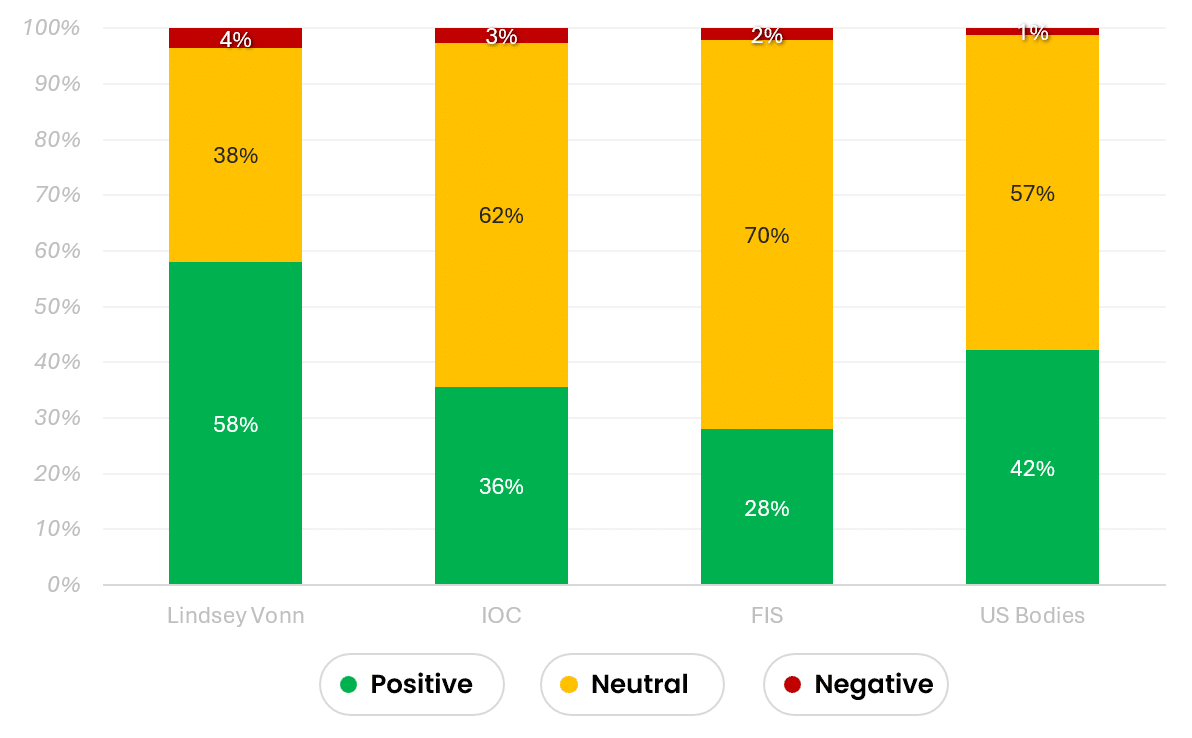
Institutional scrutiny rises, but sentiment remains largely neutral—suggesting visibility without sustained condemnation.
This is the nuance that turns the case study into media intelligence: accountability can expand without becoming a long-running blame cycle.
What this suggests: Narrative elasticity + the half-life of scrutiny
Put the signals together and a coherent mechanism emerges:
- A stable resilience frame dominates pre-incident coverage (athlete agency, defiance, legacy language).
- A shock event triggers attention, and the story’s footprint expands to include systems (medical clearance, safety protocols, governance, course design).
- Autonomy language rises alongside institutions—an immediate stabilizer that re-individualizes risk and decision-making.
- Scrutiny decays quickly (roughly a 48–72 hour window), with sentiment remaining mostly neutral.
That’s narrative elasticity: the story stretches to absorb institutional accountability, then contracts back toward an athlete-centered equilibrium. And it has a measurable half-life.
Why communicators should care
This isn’t “if it bleeds, it leads.” It’s a more operational insight: during high-attention moments, the narrative boundary of responsibility can expand quickly—then shrink just as quickly.
Three practical implications:
- Plan for an accountability expansion window.
The moment an athlete story becomes a systems story, institutional actors will be pulled into the frame whether they want to be or not. Monitoring institutional co-mentions inside athlete-centric coverage is an early warning signal that the narrative has widened. - Autonomy framing stabilizes—but can read like deflection if overplayed.
Your data suggests autonomy language functions as a fast counter-frame during scrutiny. Use it carefully and pair it with procedural clarity (what was done, by whom, when) so it doesn’t feel like responsibility is being shrugged off. - Track contraction to avoid over-reacting.
When scrutiny has a short half-life, the worst move is to keep escalating messaging after attention has moved on. A simple measurement of “peak → half-peak” decline helps teams calibrate response intensity.
Closing
The Vonn case is valuable precisely because it’s bounded and measurable. It shows how Olympic coverage can briefly reassign responsibility from individual heroism to institutional scrutiny—and how quickly that scrutiny can dissipate without broad reputational fallout.
For comms teams, the win isn’t predicting the next shock. It’s having instrumentation in place to recognize when a story stretches, what language stabilizes it, and when it’s contracting again.
This analysis was conducted by Agility PR Solutions’ media intelligence team.