

A sustainability target means one thing on a spreadsheet. That changes when you can see how it changes operations, hiring decisions, supply chain behavior, or customer experience in practice.
Most ESG reports fail for the same reason: they read like obligations instead of evidence.
Long PDFs with generic promises. A wall of metrics with no explanation of what actually changed, what was difficult, or why anyone outside the company should care.
That is where storytelling matters.
Stories help people understand data.
The companies doing this well are not inventing emotional narratives. They are making complicated work easier to follow.
Research from Harvard Business Review has consistently shown that narratives improve attention, comprehension, and memory retention compared with isolated data points.
For PR teams, ESG communication is no longer a side project attached to the annual report cycle. It is becoming part of how companies explain strategy itself.
Understanding the Components of ESG
A lot of ESG communication breaks down because companies try to talk about everything at once.
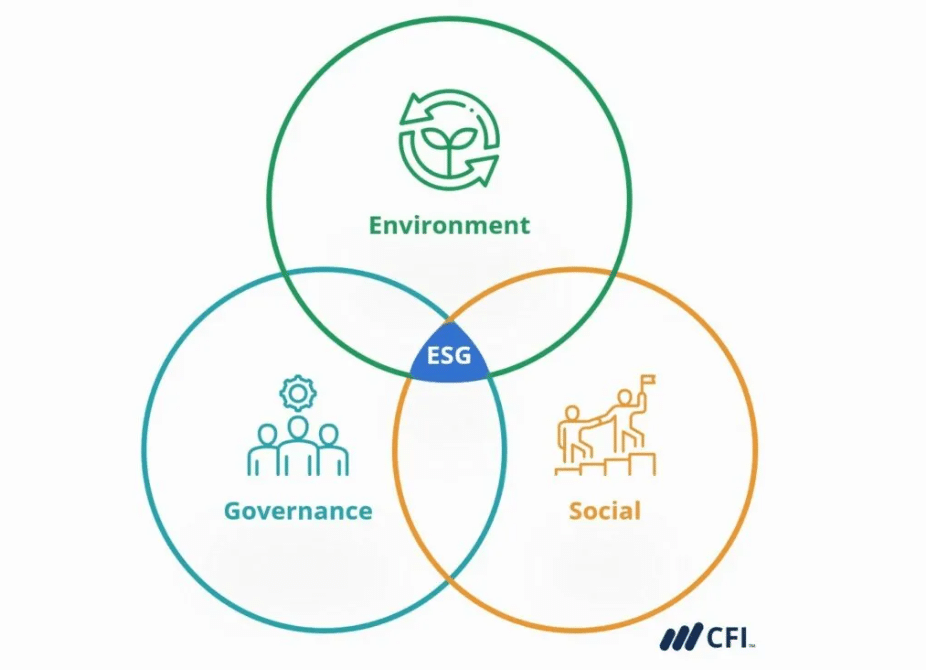
That usually makes the reporting broader, but weaker.
The better approach is to understand which parts actually matter to your business operations and stakeholders, then communicate those clearly instead of trying to cover everything.
Environmental
Most companies now track greenhouse gas emissions across Scope 1, 2, and 3 using the GHG Protocol, with many setting reduction targets through initiatives like Science Based Targets.
But operational reality matters more than terminology.
A manufacturer reducing energy usage inside facilities is different from a software company addressing cloud infrastructure emissions.
A logistics company talking about fleet electrification faces different scrutiny than a consumer brand discussing packaging waste.
Specificity matters here.
Very few stakeholders trust broad sustainability language anymore.
Social
This tends to be where companies become vague, even though it is often the section that employees and customers care about most.
Social covers;
- Worker safety
- Wages
- DEI initiatives
- Training
- Labor standards
- Supplier practices
- Product safety
- Community impact
Metrics can include turnover, pay equity gaps, audit outcomes, injury rates, or community investment tied to frameworks like the UN Sustainable Development Goals.
But the strongest communication usually comes from operational examples that people can actually picture.
- What changed internally?
- What improved for employees?
- What problems still exist?
Governance
Governance rarely gets public attention until something goes wrong.
Then it becomes the entire story.
Governance includes:
- Board structure
- Executive accountability
- Ethics policies
- Anti-corruption measures
- Risk management
- Cybersecurity oversight
- ESG-linked compensation structures
- Data privacy
This influences whether credibility strengthens or collapses. If governance looks weak, stakeholders start questioning everything else, too.
You do not need to explain every ESG category in every message. Most companies shouldn’t.
The goal is to make ESG feel integrated into how the business actually operates instead of sounding like a separate corporate language layered on top of it.
The Role of Storytelling in ESG Communication
Data proves activity. Stories explain significance.
Stakeholders want to understand whether the work is credible and likely to continue when market conditions get harder.
Numbers matter, but people still need help understanding what those numbers actually mean.
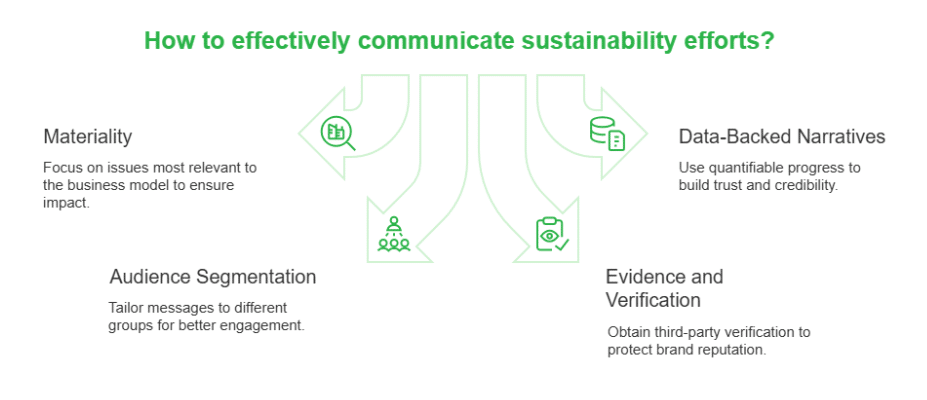
A clean water initiative is a good example. You can report treatment volumes, cost-per-household figures, infrastructure investments, and distribution metrics.
All of that matters. But what does that change? Who does it help? That’s what the story helps explain.
Strong ESG storytelling explains operational reality clearly.
Patagonia’s Worn Wear initiative works because the company shows circularity through actual repair and product longevity stories instead of generic sustainability messaging.
Microsoft’s carbon-negative commitment gained credibility because the company paired ambitious targets with public dashboards, progress reporting, and visible accountability.
Both examples work for the same reason: people can verify the behavior behind the messaging.
Crafting Your ESG Narrative
This is usually where companies overcomplicate things.
You need operational clarity first. The companies that handle this well tend to communicate in a very direct way
Start with the operational reality
Before writing anything externally, figure out what is materially true inside the business.
- What environmental changes are actually happening?
- What social initiatives are measurable instead of aspirational?
- What governance practices genuinely changed accountability?
A surprising amount of ESG communication falls apart because the messaging gets developed before the operations are mature enough to support it.
Build the evidence first
The narrative should come after the evidence.
Use recognized standards like GRI or SASB where relevant so the language matches broader reporting expectations. Support claims with measurable outcomes, timelines, and reporting structures that stakeholders can follow over time.
Specificity is what creates trust here.
“We are committed to sustainability,” says nothing.
“We are targeting a 30% reduction in Scope 1 and 2 emissions by 2028 through facility upgrades and logistics optimization,” tells people something concrete.
Add the human layer carefully
The best examples usually stay close to operational reality. Employees discussing actual workflow changes. Suppliers explaining implementation challenges. Community partners describing specific outcomes.
People can usually tell when the human story was added afterward just to soften the report.
Be honest about friction
Stakeholders already assume ESG work is complicated. Supply chains are messy. Emissions reductions take time. Internal adoption is uneven. Regulations shift. Data quality improves gradually.
Trying to frame ESG work as a clean success story usually hurts credibility.
People trust companies more when they acknowledge trade-offs, delays, and operational friction.
Using Digital Platforms for ESG Storytelling
Stakeholders now expect ESG information to feel current and easy to verify, like searchable data, live updates, interactive reporting, and visible progress.
A once-a-year PDF usually does not hold attention for long anymore.
Social platforms
Short-form updates work well when they show visible progress instead of polished messaging.
Those tend to perform better than broad sustainability campaigns because they feel closer to reality:
- Employee perspectives
- Behind-the-scenes operational changes
- Supplier conversations
- Facility improvements
- Product redesigns
Platform behavior matters too.
LinkedIn works better for industry analysis, reporting updates, and executive commentary. Instagram and TikTok tend to work better for visual operational changes and employee-led content.
Accessibility matters here as well. Captions, alt text, and clear formatting are not optional anymore.
Company websites
The strongest ESG sections usually function more like active resource hubs than archived reports. Some examples are:
- Interactive timelines
- Downloadable disclosures
- Live dashboards
- Methodology explanations
- Reporting updates
- Supplier standards
- Governance structures
People increasingly want to explore the information themselves instead of relying entirely on summarized claims.
If companies are preparing for CSRD requirements, digital tagging and structured reporting infrastructure become even more important.
Long-form formats
Podcasts, webinars, and discussion panels work particularly well when the subject matter is genuinely complicated.
That includes supply chain transitions, emissions reporting, labor standards, regulatory adaptation, or operational trade-offs where nuance matters.
Bringing in external experts, suppliers, or partners usually improves credibility too. It signals the company is willing to discuss complexity publicly instead of controlling every angle internally.
Ongoing communication
One of the biggest mistakes companies make is treating ESG communication as annual-report season.
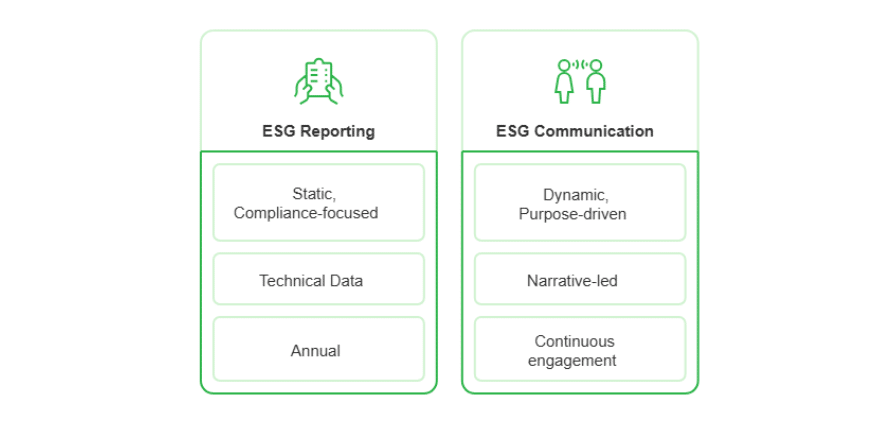
That creates long periods of silence followed by huge bursts of messaging that feel disconnected from day-to-day operations.
Jason Ledbetter, Operator at Jason Ledbetter, works closely with companies refining operational messaging, audience trust, and long-term brand positioning.
He says, “A lot of ESG communication loses momentum because companies treat it like a yearly publishing exercise instead of an operational update cycle. Stakeholders can tell when the messaging only appears around reporting season.
The companies that build trust usually communicate smaller operational changes consistently over time, even when the progress is incremental or messy. That pattern feels much more believable than a polished annual narrative that suddenly disappears for another twelve months.”
Consistency builds familiarity, and familiarity builds trust faster than occasional large campaigns do.
How to Engage Different Audiences Through ESG Stories
Investors, employees, customers, regulators, and community groups do not care about ESG for the same reasons.
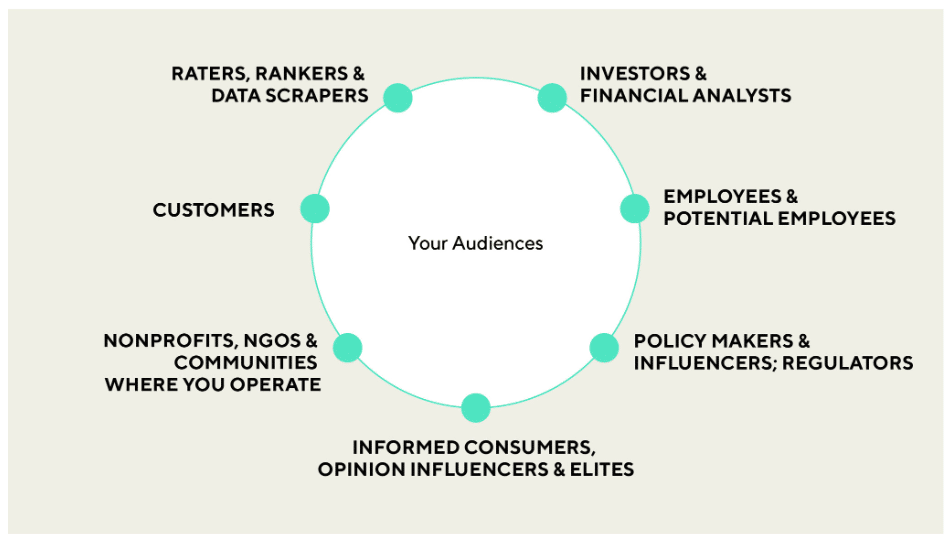
When companies push the same message to everyone, the communication usually gets weaker.
Keep the facts consistent. Change the emphasis.
Investors
Investors are increasingly evaluating ESG through operational risk and long-term financial resilience.
Climate exposure, labor instability, governance failures, supply chain vulnerability, and regulatory preparedness. Those issues affect valuation directly.
This group expects structured disclosure, scenario analysis, financial materiality, and reporting that maps to frameworks like IFRS S1/S2.
Gregor Emmian, Deputy Chief Digital Growth Officer at Rise, works in financial growth and investor acquisition, where credibility breaks down quickly if reporting feels selective or disconnected from operational performance.
He says, “If a company talks heavily about sustainability but avoids discussing governance weaknesses, supply chain exposure, or operational trade-offs, sophisticated investors notice that immediately.
The strongest ESG communication usually connects directly to business durability, risk visibility, and long-term execution instead of trying to sound aspirational.”
Broad values-based language tends to matter less here unless it connects clearly to risk management or competitive positioning.
Customers
They care about product impact and whether the company’s public values match observable behavior.
Specific sourcing claims, repair programs, product lifecycle improvements, labor transparency, and packaging reductions. Those are easier to trust than generalized sustainability leadership messaging.
This is also where regulatory scrutiny around environmental marketing claims is increasing rapidly.
Employees
Employees usually evaluate ESG through culture and internal consistency.
Employees also tend to become informal validators of ESG credibility. If internal reality conflicts sharply with external claims, that disconnect spreads quickly.
Organizations also reinforce long-term culture and recognition through tangible commemorative programs for employees, veterans, and service communities, including customized recognition displays and military award frames.
Communities and partners
This audience usually cares less about branding and more about operational impact.
The strongest ESG communication systems increasingly include ongoing feedback mechanisms: advisory councils, community forums, employee AMAs, supplier engagement processes, and internal discussion channels.
A static narrative is harder to sustain now because stakeholders expect participation, not just publication.
How to Measure the Impact of Your ESG Communications
Companies measure visibility because visibility is easy to count.
Actual influence is harder.
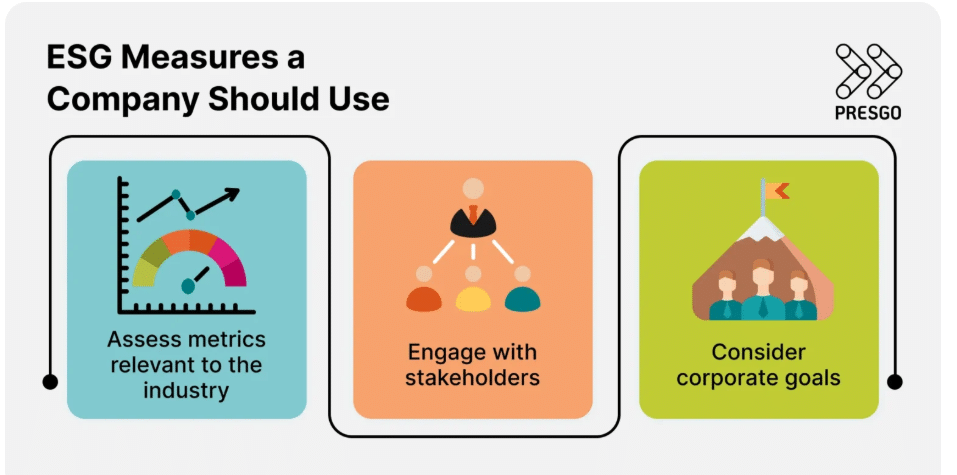
Impressions, reach, and clicks matter, but they rarely tell you whether ESG communication changed perception, trust, or behavior in a meaningful way.
Measure quality, not just reach
Coverage volume alone is not particularly useful if the messaging gets distorted or ignored.
A better question:
- Are key ESG themes appearing accurately in the coverage?
- Are stakeholders repeating the right messages back to you?
- Are competitors dominating the conversation on topics where your company should have authority?
Share of voice matters more when paired with message accuracy.
Look at engagement depth
This usually reveals more than top-line traffic numbers:
- Time spent on ESG content
- Return visits to sustainability pages
- Video completion rates
- Report downloads
- Newsletter retention
- Repeat engagement from investors or analysts
Those signals tell you whether people are actually consuming the information or simply passing by it.
Watch behavioral shifts
This is where ESG communication becomes operationally valuable.
- Are investors becoming more informed?
- Are customers referencing sustainability initiatives during procurement?
- Are job candidates mentioning ESG work during interviews?
- Are suppliers responding differently?
Those signals are slower to measure, but they matter far more than vanity engagement metrics.
Verification matters
Third-party validation increasingly affects ESG credibility.
External assurance, CDP ratings, framework alignment, independent verification, and fact-check resilience. Stakeholders want evidence that reporting systems can withstand scrutiny.
That expectation is only getting stronger as disclosure standards tighten globally.
Challenges and Considerations in ESG Storytelling
Stakeholders lose trust quickly when companies exaggerate ESG claims or disconnect them from operational reality.
That is why greenwashing damages reputations long-term.
Some companies now avoid ESG communication altogether to avoid scrutiny. But silence creates uncertainty too.
Back every claim with evidence
Companies need evidence behind environmental claims, emissions targets, labor standards, supplier commitments, and diversity metrics.
Everything needs supporting documentation, methodology transparency, and defensible reporting structures.
Regulators are tightening standards quickly. The EU’s proposed Green Claims Directive, the UK’s Green Claims Code, and SEC climate disclosure developments in the United States all point in the same direction: unsupported ESG language is becoming riskier.
Avoid vague positioning
This is still surprisingly common.
Words like sustainable, ethical, responsible, or purpose-driven mean very little without operational detail attached to them.
Stakeholders increasingly expect measurable pathways, timelines, frameworks, and evidence.
Generalized positioning alone does not hold up anymore.
Prepare for difficult questions
Good ESG communication systems assume scrutiny will happen.
The companies that handle these conversations best usually prepare for them internally before publishing anything externally.
The Future of ESG Storytelling in Public Relations
Three things are changing ESG communication quickly.
First, ESG reporting is moving closer to financial reporting. IFRS S1/S2 adoption and CSRD’s double materiality requirements are pushing sustainability discussions into broader business strategy conversations.
This is no longer a separate brand values section.
Second, reporting cycles are speeding up.
Annual ESG reports now feel slow, especially for larger companies. Stakeholders expect quarterly updates, live dashboards, operational tracking, and clearer visibility into progress throughout the year.
Third, companies no longer control the ESG narrative on their own.
Employees, suppliers, customers, and community groups shape perception publicly now. That shifts the pressure away from polished messaging and toward operational consistency.
Technology will accelerate all of this.
AI-assisted content, interactive reporting, embedded verification, virtual walkthroughs, live dashboards. Easier to produce. Easier for stakeholders to expect too.
The companies that handle ESG communication well will not necessarily say more.
They will make their claims easier to verify.
Getting Started with ESG Storytelling
Start with an audit.
Look at what you’re already claiming publicly, then compare those claims against actual evidence, operational visibility, reporting maturity, and internal alignment.
That exercise usually exposes the biggest gaps quickly.
Then narrow the focus.
Strong ESG communication depends on clarity, consistency, and credibility over time.
If your company needs help turning complex operational work into messaging that stakeholders can actually understand and trust, Agility PR Solutions provides tools for media monitoring, PR reporting, and communication visibility across fast-moving conversations.