
Most marketing disciplines are pretty straightforward. You spend money, you reach people, you measure the return. PR is different. It’s what people say about you when you are not in the room.
That is the core of earned media. You can spend lots on ads and still be ignored. But one honest mention in the right place? That can do more business than your entire marketing budget.
Earned media coverage has always been powerful, but in 2026, it matters more than ever, and for reasons that did not exist even a couple of years ago.
What Is Earned Media Strategy (And Why It Still Matters)?
Earned media is any exposure your brand gets organically from third parties. This can be media coverage, a social media mention, or a public conversation about your product, service or brand.
The part that matters here: earned media is NOT paid PR. Yes, you don’t hire an agency or pay for any ads to get published or recognized.
Here are a few examples to make it click:
- A customer leaves a glowing review because they had a great experience.
- A Reddit thread starts talking about your Bamboo T shirts Mens clothing brand, because of your sustainability practices.
- A LinkedIn post from a happy ex-employee on your company’s work culture that gets shared by industry voices and picked up by trade press.
- A creative campaign gets covered by marketing outlets after it takes off organically
- An influencer mentions your product in an unsponsored video because they actually like your stuff.
This is all earned media. And there is a reason it still carries more weight than paid ads or branded content. As it all comes down to one word: trust.
Times have changed because people today can easily sniff out brand messaging dressed up as genuine content. So, when someone with no financial incentive talks about your brand positively, that credibility transfers to you. It is that simple.
Earned media vs. paid media vs. owned media
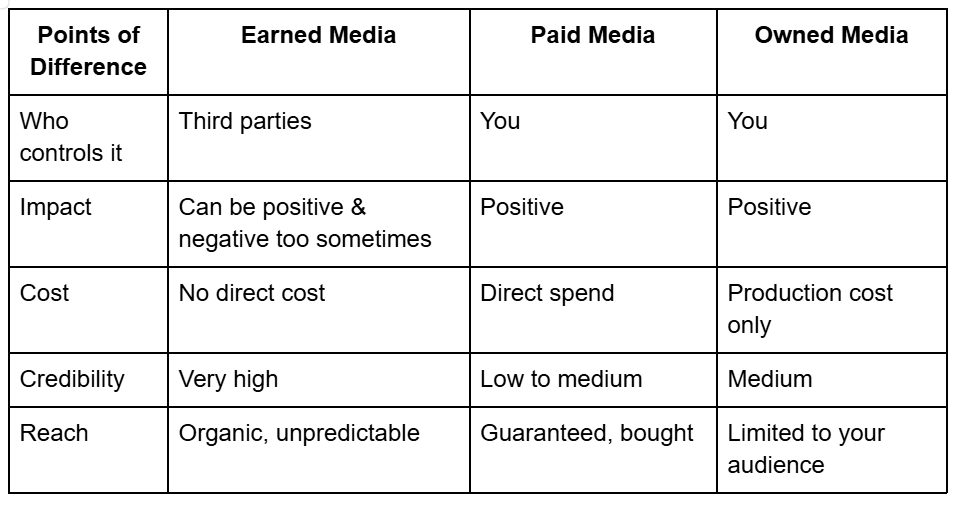
These three sit at the core of every modern PR and marketing plan. Now, To make smart decisions about where to put your energy, you need to understand how the three main media types differ and how they work together.
Earned media is what we just covered. It is completely organic and is not manipulated or paid. Earned media can be positive and negative.
Paid media is anything you pay to place. Display ads, sponsored social posts, promoted articles, Google Ads. You control the message, the placement, and the timing. It delivers reach fast, but audiences know it is an ad, which means the trust factor is lower.
Owned media is the content you create and control yourself. Your website, your blog, your email newsletters, your social media profiles. The reach you get depends on your strategy and execution.
Here is a quick overview of owned vs. paid vs earned media:
In simple words,
- Paid media buys attention,
- Owned media hosts your content,
- Earned media builds trust.
Evolution of PR and Earned Media in 2026
Five years ago, a press release and a few journalist relationships could carry a decent PR strategy. Today, that is barely a starting point.
It’s 2026, and PR media has come a long way. The news cycle has collapsed. Stories that might have taken one or two days to travel now spread in a few minutes. But now, the channels where earned media lives have expanded.
It is no longer just word-of-mouth, newspapers, and magazines. A viral TikTok review, a Reddit thread that picks up steam, a LinkedIn post from an industry leader citing your research, these all count. So, PR teams can’t afford to be only proactive anymore. They have to:
- React within minutes to breaking news, crises, or trends
- Turn every expert quote into AI‑friendly content that search and assistants can pick up
- Think beyond press releases and build stories that can live across podcasts, newsletters, LinkedIn, and Reddit
Back then, earned media used to mean “getting a byline.” Infact, all such wins from earned coverage were added to a slide deck at the end of the quarter. But the evolution is fast and real now. Earned media is a data‑driven reputation engine tightly wired into AI search, brand visibility, and social ecosystems.
Top Strategies For Effective Earned Media Coverage
If you want to utilize the power of earned media to build your brand reputation, below are some strategies:
Build Real Relationships With Journalists
This is the oldest advice in PR and it is still the most important. Reporters are getting hundreds of pitches a week. The ones that get opened are from people they recognize, people who have sent them useful stuff before, people who understand their beat and respect their time.
Building these relationships is slow work. It means reading what journalists write before you pitch them. It means offering expert commentary on a story they are working on, even if it does not mention your brand. It means being a reliable source, not just someone who shows up when they need coverage. The PR teams that consistently land earned media are the ones journalists actually want to hear from. That does not happen overnight, but it compounds over time.
Tell Stories That Actually Resonate
Journalists do not care about your product features. They care about stories their readers will find interesting, useful, or surprising. If your pitch reads like a press release with a subject line, it is going in the trash.
The brands that earn consistent coverage are the ones that frame what they do in terms of impact, not features. Not “we launched a new tool.” But “this tool is solving a problem that costs small businesses thousands of dollars a year.” Data helps. Real customer stories help more. A clear angle that connects to a trend or a broader conversation helps most.
Write the way you would explain your story to a smart friend at dinner, not the way you would write a corporate brochure. Clean, jargon-free, specific. If a journalist cannot understand your pitch in the first two sentences, they will not read the third.
Use SEO and PR as One Strategy
For a long time, SEO and PR operated in separate silos. PR got the coverage. SEO optimized the website. But in 2026, the lines have blurred to the point where separating them does not make sense.
Earned media coverage generates backlinks from credible sources, which is one of the strongest signals Google uses to rank pages. A single mention in a high-authority publication can do more for your search visibility than months of keyword optimization.
Leverage UGC To Turn Customers Into Advocates
User-generated content (UGC) is actually very underrated. According to recent data, influencer content generated over $236 billion in Earned Media Value in 2026. These trends show the power of authenticity. When real customers talk about your brand on their own channels, that is organic exposure you cannot replicate with paid ads. And it works.
The mistake most brands make is trying to control UGC too tightly. The whole point is that it is authentic. Instead of scripting customer testimonials, make it easy for people to share their honest experiences. A simple review prompt after purchase. A branded hashtag that is actually fun to use.
A community space where customers can post photos, swap tips, and talk about what they like. Make it about them, not you.
Reviews on Google, Trustpilot, and industry-specific platforms also feed directly into both human purchasing decisions and AI-generated recommendations. Every genuine review is a small piece of earned media that works for you around the clock.
Make Social Listening Do Real Work
Most brands treat social listening as a vanity metric. They track mentions and feel good when the number goes up. But the real value is in the patterns.
- Are people mentioning your brand alongside a specific problem?
- Is there a recurring question that keeps coming up in comments?
- Is a competitor getting praised for something you also do but nobody knows about?
These are not just data points. They are story opportunities and product insights packaged together.
With social listening you can amplify your brand by engaging directly, sharing it, or looping in journalists who might find it newsworthy.
Role of AI-Powered PR in 2026
Today, earned media has two audiences – humans and AI machines. There was a time when brand reputation lived in the hands of journalists, customers, and social media conversations. You earned a good story, people talked, trust followed.
Simple enough?
But now, we have LLMs keeping a check on your products, your competitors, and then deciding whether to recommend you (or quietly leave you out). Studies show that roughly 85% of AI answers pull directly from earned media quotes and articles.
If someone asks, “What is the best Shopify store and design development agency?”, the AI’s answer is based on what it has absorbed from online, i.e., agency authority, reviews, blog posts, and discussion threads.
Now, that changes the game. Here is how AI is actually reshaping PR work in 2026.
Personalized journalist pitches at scale
One of the more genuinely useful things AI has done for PR is eliminate the lazy mass pitch. You know the drill. Same email, 200 journalists, nothing changed except the first name.
But now, AI tools can scan a journalist’s recent articles, identify their preferred angles, spot recurring themes, and flag the best timing for an approach. So, with AI-powered PR, you can do more pitches in less time, target better, and because its ersonlized, the response rate will be higher.
Predictive Crisis Management
Negative coverage won’t announce before arriving. But there will be traces. a shift in sentiment across forums, a cluster of complaints gaining traction, and more. How to deal with this?
AI monitoring tools can catch these patterns early and alert you before they become news stories. That does not mean every negative mention needs a crisis response. But telling the difference between a passing complaint and the beginning of a reputational hit is incredibly valuable.
AI Engine Optimization (AEO)
AI reads your earned media footprint and then constructs a picture of what your brand actually means. If that picture is sparse, inconsistent or scattered…AI responses will reflect that.
Therefore, the goal is to make sure the information AI models pull about your brand is accurate, current, and favorable. Consistent media coverage, strong thought leadership, and a credible digital presence give AI crawlers the right material to work with.
Real-time content repurposing
A single media mention doesn’t stay in one place anymore. AI helps break it down and redistribute it. For example, a recommendation by an influencer can be repurposed as an Instagram story, a YouTube reel, and a media mention. This way, you can actually keep your messaging consistent across channels.
All in all, the benefits of AI are great, but we also need a human perspective and creative balance in PR. And AI can’t do that.
Yes, it can draft pitches in a few minutes. But it cannot build a relationship with a journalist. It cannot read a room during a crisis briefing. And it absolutely cannot tell a story that makes someone feel something.
Top 5 Mistakes to Avoid in Earned Media Marketing
Mistake #1. Pitching without reading
Sending a journalist a pitch about a topic they have never covered, or worse, one they explicitly said they are not interested in, is the fastest way to get blocked. Take five minutes to read their last few articles. It shows. Journalists can tell the difference between someone who did their homework and someone who is blasting a media list.
Mistake #2. Treating earned media like an ad
Earned media works because it is not advertising. The moment you try to control the message, demand approval over every word, or treat a journalist like a mouthpiece, you kill the thing that makes earned media valuable. Trust the process. Offer the story, provide the facts, and let the journalist do their job.
Mistake #3. Ignoring negative coverage
Many people ignore the fact that word-of-mouth, customer reviews and social media hype can be negative too.
A crisis spreads through the same channels as a success story. That is normal. What matters is how you respond. Ignoring a negative story does not make it go away. At sensitive issues, you have to speak up, acknowledge, and take thoughtful decisions to resolve things. Staying silent can be a strategic failure.
Mistake #4. Only chasing big publications
A feature in a major outlet is great, but it is not the only thing that matters. Smaller, niche platforms often carry more weight than people expect.
Industry blogs, trade publications, podcasts, and regional media have highly engaged audiences that trust those sources deeply. A mention in a niche newsletter read by 5,000 people who work in your space can easily outperform a quick name-drop in a national publication read by a million people who don’t.
Mistake 5. Forgetting that consistency beats volume
One big hit will not sustain your brand. Earned media is a compounding game. Regular mentions, ongoing thought leadership, steady review flow, and consistent community engagement build a presence that is hard to replicate. Brands that treat PR as a one-and-done activity are always starting from scratch. The ones that stay visible over time are the ones that earn trust, not just attention.
Conclusion
Earned media in 2026 is not the same as it was five years ago. The demand of audiences has changed, and AI has added a layer of complexity that did not exist before. But the core idea is the same as it has always been – build something worth talking about, and give people a reason to talk about it.
The brands that will thrive are the ones that understand this evolution without overcomplicating it. Invest in real journalist relationships. Tell stories that matter. Create experiences customers actually want to share. And finally, use AI tools and software. It genuinely helps and keep humans in the driver’s seat where it counts
FAQs
How is earned media different from paid media?
Earned media is organic and unpaid. Paid media requires direct spending for visibility.
What are the elements of an earned media strategy?
A solid earned media strategy includes strong storytelling, journalist relationships, customer advocacy, and consistent visibility.
In what ways does earned media contribute to PR success?
Earned media builds credibility, improves search rankings, influences purchasing decisions, and establishes your brand as a trusted voice in your industry.
Can earned media be negative?
Yes. Earned media is not always positive. A negative review, a critical article, or a viral complaint are also forms of earned media.