

Open a reporter’s inbox at 9 a.m., and you’ll see chaos. By 9:05 am, they’re already behind schedule, juggling deadlines, editors, breaking news, and pitches from people hoping for coverage.
Those first few seconds when they open your pitch? They matter more than you think. At that moment, reporters are already scanning your subject line and preview text, deciding whether to click or delete.
And once they click, what determines if you get a reply isn’t just about being interesting. You need to come across as credible and relevant for the story they’re writing. Otherwise, your pitch gets kicked into the spam box.
In this article, we’ll share how to avoid this and how to get responses within 3 seconds from your target reporters.
Seeing From a Journalist’s Perspective
Journalists are overwhelmed long before your pitch arrives.
Reporters receive dozens to hundreds of pitches each week. That volume continues to rise as newsrooms shrink and individual beats expand. Yet the average reporter publishes only about 11 stories per week.
This imbalance explains everything.
Journalists do not need more content from you. They need the right content. And their job is to act as gatekeepers for their readers. That means every pitch has to be evaluated for accuracy, relevance, and public value.
Also, the SPJ Code of Ethics explicitly states that journalists must prioritize accuracy, maintain independence, and avoid causing harm. Each story they choose reflects directly on their credibility.
That pressure has only increased. A 2024 report from the Reuters Institute shows that audience trust in news remains fragile. Reporters know that one poorly sourced or self-serving story can erode that trust.
So, when a journalist reviews a pitch, they are not looking for novelty alone. They are asking a deeper question. Is this accurate, useful, and safe to put in front of my audience right now?
If your pitch does not answer that question almost immediately, it never makes it past the inbox.
5 Key Elements Reporters Consider Before Submitting a Pitch
Before hitting the send button, your pitch must include five key elements: relevance, timeliness, originality and uniqueness, source credibility, and presentation and clarity.
1. Relevance Is The First Filter
Tom Bukevicius, Principal at SCUBE Marketing, works closely with brands that prioritize earned media for growth over volume-driven outreach. He believes that if your pitch doesn’t align with a reporter’s beat or current coverage, you’ve already lost.
“Relevance is not optional. If your pitch does not clearly align with what the reporter covers today, it forces them to think. Thinking costs time, and time is what they do not have. The best pitches feel like a continuation of their beat, not a disruption.”
“So, read their recent work. Connect your idea to what their readers care about now. Your pitch should not be about your preferred topic but what falls into the spectrum of your reporter’s interests.”
2. Timeliness Determines Urgency
Samuel Charmetant, Founder of ArtMajeur, works closely with journalists covering art markets, creator economies, and digital commerce. His experience shows that timing often determines whether an insight becomes a story or background noise.
“If your pitch does not clearly explain what has changed right now, it gives the reporter nothing to anchor the story to. News is about movement. When you connect your insight to a shift that is already happening, you stop sounding like commentary and start sounding like reporting,” Samuel says.
“Link your pitch to something happening currently, for instance, a recent development, an upcoming milestone, fresh data, or a timely event. Got something embargoed? Say when and say it quickly. Running late? Offer a fresh angle or data nobody else has, at least before they think of it.”
3. Originality and Uniqueness
Journalists crave credible data, expert sources, and trend insights they can use to build stories. They want angles that surprise them.
Cris McKee, Founder at Getworksheets, reinforces this conclusion with insights grounded in real-world data from educators and students.
“Original ideas get attention, especially when they are backed by quantifiable behavior, not opinions. If you can show or demonstrate what people are actually doing, reporters do not have to guess whether the story holds up. So, bring in exclusive data, proprietary research, unexpected case studies, and contrarian takes, with evidence.”
4. Source Credibility
Ryan Beattie, Director of Business Development at UK SARMS, operates in a tightly regulated industry where sources are scrutinized heavily for disinformation before publication. He agrees that experience naturally trumps enthusiasm and positions you as a credible source that people can read, share, or reference.
“When a reporter looks at your pitch, they are already thinking about verification. If your role, experience, or data source is unclear, you create doubt that they do not have time to resolve.”
“To avoid that, include specifics like your title, years in the field, relevant projects, and where your insights originate. Link to past work, research, or commentary. Pitching someone else? Give their credentials and explain why they fit this story.”
5. Presentation and Clarity
Reporters scan fast. That means no chunky texts or ambiguous narratives. Write clear subject lines, short opening paragraphs, and use bullets sparingly.
Also, most journalists prefer pitches under 200 words that read well on phones. So, don’t bury your news hook and value points inside a paragraph of ten lines.
Additionally, AI usage by enterprise editors and businesses like yours is growing. Don’t shy away from using AI-driven tools like Grammarly to review your drafts for readability before sending them out.
How to Craft an Effective Pitch
Crafting an effective pitch that will compel a reporter to respond is not rocket science. Here’s how to do it
-
Build a Clickworthy Subject Line
Good subject lines tell the truth while earning clicks. Be specific, timely, and relevant to their beat. Your subject line should answer what’s the story, who cares, and why now? Skip vague teasers.
Examples that work:
- New data: Retail hiring up 18% post-holiday — exclusive charts + Target case study
- For your fintech beat: Stripe first to offer instant payouts; results from 1,200 merchants
- Expert take: Fed rate cut means cheaper mortgages within 24 hours
Your subject line makes a promise, and your first paragraph delivers. Spend as much time on those twenty words as the rest of the pitch. Show immediate value and respect for their time up front, and journalists will keep reading.
-
Personalize Every Statement
Real personalization goes beyond using names. Reference their recent work and explain how your angle builds on it. Suggest sources they’d actually want to interview. See this example:
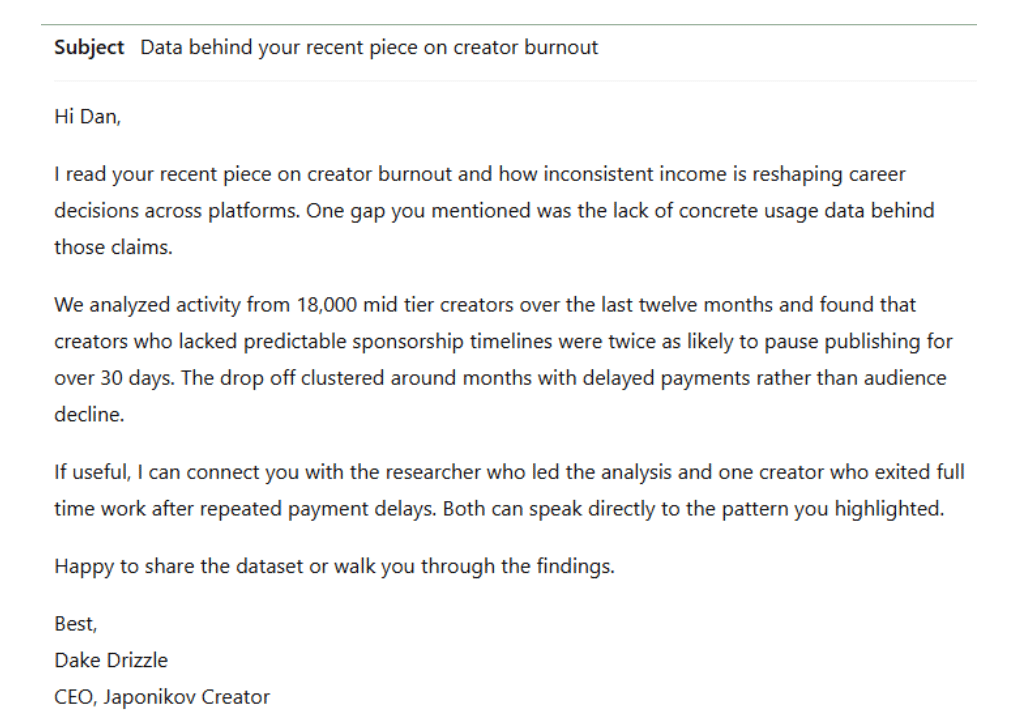
Provided by Author
If you can’t explain why this specific journalist should care, then don’t send it.
-
Craft a Strong Hook
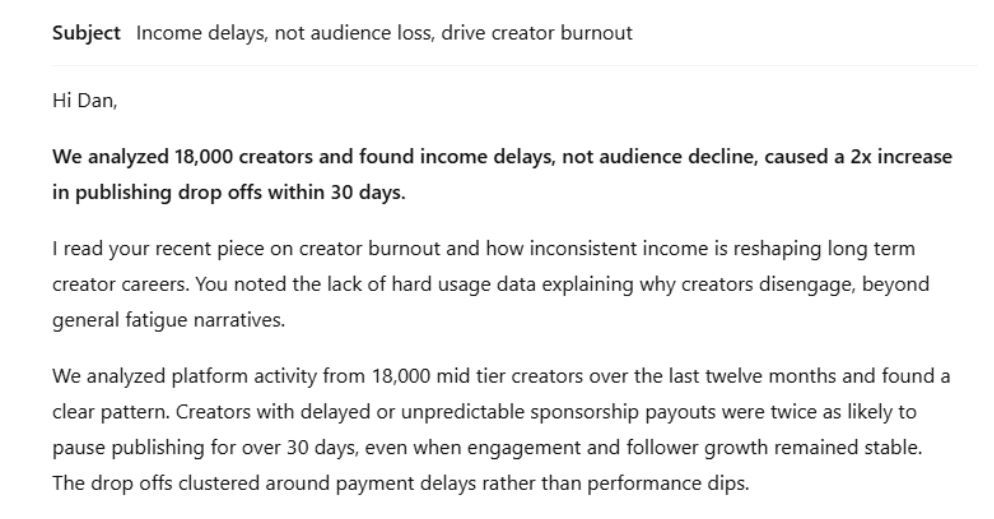
The first header hook after the subject line often determines if a reporter should keep reading the rest of your pitch. So, start with your strongest card:
- A surprising data point that shifts the narrative
- A real example with measurable results
- An insight that challenges assumptions, with proof
- Immediate access: “CEO available today 2-5 PM ET with charts and raw data”
Screenshot provided by the Author
Your first two sentences must explain what’s new and why it matters now. If they don’t, rewrite.
-
Organize Content and Be Brief
Journalists don’t have all the time to read through disconnected paragraphs and blocks of chunky text. That’s why it’s essential to structure your pitches properly and be as concise as possible.
- Context in one line
- What you’re offering (expert, data, case study, access)
- Why it’s different (exclusive, unprecedented scale, unique angle)
- Next steps (availability, asset links, direct phone)
Make it scannable. Use bullets sparingly. Reporters prefer choosing what to download, especially on mobile. So, link to materials instead of attaching all the large files you think might be relevant.
Common Mistakes to Avoid Before Pitching
The fastest ways to get ignored or blocked when pitching a reporter can fill a laundry list, but here are some to pay attention to:
- Mass blasting generic pitches that ignore beats
- Writing misleading subject lines
- Burying the news in corporate speak
- Offering nothing concrete. No data, examples, or qualified sources
- Sending huge attachments or sketchy tracking links
- Following up with empty “just checking in” messages
- Claiming the exclusivity you can’t deliver
- Pushing unqualified sources on sensitive topics
- Disappearing when reporters respond
Make these mistakes repeatedly, and you might end up getting blacklisted for wasting journalists’ time with irrelevant pitches.
3 Steps to Build Long-term Relationships with Reporters
Building a strong bond with a few reporters saves you the cost and effort of finding new ones. This is what you need to do:
Be Consistent and Reliable
Do what you promise, when you promise it. Don’t know something? Say so and give a timeline. Expert cancels? Propose alternatives immediately. This reliability helps ensure your future emails are opened.
Follow Up, but Respectfully
One brilliant follow-up after 48-72 hours works. Add value like new data, a visual, or a sharper angle. If the news window closes, acknowledge it and offer to reconnect when you have a better offer. Cold calls rarely work unless you know they prefer them.
Create Mutually Beneficial Interactions
Help beyond your immediate needs by sharing data or graphics they can use, inviting them to industry events, connecting them with third-party experts, and offering background briefings without an agenda. Also, provide documentation and context for quick verification.
Wrapping Up
Reporters decide fast because they must. In three seconds, they’re looking for relevance, timeliness, originality, credibility, and clarity. If you want to get a response, make their job easier.
Connect your idea to their beat, explain the immediate value, offer exclusive angles, and write concisely.
Be consistent and reliable with your information, follow up respectfully and when needed, and be helpful without a third string attached.