
For much of the past two years, conversations about AI-generated content revolved around a single question:
Can you tell whether something was written by AI?
That question shaped how publishers, communications teams, agencies, universities, and businesses approached generative AI. Detection scores became reference points. Editorial teams wanted reassurance that content met organizational standards. Marketing departments wanted confidence that scaling production would not weaken credibility. Business leaders wanted greater visibility into how AI was influencing professional communication.
At the time, the focus made sense.
Generative AI had entered mainstream workflows at remarkable speed, and organizations needed practical ways to understand what that meant for their content operations. Detection offered something measurable. It produced a score, a probability, or a signal that appeared capable of answering a question many organizations were asking for the first time.
How much of this communication was created by AI?
Increasingly, however, that question feels incomplete.
The organizations making the greatest progress with AI are discovering that identifying machine-generated content is only one part of a much broader communication process. The more meaningful challenge is determining whether AI-assisted communication is accurate, understandable, aligned with organizational standards, and ultimately worthy of representing the business itself.
That shift represents a significant change in how professional communication is evolving.
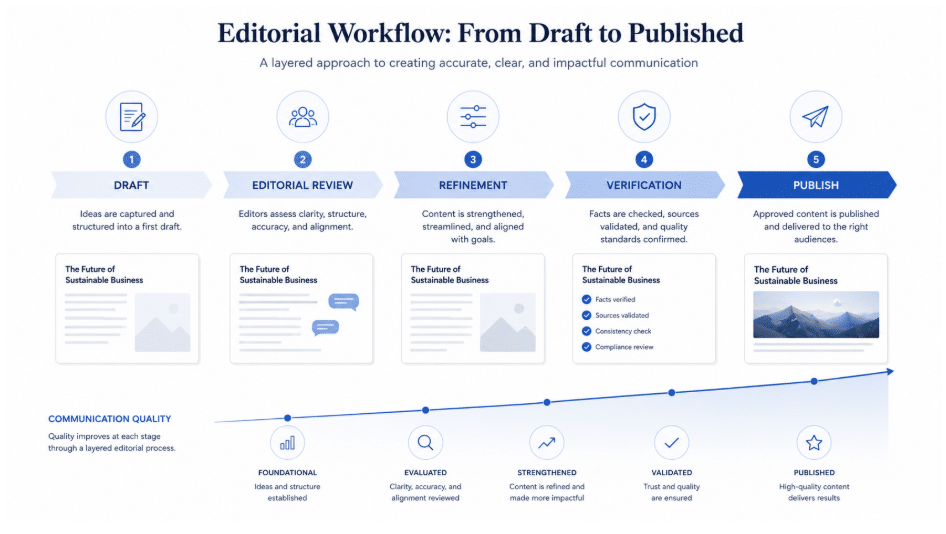
Rather than treating detection as the destination, organizations are beginning to view verification as one stage within a larger editorial workflow that includes ideation, drafting, refinement, review, governance, and publication.
In many respects, the discussion has matured.
The conversation is no longer simply about AI.
It is about communication quality.

Why Detection Was the Starting Point
The earliest wave of enterprise AI adoption focused heavily on visibility.
Organizations wanted to understand how generative AI was entering their workflows and where additional oversight might be required. Editors needed confidence that published material reflected editorial standards. Communications leaders wanted reassurance that AI-generated content would not introduce reputational or legal risks. Marketing teams sought ways to scale production without sacrificing consistency or audience trust.
Detection naturally became the first response.
It offered a practical way to review AI-assisted content before publication and provided organizations with a structured starting point for understanding how generative AI was influencing communication. At this stage, an AI detector can help teams flag content that may require closer editorial review without treating the result as a final judgment on its quality.
Over time, however, communications professionals began recognizing an important limitation.
A detection score could indicate certain characteristics of a document, but it could not determine whether the communication itself was effective.
A piece of content might receive a low detection score while still lacking clarity, strategic direction, or audience relevance. Another document could contain valuable analysis, strong editorial judgment, and useful recommendations while displaying patterns commonly associated with AI-assisted writing.
The score alone rarely answered the questions that communication professionals cared about most.
Is this accurate?
Is it understandable?
Does it reflect our standards?
Will our audience trust it?
Those questions require considerably more than pattern recognition.
They require editorial judgment.
Modern Communication Begins Earlier Than Drafting
Another important shift is occurring even before content is written.
Many organizations are discovering that communication quality is heavily influenced by the earliest stages of planning rather than by editing alone.
One of the most significant changes in professional communication is happening before the first draft is even written. Many teams now begin projects inside an AI Chat environment where they brainstorm ideas, organize research, explore alternative structures, and clarify arguments before presentation or content creation begins. Rather than replacing expertise, conversational AI is becoming the first stage of modern editorial thinking, helping professionals reduce uncertainty, strengthen narratives, and build better communication before moving into drafting, refinement, and verification.
This represents a meaningful change in how communication is created.
Historically, teams often started with a blank document.
Today, many begin with questions.
- What problem are we trying to solve?
- What information actually matters?
- Which audience are we addressing?
- What objections should be anticipated?
- How should this story unfold?
Using AI during this planning stage helps professionals reduce uncertainty before investing time in drafting and editing. Rather than replacing expertise, AI increasingly supports the thinking process by helping teams organize information into clearer communication strategies.
This shift also explains why many organizations are moving away from isolated AI tools and toward connected communication workflows.
Research, ideation, writing, refinement, verification, and publication are no longer treated as independent activities. They increasingly function as connected stages within the same editorial process.
Verification Is Becoming an Editorial Discipline
As communication workflows mature, verification is beginning to occupy a different role.
Instead of functioning solely as a technical checkpoint, verification is becoming an editorial discipline concerned with communication quality rather than content origin.
Organizations increasingly rely on AI detector tools as one layer within broader review processes that include editorial oversight, governance, audience evaluation, and publication readiness. Detection becomes one signal among many rather than the final decision.
That distinction is important.
Communication teams are rarely trying to determine whether AI was involved.
They are trying to determine whether communication is ready.
- Is the message clear?
- Does the tone match the audience?
- Are important claims properly supported?
- Does the communication reflect the organization’s standards?
Those questions extend well beyond detection itself.
They illustrate why verification is becoming increasingly integrated into broader editorial workflows rather than existing as a standalone technical exercise.
In many organizations, the conversation is shifting from “Was this written by AI?” toward “Is this communication ready to represent us?”
Refinement Is Becoming a Distinct Stage of Professional Communication
If verification helps organizations evaluate communication, refinement helps improve it.
That distinction is becoming increasingly important as AI-generated content moves deeper into everyday business operations. Early conversations about AI often focused on content generation, with the assumption that producing a first draft represented the most significant challenge. Experience has shown otherwise.
Generating content has become relatively easy.
Producing communication that feels natural, aligns with brand standards, and genuinely connects with its audience remains considerably more difficult. As AI-generated content became more common, interest also grew in tools and workflows designed to turn AI to human text, helping organizations make AI-assisted communication feel more natural, readable, and appropriate for professional audiences.
This is why many communications teams now dedicate significant attention to AI Humanizer by improving readability, refining tone, reducing repetitive phrasing, and adapting communication for different audiences. The objective is not to disguise the use of AI or chase lower detection scores. It is to ensure that AI-assisted communication reflects the clarity, nuance, and consistency expected in professional environments.
Platforms such as Quillbot illustrate this broader shift in the market. Rather than positioning AI as a replacement for editorial judgment, the focus is increasingly on helping professionals strengthen communication through connected workflows that support drafting, refinement, verification, and collaboration. The technology becomes part of the editorial process rather than its destination.
This reflects a broader change in how organizations think about AI-assisted communication.
The objective is no longer simply to create content more quickly.
The objective is to create communication that people understand, trust, and act upon.
Communication Quality Is Becoming the Competitive Advantage
This evolution is visible across nearly every communication function.
Public relations teams continue to use AI to accelerate drafting, but publication decisions remain dependent on message quality, stakeholder expectations, editorial judgment, and reputational considerations. Marketing departments are scaling content production while investing more effort in review and refinement to ensure campaigns remain useful and audience-focused. Internal communications teams increasingly evaluate clarity, accessibility, and organizational relevance before distributing information to employees. Agencies are building review frameworks that help maintain consistent quality across multiple clients, industries, and editorial standards.
Across these examples, the pattern is remarkably consistent.
Organizations are no longer measuring success by how quickly content can be generated.
They are measuring success by how effectively communication performs once it reaches its audience.
That represents an important shift.
The discussion is moving away from AI as a production tool and toward AI as one component of a broader communication ecosystem.
The Future Of AI-Assisted Communication
The first generation of AI adoption demonstrated that machines could produce content.
The next generation is demonstrating that content alone is not enough.
Professional communication depends on judgment, structure, clarity, audience understanding, and trust. Those qualities emerge through workflows that connect research, planning, drafting, refinement, verification, and publication rather than treating each activity as an isolated task.
This explains why many organizations are redesigning their communication processes rather than simply adopting new AI applications. Instead of looking for a single tool that performs every task, they are building connected systems that reduce friction between different stages of communication while preserving human oversight where it matters most.
The organizations that benefit most from AI are unlikely to be those producing the greatest volume of content.
They will be the organizations that build the strongest editorial workflows.
Verification becomes part of governance.
Refinement becomes part of communication quality.
AI becomes part of thinking rather than simply writing.
Ultimately, the future of AI-assisted communication may not be defined by how effectively organizations generate content.
It will be defined by how effectively they transform information into communication that audiences understand, trust, and are willing to act upon.
That may prove to be the most important evolution of all.
Related: SEO for ChatGPT: Practical tips for digital marketers