

79% of B2B leads never convert to sales. That is not a qualification problem. That is a systems problem.
The traditional approach to lead generation (manual research, gut-feel scoring, batch-and-blast emails) was built for a world where buyers were patient, and sales cycles were predictable. Neither of those conditions exists in 2026. Modern B2B buyers complete 70% of their research before ever talking to a sales rep. By the time they raise their hand, they have already eliminated 80% of vendors from consideration.
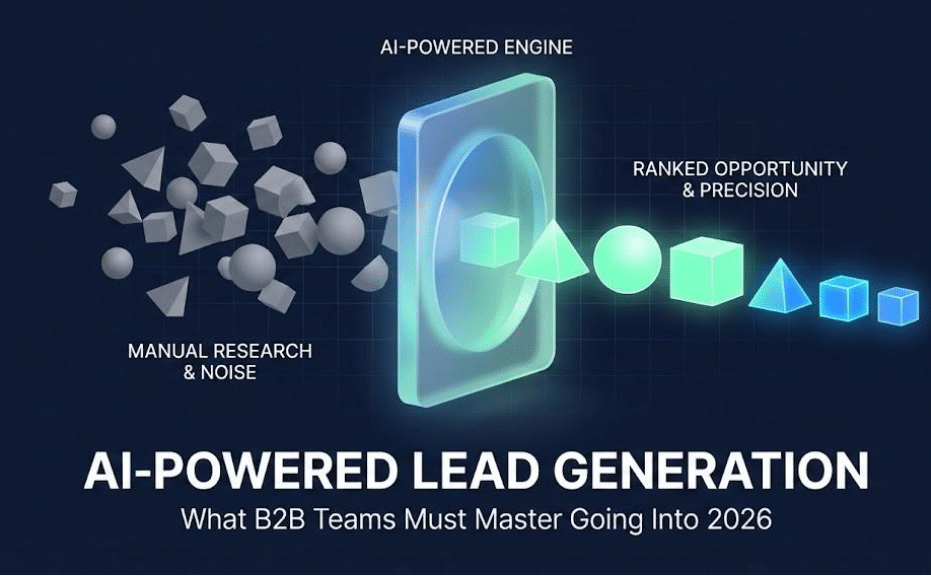
AI-powered lead generation changes this dynamic. It does not just automate prospecting. It identifies which accounts are actively researching your category, scores them based on likelihood to convert, and triggers personalised outreach at the exact moment buyers are most receptive. Companies using AI for lead generation see 50% more sales-ready leads and up to 60% lower customer acquisition costs.
The gap between AI adopters and holdouts is widening fast. 75% of B2B sales organisations have integrated Generative AI tools, yet only 9% of individual sales reps actively use them. This disconnect reveals the real challenge: implementation, not capability.
The Problem With Traditional Lead Scoring
Manual lead scoring operates on assumptions. A sales rep reviews a prospect’s company size, industry, and job title, then assigns a qualification score based on pattern recognition and experience. This approach delivers 50-70% accuracy on a good day.
The limiting factor is human bandwidth. A single rep can manually research 20-30 prospects per day. That ceiling means most leads sit untouched for days or weeks while competitors move faster.
Traditional scoring also suffers from recency bias. Reps prioritise the most recent inquiries rather than the highest-value opportunities. They chase warm leads that feel productive instead of cold accounts showing strong intent signals. This is why 61% of marketers cite “quality lead generation” as their number one pain point.
The shift to predictive AI scoring removes these bottlenecks. Machine learning models analyse thousands of data points (website visits, content engagement, LinkedIn activity, email behaviour, technographic data) and compute a probability score in real time. Accuracy jumps to 90%+, and the system handles 10,000+ leads simultaneously.
The economics justify this specialisation. Google Ads averages $70 cost per lead with 78% ROAS, making it ideal for volume generation. LinkedIn costs $150-$400 per lead but delivers 113% ROAS, the only platform consistently exceeding 100% return. Email marketing operates at near-zero marginal cost once infrastructure is built.
The Data Quality Prerequisite Nobody Talks About
60% of sales leaders cite poor data quality as their top barrier to AI adoption. This is the unglamorous truth that vendor case studies conveniently omit.
AI models train on historical data. If your CRM contains duplicate accounts, incorrect contact information, outdated job titles, and leads that were never properly qualified, the algorithm learns from garbage. The output will be garbage scores that your sales team rightfully ignores, ultimately hurting your lead generation performance.
Most B2B organisations operate with fragmented data across multiple systems: Salesforce for pipeline, Marketo for marketing automation, LinkedIn Sales Navigator for prospecting, and spreadsheets for manual tracking. Each system holds a different version of the truth. When you ask AI to score a lead for lead generation, it is pulling from contradictory sources.
Before deploying AI-driven lead generation, companies must invest in data governance:
Deduplicate accounts across all systems using tools like ZoomInfo or Clearbit for data enrichment and validation.
Standardise field formats including company names, job titles, and industries to ensure consistency.
Establish data entry protocols for sales reps with mandatory field requirements and validation rules.
Implement regular data hygiene audits on a quarterly minimum schedule with automated flagging.
Define clear lead definitions that marketing and sales both agree to, eliminating downstream qualification disputes.
This is a 90-day project, not a weekend task. But it is non-negotiable. Companies that skip data cleanup see AI adoption rates below 30%. Companies that prioritise it see 75%+ adoption within six months.
The ROI justification is straightforward: Clean data enables accurate scoring, accurate scoring builds sales team trust, and trust drives usage. Without trust, even the most sophisticated AI tool becomes shelfware.
LinkedIn: Precision Decision-Maker Targeting
LinkedIn’s competitive advantage is professional targeting granularity. You can reach “VP of Sales at 500-1,000 employee SaaS companies in North America who follow competitor pages.” No other platform offers this precision for B2B audiences.
LinkedIn Lead Gen Forms convert at 13%, crushing the 2-5% typical for external landing pages. The native experience reduces friction to a single click. Pre-filled fields eliminate form fatigue while maintaining data accuracy through LinkedIn’s verified profile information.
The higher cost per lead reflects audience quality, not platform inefficiency. LinkedIn-generated leads have 32% higher closure rates when they reach opportunity stage compared to Google leads. Average deal values tell the same story: $26,700 for LinkedIn versus $18,500 for Google, a 44% premium.
How Predictive Lead Scoring Actually Works
Predictive lead scoring uses machine learning to analyse two categories of data: historical conversion patterns and real-time behavioural signals.
The historical analysis examines every lead your company has ever touched (those that became customers, those that stalled in the pipeline, those that churned, those that never responded). The algorithm identifies patterns: What did high-converting leads have in common? What characteristics predicted failure?
Common conversion predictors include:
Company size within your ideal customer profile range, typically measured by employee count and annual revenue.
Specific job titles, including VP of Sales, Director of Marketing, or Chief Revenue Officer, with budget authority.
Technology stack compatibility verified through technographic data from platforms like BuiltWith or Datanyze.
Recent funding rounds or expansion announcements that signal growth budgets and increased buying capacity.
Employee headcount growth trends indicate organisational expansion and potential for new tool adoption.
The behavioural layer adds real-time intent signals. This is where AI outperforms humans by orders of magnitude. A machine can track:
Website page visits with pricing page activity indicate high intent and purchase readiness.
Content downloads, including whitepapers, case studies, and solution guides that reveal specific pain points.
Email engagement patterns measuring opens, clicks, forwards, and time spent reading to gauge interest level.
LinkedIn profile updates capture job changes, company changes, and career transitions that create buying opportunities.
Competitor research activity captured via third-party intent data from providers like Bombora or 6sense.
When a prospect matches your ideal customer profile and shows multiple intent signals (visiting your pricing page three times in one week, downloading two case studies, engaging with your LinkedIn content), the AI assigns a high probability score. These leads convert at 3.5x higher rates than manually scored prospects.
| Dimension | Traditional Manual Scoring | Predictive AI Scoring |
| Accuracy | 50-70% (prone to bias) | 90%+ (data-driven) |
| Speed | Days (manual review) | Real-time (instant) |
| Scalability | Limited (manual ceiling) | Unlimited (10K+ leads) |
| Adaptation | Static (quarterly reviews) | Dynamic (continuous learning) |
| Cost per Lead | $150-300 (internal hours) | $20-50 (platform cost) |
| Conversion Rate | 10-15% | 30-40% |
The table reveals an uncomfortable truth: AI wins on every metric except one. Sales rep trust. Traditional scoring enjoys 85%+ adoption because reps understand it. AI scoring starts at 45-70% adoption because it feels like a black box.
This is the implementation barrier that kills most AI projects.
The Black Box Problem: Why Sales Teams Distrust AI
70% of sales reps hesitate to trust AI recommendations without explainability. This is not technophobia. It is rational skepticism.
Imagine you are a B2B sales rep with a quota. The AI platform gives you a list of 50 leads, ranked by score. Lead #1 has a score of 94/100. Lead #2 has 91/100. The system says to call Lead #1 first.
You look at Lead #1. It is a mid-market company you have never heard of. The contact is a Director of Operations (not your typical buyer persona, which is usually VP of Sales). The company operates in a vertical you do not serve often.
You look at Lead #2. It is a Fortune 500 brand. The contact is a VP of Sales. You have closed three deals with similar companies this year.
Which lead do you call first? Most reps choose Lead #2. They ignore the AI score because they do not understand why Lead #1 scored higher. Maybe the Director of Operations visited the pricing page six times this week. Maybe the company just raised Series B funding. Maybe they are expanding into a new market where your solution is critical.
The AI knows this. The rep does not.
Without explainability, AI recommendations feel arbitrary. Sales teams revert to gut instinct, and the expensive AI platform becomes unused.
The solution is transparency. Modern AI platforms now show the reasoning behind scores:
Intent signals triggered: 6 website visits (pricing page), 2 case study downloads, 3 LinkedIn engagements
Profile match: 95% fit with ideal customer profile (company size, industry, tech stack)
Buying stage: Late-stage research (pricing comparison phase)
Similar closed deals: 4 customers with identical profiles closed in the past 90 days
When reps see this breakdown, trust builds. They understand that the AI is not guessing. It is pattern-matching based on data that they do not have time to analyse manually. Companies that implement explainable AI see adoption rates climb from 45% to 75% within three months.
Intent Data: The Competitive Advantage Most Teams Ignore
96% of B2B marketers report success with intent data. Only 25% of companies actually use it.
This gap represents the single biggest opportunity in B2B lead generation. Intent data reveals which accounts are actively researching your solution category right now, before they ever fill out a form or request a demo.
Intent signals fall into two categories:
First-Party Intent (Data You Own)
Website visits and page views are tracked through analytics platforms like Google Analytics or Heap.
Content downloads include gated assets, product sheets, and comparison guides.
Email opens and clicks are measured through marketing automation platforms like HubSpot or Marketo.
CRM engagement history showing past conversations, meetings, and proposal interactions.
Product trial sign-ups indicate hands-on evaluation and serious purchase consideration.
Third-Party Intent (External Signals)
Content consumption on publisher networks tracks which topics prospects research across the web.
Search behaviour on Google, industry sites, and review platforms reveals solution exploration.
Social media activity on LinkedIn and Twitter shows thought leadership engagement and peer discussions.
Review site research on G2, Capterra, and TrustRadius, indicating active vendor comparison.
Competitor evaluation signals are captured when prospects research alternative solutions in your category.
The power of intent data shows in the conversion metrics. Intent-driven outreach delivers 60% lead qualification rates compared to 25% for traditional prospecting. Conversion to opportunity jumps from 10-15% to 30-40%. That is a 2.4x improvement in pipeline efficiency.
Here is why it works: You are reaching buyers when they are already looking for solutions. Traditional cold outreach interrupts someone’s day with a problem they may or may not have. Intent-based outreach says, “I noticed you are researching [specific topic]. Here is how we solve that.”
The timing advantage compounds. B2B buyers move fast once they enter active research mode. The vendor that responds first wins 35-50% of deals. Intent data gives you early warning, sometimes 3-4 months before a buyer issues an RFP.
But here is the implementation challenge: Most companies collect intent data but do not activate it. The signals sit in a dashboard while sales reps continue cold calling from stale lists. Activation requires workflow automation:
Intent signal fires when a prospect visits the pricing page 3x in one week.
Lead score updates automatically in CRM systems like Salesforce or Microsoft Dynamics.
Alert triggers to the assigned sales rep via Slack, email, or mobile notification.
Personalised email sequence launches within 1 hour using platforms like Outreach or SalesLoft.
Rep receives context: “This prospect researched [specific features] and downloaded [case study]. Recommended talk track: [AI-generated angle].”
This is where AI automation delivers ROI. Humans cannot monitor intent signals for 1,000+ accounts in real time. AI can, and it never sleeps.
Real-World Implementation: What Actually Works
Case Study: Smartling (B2B SaaS)
Smartling’s sales team faced a classic scaling problem. Their BDRs spent 80% of their time on manual prospect research: scraping LinkedIn profiles, reading company blogs, and finding personalisation angles. This limited them to 15-20 personalised emails per day.
They implemented AI-powered prospect research and automated email personalisation. The system analysed each prospect’s LinkedIn activity, company news, and technology stack, then generated tailored email templates highlighting relevant use cases.
Results: 10x increase in personalised outreach volume. BDRs shifted from research to selling (high-value discovery calls and relationship building). Payback period: 3-6 months.
The key insight: AI did not replace the sales team. It freed them to do what humans do best: build relationships. The machines handled pattern recognition and data analysis.
Case Study: VTT (B2B Financial Software)
VTT had a different problem: inbound lead volume exceeded SDR capacity. With a team of 5 SDRs, they could only reach 40% of inbound leads within the critical first hour. The rest sat untouched for days, by which time many had moved to competitors.
They deployed AI sales prospecting that analysed website visits, content engagement, and CRM interactions to rank accounts by buyer intent. The system automatically scored every inbound lead and routed high-priority prospects to available SDRs.
Results: 100% inbound lead coverage within 1 hour (previously 40%). Expected sales impact: 2.5x increase in closed deals from improved response time.
The key insight: Speed matters in B2B. Intent signals decay fast. The buyer who visited your pricing page today might sign with a competitor tomorrow if you do not respond immediately.
Both cases illustrate the same principle: AI is leverage, not replacement. It handles repetitive, data-intensive tasks so humans can focus on complex judgment calls and relationship-building.
The Cost Structure: When AI Lead Gen Makes Financial Sense
AI lead generation platforms cost $500-$5,000 per month, depending on lead volume, feature set, and integrations. For most B2B companies, the payback calculation is straightforward.
Baseline Scenario (Before AI)
1,000 leads per month generate 25% qualification rate (250 MQLs).
14% of MQLs convert to SQLs (35 leads) through traditional scoring methods.
20% of SQLs close (7 deals) with average deal size of $50,000.
Monthly revenue: $350,000 from conventional lead generation efforts.
AI-Powered Scenario (After Implementation)
Same 1,000 leads per month with 60% qualification rate via intent filtering (600 MQLs).
40% of MQLs convert to SQLs (240 leads) using predictive scoring algorithms.
25% of SQLs closed (60 deals) with an average deal size of $50,000.
Monthly revenue: $3,000,000 from AI-enhanced lead generation.
Monthly revenue lift: $2,650,000. Even at a $5,000/month platform cost, the ROI is 530:1.
But this calculation assumes clean data, proper implementation, and sales team adoption. Companies that skip the prerequisites see negligible results.
AI automation saves sales teams 2+ hours daily and generates 451% more qualified leads.
The ROI inflexion point occurs at Month 4-6. Early months focus on data cleanup, model training, and building sales team trust. By Month 6, the AI has analysed enough conversion data to make accurate predictions, and reps have seen enough wins to trust the scores.
Cost per acquisition drops 60% on average from $350 to $120 over 12 months. Conversion rates climb from 12% to 32% as the system learns which signals predict success.
Who This Strategy Is NOT For
AI lead generation is not universally applicable. Five scenarios where traditional methods still win:
Solo sales reps or micro-businesses with less than $1M ARR require minimum lead volumes of 100+ per month to train AI effectively. Below that threshold, platform costs exceed benefits. Stick with LinkedIn manual prospecting until you reach scale.
B2C or mass-market companies face different dynamics than complex B2B sales cycles. B2C customer acquisition costs are measured in dollars, not percentages. Use paid social ads and email marketing instead.
Companies without sales-marketing alignment cannot leverage AI when teams disagree on qualification criteria. If you cannot agree on what “qualified” means, AI will not fix the disconnect. Establish a shared lead definition first.
Organisations unwilling to invest in data governance will produce garbage outputs from garbage inputs. If you cannot commit to cleaning your CRM, the AI scores will be meaningless. Run a 90-day data cleanup project before buying AI tools.
Pure product-led growth models with no traditional sales team and complete self-serve sign-ups make lead scoring irrelevant. Focus on product analytics and activation metrics instead.
The common thread: AI amplifies existing processes. If your foundation is broken, AI makes it worse faster.
The Implementation Roadmap: Month-by-Month
Most companies approach AI lead generation backwards. They buy the tool first, then figure out implementation. This guarantees failure.
Month 1: Data Audit & Cleanup
Export the full CRM database and conduct a comprehensive analysis of record quality.
Identify duplicates, stale records, and incomplete profiles using data validation tools.
Standardise company names, job titles, and industry classifications across all systems.
Establish data entry protocols for the sales team with mandatory fields and validation rules.
Define lead qualification criteria, including ICP parameters and scoring thresholds.
Month 2: Tool Selection & Integration
Evaluate AI platforms based on CRM compatibility with Salesforce, HubSpot, or Microsoft Dynamics.
Prioritise explainability features for sales adoption and trust-building mechanisms.
Test integrations in the sandbox environment before production deployment.
Configure scoring model with historical conversion data from the past 12-24 months.
Set up automated workflows, including alert triggers and email sequences.
Month 3: Pilot Program & Training
Launch with 2-3 top-performing sales reps as early adopters and internal champions.
Train on interpreting AI scores and intent signals with clear explainability frameworks.
Establish a feedback loop where reps mark scores as accurate or inaccurate for model refinement.
Document quick wins and share with the broader team through regular communications.
Refine the model based on initial results and rep feedback.
Month 4-6: Scaling & Optimisation
Roll out to the full sales team after proving the concept with the pilot group.
Expand intent data sources by integrating third-party signals from Bombora or 6sense.
Implement A/B testing on email personalisation to optimise messaging effectiveness.
Track adoption metrics measuring the percentage of reps using AI recommendations daily.
Adjust scoring weights based on closed deal analysis and conversion pattern identification.
Month 7-12: Continuous Improvement
Add predictive forecasting for pipeline planning and revenue projection accuracy.
Integrate conversational AI for lead qualification through chatbots and automated responses.
Expand to account-based marketing workflows, coordinating multi-stakeholder engagement.
Build executive dashboards showing ROI metrics, conversion trends, and productivity gains.
Scale to additional regions or product lines after perfecting initial implementation.
Key milestone: Trust threshold. This occurs when 75%+ of sales reps actively use AI recommendations without questioning every score. Most companies hit this at Month 5-6, assuming they invested in explainability and training.
Conversational AI: The Next Frontier
64% of businesses using AI chatbots report increased qualified leads. 26% see a 10-20% lift in lead volume.
Conversational AI represents the next evolution beyond static lead scoring. Instead of waiting for prospects to fill out forms, AI chatbots engage website visitors in real-time dialogue, ask qualifying questions, and route high-value leads to sales immediately.
The Workflow
Prospect lands on the pricing page, triggering high-intent signal detection.
Chatbot triggers: “I see you are exploring our enterprise plan. What is your biggest challenge with [their current solution]?”
Prospect responds with pain points, revealing specific needs and urgency levels.
Chatbot asks qualifying questions covering company size, timeline, budget authority, and decision-making process.
If the prospect qualifies, the chatbot offers instant calendar booking with a sales rep using Chili Piper or Calendly.
If the prospect does not qualify, the chatbot delivers nurture content and captures email for follow-up sequences.
This handles 80% of routine qualification tasks that previously required human SDRs. The remaining 20% (complex discovery, relationship building, objection handling) stays with humans.
The impact on lead response time is dramatic. Traditional lead follow-up takes 24-48 hours on average. Conversational AI responds in seconds. In B2B, the first responder advantage translates to 35-50% higher close rates.
But conversational AI only works if it is trained on your specific use cases. Generic chatbot scripts that ask “How can I help you?” drive visitors away. Effective bots recognise context (which page the visitor came from, what content they have downloaded, and whether they are a return visitor) and tailor the conversation accordingly.
Multi-Touch Attribution: Proving AI ROI
The hardest part of AI lead generation is not implementation. It is proving ROI to sceptical executives.
Traditional attribution models fail with AI because modern buyers interact with your brand across 8-12 touchpoints before converting. They might discover you via a LinkedIn ad, visit your website, download a whitepaper, attend a webinar, receive 3 nurture emails, and finally request a demo. Which touchpoint “caused” the conversion?
Multi-touch attribution models solve this by assigning fractional credit:
First-touch: Credits the initial awareness channel that introduced the prospect to your brand.
Last-touch: Credits the final conversion point where the prospect became a qualified lead.
Linear: Distributes credit equally across all touchpoints in the buyer journey.
Time-decay: Gives more credit to recent interactions as they typically indicate higher intent.
U-shaped: Credits first and last touch heavily (40% each), distributes remainder (20%) across middle touches.
W-shaped: Credits first touch, middle touch (key engagement), and last touch equally at 30% each.
AI-powered attribution platforms track every interaction and compute the probability that each touchpoint influenced the outcome. This reveals which intent signals actually predict conversions.
For example, you might discover that “pricing page visits” correlate with 85% of closed deals, while “blog post reads” only correlate with 15%. This insight tells you to weigh pricing page visits heavily in your lead scoring model.
Multi-touch attribution also quantifies AI’s contribution. You can measure:
Revenue from AI-scored leads versus manually scored leads to prove incremental value.
Conversion rates by score threshold comparing 90+ versus 70-89 versus below 70 performance.
Deal cycle length for AI-prioritised prospects versus traditional pipeline progression.
Sales rep productivity before and after AI implementation measured by pipeline velocity.
Companies using AI lead scoring report 77% higher lead conversion rates and 79% increase in revenue from marketing efforts. Multi-touch attribution proves these numbers at the deal level.
The Human Element: Sales Team Training That Actually Works
Most AI implementations fail because of human resistance, not technical limitations. Sales teams view AI as a threat to their expertise or worse, as a precursor to job elimination.
The Trust-Building Framework
Week 1: Education, Not Evangelism
Explain how AI works using pattern recognition, not magic or black box descriptions.
Show the data sources including website behaviour, email engagement, and firmographic fit criteria.
Demonstrate explainability with clear “This lead scored high because…” breakdowns.
Address job security fears directly by positioning AI as augmentation, not replacement.
Week 2: Quick Wins
Hand-select 10 obviously high-quality leads with strong ICP fit and multiple intent signals.
Ask reps to call these leads first and track conversion outcomes meticulously.
Document conversion success with specific examples of closed deals or advanced opportunities.
Share wins with the full team using messaging like “AI identified these opportunities that we might have missed.”
Week 3: Feedback Loop
Ask reps to mark AI scores as accurate or inaccurate after every call for continuous learning.
Show how their feedback improves the model through visible score adjustments and refinements.
Create shared accountability where reps become model trainers, not passive users.
Gamify adoption with leaderboards tracking the most AI leads converted or the highest score accuracy.
Month 2: Process Integration
Redesign sales workflows around AI insights rather than treating AI as a separate activity.
Make AI scores visible in CRM directly in Salesforce, HubSpot, or Microsoft Dynamics interfaces.
Automate routine tasks, including research and data entry so reps focus on selling.
Tie AI usage to performance reviews measured by outcomes (conversion rates), not activity (number of calls).
Month 3: Advanced Training
Teach reps to interpret complex intent patterns including multi-signal combinations and timing indicators.
Train on personalisation techniques based on intent signals for higher engagement rates.
Share competitive intelligence showing how AI helps you move faster than competitors.
Expand use cases to forecasting, deal prioritisation, and account planning beyond initial lead scoring.
The success metric: When sales reps start requesting more AI insights rather than questioning the ones they receive. This shift usually occurs at Month 4-5 if training is executed properly.
70% of sales reps distrust AI initially, but trust climbs to 75% after six months with proper training and explainability.
Data Privacy and Compliance Considerations
AI lead generation operates on prospect data: website behaviour, email engagement, job titles, and company information. This triggers privacy regulations in most jurisdictions.
Key Compliance Requirements
GDPR (Europe): Requires explicit consent before tracking website visitors. Cookie banners must explain that data will be used for lead scoring. Prospects have the right to access their data and request deletion.
CCPA (California): Similar to GDPR but with different consent mechanisms. Prospects can opt out of data collection. Companies must disclose what data is collected and how it is used.
CAN-SPAM (US): Regulates email marketing. All AI-generated emails must include unsubscribe links and accurate sender information.
Industry-specific regulations: Healthcare (HIPAA), finance (GLBA), and government contractors (FedRAMP) face additional restrictions on data processing.
Best Practices for Compliant AI Lead Generation
Implement consent management platforms for website tracking using OneTrust or Cookiebot.
Anonymise data in AI training sets by removing personally identifiable information.
Provide transparency in privacy policies about AI usage and data processing methods.
Honour opt-out requests within required timeframes (typically 30 days for GDPR).
Conduct regular data security audits using third-party penetration testing and vulnerability assessments.
Use vendors with SOC 2 Type II certification ensuring enterprise-grade security standards.
Maintain data processing agreements with third-party platforms documenting compliance responsibilities.
Non-compliance risks are significant. GDPR fines reach 4% of annual revenue. But compliance does not require abandoning AI. It requires thoughtful implementation that respects buyer privacy while still leveraging behavioural signals.
Integration With Existing Sales Stack
AI lead generation does not exist in isolation. It must sync with your existing CRM, marketing automation platform, sales engagement tools, and data enrichment sources.
Common Integration Architecture
Data Layer
CRM systems, including Salesforce, HubSpot, or Microsoft Dynamics, as the system of record.
Marketing automation platforms like Marketo or Pardot for nurture workflows and campaign management.
Data enrichment services, including ZoomInfo, Clearbit, or Clay, for firmographic data enhancement.
Intent data providers such as Bombora or 6sense for behavioural signal collection.
AI Layer
Lead scoring engine using native CRM AI or third-party platforms like Growleads for predictive analytics.
Predictive analytics tools for forecasting, propensity modelling, and pipeline probability analysis.
Conversational AI platforms powering chatbots and email automation for qualification workflows.
Activation Layer
Sales engagement platforms including Outreach or SalesLoft for sequencing and cadence management.
Calendar automation tools like Chili Piper or Calendly for meeting booking and scheduling optimisation.
Call intelligence platforms such as Gong or Chorus for conversation analysis and coaching insights.
The integration challenge: Most companies have 8-15 sales tools that do not talk to each other. Data lives in silos. Lead scores calculated in one system do not appear in the rep’s daily workflow.
Solution: API-first architecture. Modern platforms offer REST APIs that sync data bidirectionally. When a lead score updates in the AI platform, it automatically pushes to Salesforce. When a rep marks a lead as “not interested” in Salesforce, it feeds back to the AI model for retraining.
Implementation timeline: Expect 4-6 weeks for full integration. Simple CRM connections take days. Complex multi-system integrations require custom development and testing.
The Competitive Landscape: What Is Coming in 2026
AI lead generation is evolving rapidly. Four trends will dominate 2026:
1. Generative AI for Hyper-Personalisation
Current systems personalise emails with merge tags ({{First_Name}}, {{Company}}). Next-generation AI writes unique email copy for each prospect based on their specific pain points, company news, and behavioural signals. Early adopters report 14% higher email open rates and 10% better response rates.
2. Multi-Channel Intent Fusion
Today’s intent data focuses primarily on website behaviour. Tomorrow’s systems will combine web signals, email engagement, LinkedIn activity, app usage, and offline events (conference attendance, sales calls) into unified intent scores.
3. Predictive Buyer Timing
Beyond “who will buy,” AI will predict “when they will buy” with 30-90 day windows. This enables proactive outreach: “Our model predicts your team will evaluate solutions in Q2. Let us start the conversation now.”
4. AI-Powered Account Orchestration
Instead of scoring individual leads, AI will orchestrate entire account campaigns: identifying buying committees, mapping influencers, personalising content for each stakeholder, and timing outreach to match the account’s buying stage. Companies using AI-driven ABM report 76% higher win rates.
The competitive advantage belongs to companies that implement now, learn fast, and iterate continuously. By 2026, AI lead generation will be table stakes, not differentiation.
Ready to Scale Your B2B Reach?
AI-powered lead generation transforms the economics of B2B sales. 50% more sales-ready leads, 60% lower customer acquisition costs, and 2-3x higher conversion rates are achievable with proper implementation.
The gap between intent and action is where most teams stall. 96% of marketers acknowledge that intent data works. Only 25% actually use it. 75% of sales orgs have integrated AI tools. Only 9% of reps actively use them.
Grow smarter. Discover the best AI-powered lead generation strategies with Growleads for enriched B2B lead generation. For teams managing media outreach and public relations alongside lead generation, AgilityPR provides enterprise-grade solutions for coordinated multi-channel campaigns.
FAQs
Q1. What is AI-powered lead generation, and how does it differ from traditional lead gen?
AI-powered lead generation uses machine learning algorithms to automatically identify, score, and prioritise high-value prospects based on behavioural signals, firmographic data, and intent indicators. Traditional lead gen relies on manual research and rule-based scoring, resulting in 30-40% better prediction accuracy and 3.5x higher conversion rates for AI-driven approaches. The key difference is scale and speed. AI analyses thousands of data points in real time while humans are limited to reviewing dozens of prospects per day.
Q2. What is the ROI of implementing AI lead generation tools?
Companies using AI for lead generation report 50% more sales-ready leads, 60% lower customer acquisition costs, and 25-51% higher conversion rates. Typical payback periods range from 3-6 months, depending on lead volume and data quality. The ROI inflexion point occurs at Month 4-6 when the AI model has learned from enough conversion data and sales team adoption reaches 75%.
Q3. How does predictive lead scoring work?
Predictive lead scoring analyses historical customer data alongside real-time behavioural signals to build a machine learning model that scores prospects on the likelihood to buy. The system examines which leads have been converted in the past, identifies common patterns, and applies those patterns to new prospects. This achieves 90%+ accuracy compared to 50-70% for manual scoring by processing website visits, email opens, content engagement, LinkedIn activity, and firmographic data simultaneously.
Q4. What are intent signals and why do they matter for B2B lead gen?
Intent signals are indicators of active buying interest, such as website visits, whitepaper downloads, pricing page visits, competitor research, LinkedIn profile updates, and content engagement. Using intent-driven targeting improves lead qualification rates from 25% to 60% and conversion-to-opportunity rates from 10-15% to 30-40%. Intent signals matter because they reveal which accounts are actively researching solutions right now, enabling sales teams to reach buyers at the peak of their buying journey.
Q5. What is the biggest barrier to AI adoption in B2B sales?
The top three barriers are data quality issues (60% of leaders cite poor CRM data as their primary obstacle), sales rep distrust (70% of reps hesitate to trust AI without explainability), and process misalignment (adding AI to broken processes just automates inefficiencies). Success requires data cleanup, sales training, workflow redesign, and demonstrating quick wins to build trust. Most failed implementations stem from treating AI as a plug-and-play tool rather than a strategic initiative that requires change management.