AI has fundamentally changed how marketing teams operate. What used to require large teams, long timelines, and significant budgets can now be done faster and more efficiently.
But that’s where most teams struggle. Adopting AI in marketing isn’t just about adding new tools to your existing process. It requires a different way of thinking, a different team structure, and workflows that are actually built around how AI works best.
This guide takes you through everything you need to build an AI-first marketing team from the ground up. From understanding what AI-first really means, to the key roles you need, the tools worth investing in, and the common mistakes to avoid along the way.
What does “AI-First” actually mean?
If you’ve been in marketing for a while, you’ve probably come across the term “AI-first” more times than you can count. But what does it actually mean for you and your team?
Simply put, being AI-first means that when you start planning a campaign, writing content, or analyzing results, your first instinct is to ask, “How can AI help me do this better or faster?” It’s not just about using a few extra tools; it’s a complete change in how you think and work.
When you’re AI-first, AI is built into almost everything you do. You design your entire workflow around it, not just reach for it when it’s convenient.
Here’s what that mindset looks like in practice:
- You stop doing everything manually. If a task is repetitive — like writing product descriptions, scheduling posts, or pulling reports — you let AI handle it so you can focus on higher-value decisions.
- You trust data over assumptions. AI gives you access to insights and patterns you simply can’t spot on your own, and an AI-first marketer uses that information to make smarter choices.
- You treat AI as a teammate. Your role shifts from doing the routine work to directing, reviewing, and improving what AI produces.
Assessing your current team’s readiness
Building an AI-first marketing team starts with understanding what you’re working with. Skipping this step is one of the most common mistakes teams make — and it often leads to wasted time and budget.
Start by auditing what your team is already doing. Look at the tools they use, the tasks they repeat every day, and the areas where progress feels slow. This gives you a clear picture of where AI can make a real difference versus where it would just add complexity.
Here are the key areas you want to assess:
- Current skill levels. Does your team understand the basics of AI and how it applies to marketing? You don’t need a team of data scientists, but a foundational understanding goes a long way.
- Existing tools and integrations. What tools are you already running? Some of them may already have built-in AI features — which means you might not need to buy anything new.
- Repetitive tasks that are consuming time. Where is your team spending hours on work that could be automated? These are your biggest opportunities.
- Data quality and availability. AI is only as good as the data behind it. If your customer data is scattered, that needs to be addressed first.
Once you have a clear picture, ask these three questions before making any changes. Is your team open to adopting new ways of working? Is your data in good enough shape to support AI-driven decisions? And are your current workflows structured enough to layer AI into them?
The goal isn’t to overwhelm your team with change all at once. It’s about identifying the right starting points — the areas where AI delivers the most value with the least effort.
The key roles on an AI-first marketing team
Most marketing teams weren’t built with AI in mind. But it does mean some things need to change. The skills you need, the responsibilities on your team, and even how people work together look quite different when AI is at the center of everything.
Here are the core roles that make an AI-first marketing team actually work:
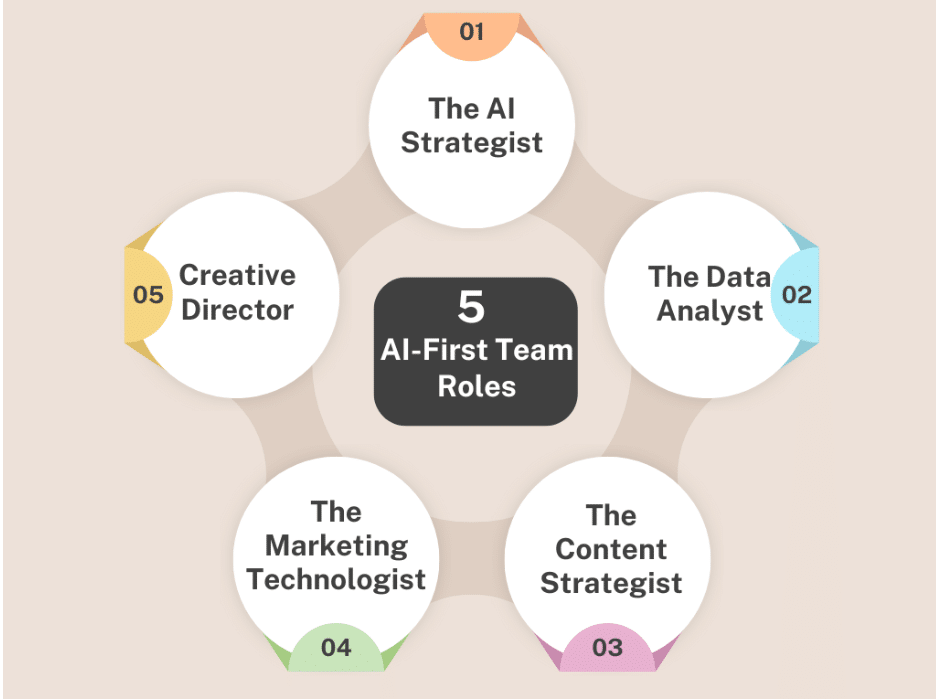
1/ The AI strategist. This person decides how and where AI gets used across your marketing — and just as importantly, where it shouldn’t be. They evaluate new tools, prioritize what actually drives ROI, and keep the team from going in too many directions at once.
This doesn’t have to be a standalone hire. In many teams, it’s a senior marketer or marketing director who owns this responsibility in addition to their existing role.
2/ The data analyst. An AI-first marketing team runs on data — and this person makes sure you’re actually using it well. They analyze campaign performance, customer behavior, and market trends to surface insights that the rest of the team can act on. Without this role, you’re essentially making decisions in the dark.
What sets a great Data Analyst apart on an AI-first team is their ability to work alongside AI tools — not just interpret spreadsheets. They know how to feed the right data into your AI systems, identify when the outputs don’t look right, and translate complex findings into clear recommendations that non-technical teammates can actually use.
3/ The content strategist. AI can generate content fast, but fast doesn’t always mean effective. The Content Strategist sets the tone, defines the brand voice, and creates the guidelines that keep AI-generated content feeling consistent and human.
On a practical level, they brief the AI, review the output, and decide what’s ready to publish and what needs more work. They also think beyond individual pieces — making sure everything connects across channels. This role needs someone who is both a strong writer and a strategic thinker.
4/ The marketing technologist. Most marketing teams have more tools than they know what to do with. The Marketing Technologist brings order to that. They manage your AI tool stack, handle integrations, and make sure all your platforms are connected and working effectively.
But their role goes beyond maintenance. They stay on top of new tools coming into the market, evaluate whether they’re actually worth adopting, and make sure any new addition fits into your existing setup without creating more problems than it solves.
5/ Creative director. The Creative Director brings the human judgment that no tool can replicate. They make sure your campaigns don’t just perform well on paper but actually connect with the people you’re trying to reach. From visuals to messaging, they’re the ones setting the creative standard across everything your team puts out.
They work closely with both the Content Strategist and the AI tools your team uses — but their job is to push the work further.
The essential AI tool stack
Getting the right people in place is important — but the tools they work with are just as critical. The challenge is that with hundreds of AI marketing tools launching every month, it’s easy to end up investing in software your team barely uses. The goal isn’t to have the most tools. It’s to have the ones that actually solve real problems.
Here’s a breakdown of the core categories your stack should cover:
1/ Content creation. Tools like ChatGPT, Claude, and Jasper have changed how marketing teams produce content. What used to take days can now take hours. You can generate blog posts, social captions, email copy, and product descriptions — all from a single brief. For visual content, marketers can pair their copy tools with image-to-image AI tools that transform existing assets into new styles, backgrounds, or formats. The Krea AI editing tool allows teams to create on-brand variations from existing images, helping them adapt visuals for different campaigns more efficiently.
That kind of speed gives your team more room to focus on strategy and creativity rather than staring at a blank page. That said, these tools work best when they have a clear direction. Without proper brand guidelines and well-structured prompts, the output can feel generic.
2/ SEO and analytics. Platforms like Surfer SEO and Semrush’s AI features take a lot of the guesswork out of content planning. They help you identify high-potential topics, understand what your competitors are ranking for, and structure your content in a way that search engines actually reward.
Beyond content, these tools give you a clearer picture of what’s working and what isn’t. Instead of spending hours pulling data and building reports manually, AI shows the insights that matter the most.
3/ Paid advertising. Meta Advantage+ and Google Performance Max have shifted how teams run paid campaigns. Rather than manually testing every audience, creative, and bid strategy, AI handles real-time optimization — making adjustments based on performance data that no human could process at the same speed.
This doesn’t mean you hand over full control and walk away. Your team still needs to set the right objectives, give the platforms quality content, and monitor results closely. But most of the day-to-day optimization is handled, freeing your team to focus on the bigger picture.
4/ CRM and personalization. Platforms like HubSpot and Salesforce Einstein bring AI into how you manage and engage your audience. They help you segment contacts more precisely, personalize communication based on behavior, and identify which leads are worth prioritizing at any given time.
What makes these tools particularly valuable is that personalization at scale used to require a large team and a lot of manual effort. Now, intelligent automation, powered by multi-agent systems, can tailor the experience for thousands of contacts simultaneously, making every interaction feel more relevant without adding more work to your team’s workload.
5/ Automation and workflow. A lot of time in marketing gets spent on tasks that are important but not exactly high-value. For example, moving data between platforms, triggering follow-up emails, updating records, and keeping everything in sync. Tools like Zapier and Make handle all of that.
They connect your tools, automate repetitive tasks, and ensure nothing gets missed, even if someone forgot to do it manually. The bigger benefit is that your team stops operating in reactive mode.
When the right workflows are in place, processes run on their own in the background through effective workflow automation, giving your team more time to focus on work that actually requires their attention.
6/ AI communication and outreach. How your team communicates with leads, customers, and prospects is just as important as the content you create. AI-powered communication tools bring intelligence into that process — powering chatbots that qualify leads in real time, automating follow-up sequences, and helping your team write better outreach emails that actually get responses.
Many teams also combine AI-driven outreach with external partners focused on b2b lead generation, especially when using personalized outreach across channels like email and LinkedIn becomes difficult to manage internally.
7/ Compliance, security, and governance. With the rise of AI-first marketing, the amount of customer data being collected and processed by marketing teams is also increasing. This is why compliance, security, and governance are more important than ever. This means that as your marketing becomes more data-driven and automated, your risk management will also keep pace.
Building AI into your workflows
Having the right team and the right tools is a great start. But if AI isn’t built into how your team actually works day to day, it won’t deliver the results you’re expecting.
The first step is figuring out where AI fits. Not every task needs it, and trying to automate everything at once is a quick way to create confusion. Start by looking at where your team spends the most time on repetitive, predictable, or process-driven work.
Here’s a practical way to think about it:
- Tasks AI should own. Tasks AI should own. First draft generation, data pulling, report formatting, social scheduling, and managing conversations through social inbox. These are tasks where speed matters more than creative judgment.
- Tasks AI should support. Campaign planning, audience segmentation, and content optimization. AI brings useful input here, but your team members should be making the final call.
- Tasks that should stay human-led. Brand strategy, creative direction, relationship building, and anything that requires careful judgment or emotional intelligence — similar to how shared equity models still rely on human decision-making despite structured ownership distribution.
Once you’ve outlined that, the next step is to build clear SOPs for how AI is used across each workflow. It’s about documenting the process so everyone on the team is using AI consistently and getting predictable results.
A good example is your content workflow. Instead of everyone approaching AI-generated content differently, you define the process — how briefs are structured, what prompts are used, how output gets reviewed, and what the approval process looks like before anything goes live.
Common mistakes to avoid
Using AI in your marketing team is valuable — but it’s also where a lot of teams make avoidable mistakes. Here are the most common ones to look out for:
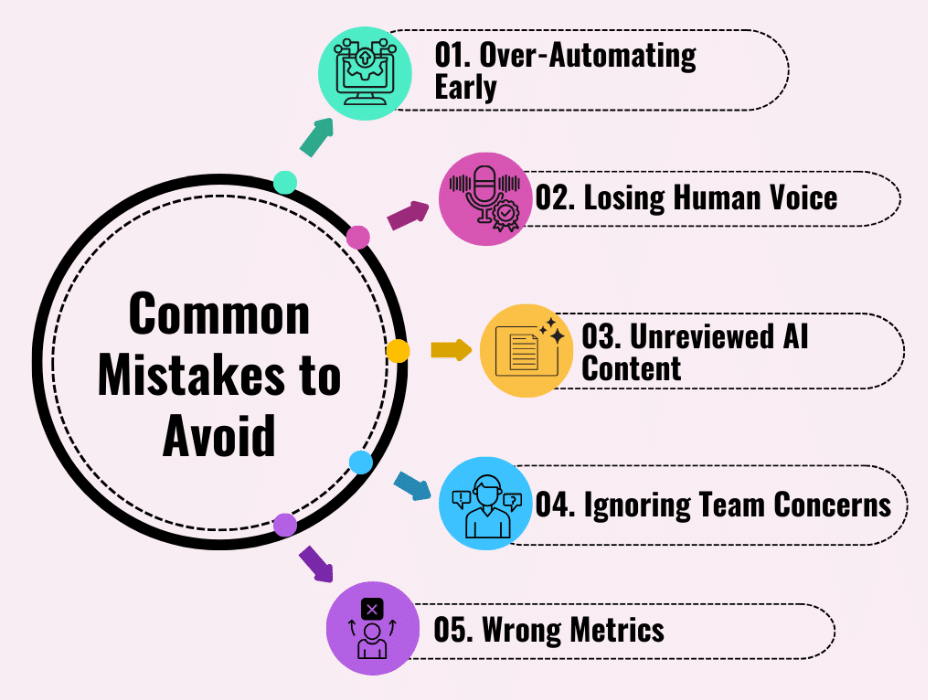
- Over-automating too early: The instinct to automate everything is real. But moving too fast without the right processes in place often creates more problems than it solves. Start with a few high-impact workflows, get them right, and then expand from there.
- Losing your brand’s human voice: AI can produce content quickly, but without proper direction, it tends to sound the same as everyone else’s. If your audience can tell your content was generated without much thought, you’ve already lost their attention.
- Publishing AI output without reviewing it: AI gets things wrong — facts, tone, context. Every piece of content that goes out under your brand name needs a human touch before it does.
- Ignoring your team’s concerns: Not everyone on your team will be immediately comfortable with AI. Pushing adoption without addressing concerns or providing proper training is a quick way to create resistance.
- Measuring the wrong things: It’s easy to get caught up in metrics that look good but don’t mean much. Focus on outcomes that tie directly to business performance — opportunities generated, conversion rates, revenue influenced — rather than output volume alone.
Conclusion
The shift to AI-first marketing is no longer a competitive advantage — it’s becoming the baseline. Teams that have the right structure, the right tools, and the right processes in place will simply outpace those that don’t.
But none of that happens overnight. Start with what you can act on today. Identify where AI can make an immediate difference, get the right people owning the right responsibilities, and build from there. AI won’t replace great marketing. But it will significantly improve it — and the teams that understand that difference are the ones that will come out ahead.