

Running a business in today’s economy feels a lot like trying to hit a moving target while standing on a treadmill. The rules keep changing, customer expectations evolve faster than ever, and the competition never sleeps. Yet amid all this chaos, one truth remains constant: companies that master the art of revenue generation don’t just survive, they thrive.
What separates thriving businesses from those merely getting by? More often than not, it comes down to people. Specifically, the teams responsible for bringing in new customers and expanding existing relationships. Getting this piece of the puzzle right can mean the difference between stagnant growth and explosive success.
Let’s explore what it really takes to build a revenue engine that runs smoothly, scales effectively, and delivers consistent results.

Why Traditional Approaches to Revenue Generation Are Falling Short
Remember when closing deals meant cold calls, steak dinners, and a firm handshake? Those days aren’t entirely gone, but they’ve certainly evolved. Today’s buyers are more informed, more skeptical, and have more options than ever before. They’ve often completed 70% of their research before ever speaking to a company representative.
This shift has created a fundamental problem for businesses clinging to outdated methods. The spray and pray approach of reaching out to everyone and hoping something sticks wastes resources and burns through potential leads. Meanwhile, relying solely on inbound marketing means waiting passively while competitors actively court your prospects.
The solution lies somewhere in the middle, but finding that sweet spot requires rethinking how revenue teams are structured, trained, and deployed.
Modern buyers expect personalized experiences. They want to feel understood, not sold to. They respond to outreach that demonstrates genuine knowledge of their challenges and offers specific solutions. This level of personalization demands specialized skills, dedicated focus, and the right tools.
Companies that recognize this shift are reorganizing their revenue functions accordingly. Rather than expecting a single representative to handle everything from initial outreach to closing to account management, they’re creating specialized roles that allow people to excel at specific stages of the customer journey.
The Anatomy of a Modern Revenue Organization
Think of a well-functioning revenue team like a relay race rather than a marathon. Each runner has a specific leg to complete, and success depends on smooth handoffs and specialized training for each portion of the race.
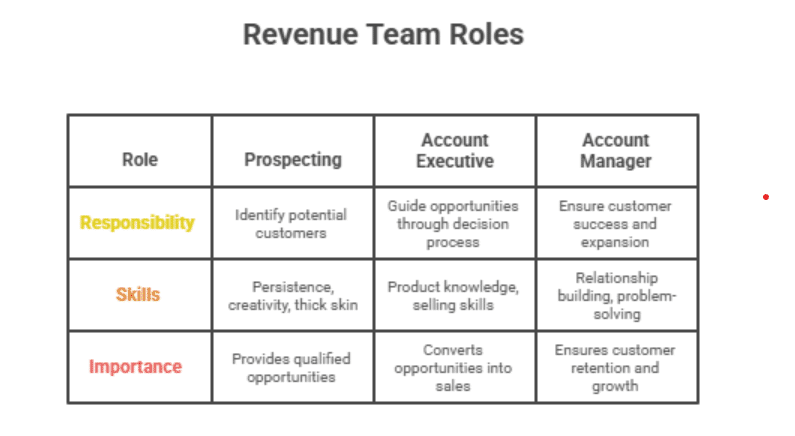
At the front of this relay sits the prospecting function. These are the people responsible for identifying potential customers, making initial contact, and qualifying whether there’s genuine fit and interest. It’s painstaking work that requires persistence, creativity, and thick skin. Most outreach attempts go unanswered, and rejection is a daily occurrence.
Yet this role is absolutely critical. Without a steady stream of qualified opportunities entering the pipeline, even the most talented closers have nothing to work with. It’s like having a world-class chef but no ingredients in the kitchen.
The next leg belongs to account executives or closers. These individuals take qualified opportunities and guide them through the evaluation and decision-making process. They conduct demonstrations, negotiate terms, handle objections, and ultimately ask for the business. This role demands deep product knowledge, consultative selling skills, and the ability to navigate complex buying committees.
Finally, account managers or customer success teams take over after the initial sale. Their job is to ensure customers achieve their desired outcomes, identify opportunities for expansion, and maintain relationships that lead to renewals and referrals.
When each of these functions operates at peak efficiency, the result is a revenue machine that generates consistent, predictable growth. When any piece falters, the entire system suffers.
The Talent Challenge: Finding and Keeping Great People
Here’s where things get tricky. Building these specialized teams requires finding people with specific skill sets, training them effectively, and keeping them engaged long enough to see returns on that investment. The talent market for revenue professionals remains incredibly competitive, with top performers commanding premium compensation and often receiving multiple offers.
For many growing companies, this creates an impossible situation. They need experienced professionals to accelerate growth, but they can’t afford to compete with larger organizations for that talent. They could promote from within, but that takes time they may not have. And hiring inexperienced candidates means a longer ramp to productivity with uncertain outcomes.
This challenge has led many forward-thinking companies to explore alternative approaches. Some have found success by partnering with specialized agencies that provide trained professionals on a fractional or outsourced basis. Others have leveraged technology to make smaller teams more productive. Still others have gotten creative about where and how they source talent.
When companies hire a sales team through specialized providers, they often gain access to pre-trained professionals who can hit the ground running. This approach eliminates much of the hiring risk while providing flexibility to scale up or down based on business needs.
The key is matching the approach to the company’s specific situation, growth stage, and resources. There’s no one size fits all solution, but there are proven models that work for organizations of various sizes and industries.

Technology as an Enabler, Not a Replacement
The rise of artificial intelligence and automation has sparked both excitement and anxiety in revenue organizations. Will robots replace human salespeople? Can algorithms identify and qualify prospects better than trained professionals? Should companies invest in technology or talent?
The truth, as usual, lies somewhere in the nuance. Technology has become essential for modern revenue teams, but it works best as an amplifier of human capabilities rather than a replacement for them.
Consider the prospecting function. Manually researching companies, finding contact information, and tracking outreach attempts across spreadsheets simply doesn’t scale. Modern tools can automate much of this tedious work, allowing professionals to focus on high-value activities like crafting personalized messages and having meaningful conversations.
Similarly, artificial intelligence can help identify which prospects are most likely to buy based on behavioral signals and historical patterns. It can suggest optimal times for outreach, recommend messaging approaches, and even draft initial communications for human review and refinement.
But technology falls short in areas that require genuine human connection. Building trust, understanding unstated concerns, navigating organizational politics, and crafting creative solutions to complex problems all demand the kind of emotional intelligence and adaptability that machines haven’t yet mastered.
The most successful revenue organizations find the right balance. They invest in technology that handles repetitive tasks and provides valuable insights while empowering their people to do what humans do best: connect, understand, and solve problems.
Building a Culture That Attracts and Retains Top Performers
Even with the right structure, technology, and talent acquisition strategy, success ultimately depends on culture. Revenue roles are demanding, often involving rejection, pressure, and long hours. The organizations that build sustainable high-performance teams create environments where people want to stay and do their best work.
What does this look like in practice? It starts with clarity. Top performers want to understand exactly what’s expected of them, how their success will be measured, and what resources they have available. Ambiguity breeds frustration and disengagement.

Recognition matters enormously. Revenue professionals are often competitive by nature, and public acknowledgment of achievements fuels motivation. But recognition needs to extend beyond just closing deals. Celebrating process excellence, creative problem-solving, and team collaboration builds a more sustainable culture than purely outcome-based praise.
Development opportunities keep people engaged over the long term. Ambitious professionals want to grow their skills, take on new challenges, and advance their careers. Organizations that invest in training, mentorship, and clear career paths retain their best people longer and develop deeper benches of talent.
Finally, compensation needs to be competitive and aligned with the behaviors you want to encourage. This seems obvious, but many organizations inadvertently create incentive structures that reward the wrong things. Short-term deal closing at the expense of customer fit, for example, or individual performance that undermines team collaboration.
Measuring What Matters: Metrics That Drive Performance
You can’t improve what you don’t measure, but measuring the wrong things leads to worse outcomes than measuring nothing at all. Effective revenue organizations identify the key metrics that predict success and build systems to track and improve them.
At the top of the funnel, activity metrics provide visibility into effort. How many prospects are being contacted? What’s the connection rate? These numbers help identify capacity issues and coaching opportunities.
Conversion metrics reveal effectiveness at each stage. What percentage of initial conversations turn into qualified opportunities? How many qualified opportunities result in proposals? What’s the win rate on proposals submitted? Tracking these ratios helps pinpoint where improvements will have the greatest impact.
Pipeline metrics provide forward-looking visibility. How much potential revenue sits at each stage? Is the pipeline growing, shrinking, or stagnant? Are there enough opportunities to hit upcoming targets? These indicators help leaders anticipate problems before they become crises.
Finally, outcome metrics tell the ultimate story. Revenue generated, customer acquisition costs, lifetime value, and retention rates reveal whether all the activity and effort is translating into sustainable business results.
The best organizations make these metrics transparent, review them regularly, and use them as a basis for continuous improvement rather than punishment.
Looking Ahead: Trends Shaping the Future of Revenue Teams
The landscape continues to evolve rapidly. Several trends are reshaping how companies think about building and managing revenue organizations.
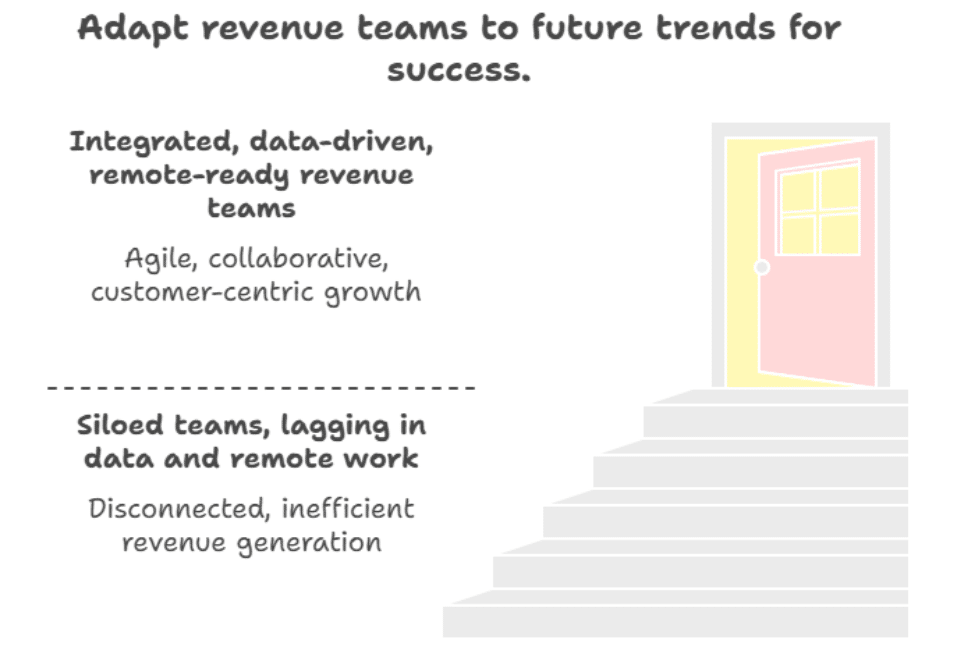
Remote and distributed work has become normalized, expanding the potential talent pool while creating new challenges for collaboration and culture building. Companies that master virtual team management gain access to talent regardless of geography.
Buyer expectations continue to rise. The bar for personalization, responsiveness, and value-added interaction keeps getting higher. Organizations that can’t meet these expectations find themselves losing to competitors who can.
Data and analytics are becoming more sophisticated. The ability to identify patterns, predict outcomes, and optimize approaches in real-time provides significant advantages to organizations that invest in these capabilities.
Finally, the line between sales and marketing continues to blur. The most effective organizations break down silos and create integrated revenue teams that align around customer journeys rather than departmental boundaries.
Taking Action: Where to Start
Reading about best practices is useful, but impact comes from implementation. If you’re looking to strengthen your revenue organization, start by honestly assessing your current state. Where are the gaps? What’s working well? What’s holding you back?
Next, prioritize ruthlessly. Trying to fix everything at once usually means fixing nothing. Identify the one or two improvements that would have the greatest impact and focus there first.
Consider whether you have the internal resources and expertise to make needed changes or whether external help would accelerate progress. Sometimes bringing in specialized expertise, even temporarily, can jumpstart improvements that would take much longer to achieve internally.
Finally, commit to continuous improvement. Building a great revenue organization isn’t a project with a finish line. It’s an ongoing journey of learning, adapting, and getting better every day.
The companies that master this journey don’t just grow faster. They build sustainable competitive advantages that compound over time. In a world where products and services can be copied quickly, the ability to build and maintain relationships with customers becomes the ultimate differentiator.
The opportunity is there for organizations willing to invest in their people, embrace modern approaches, and commit to excellence. The question isn’t whether these investments pay off. It’s whether you can afford not to make them.