

Imagine an e-commerce organization dedicates $40,000 per month with a 1.8% click-through rate on paid ads. The same targeting had been used for two years, the same creatives were recycled, and campaigns were optimised manually once a week.
Within six months of integrating AI into their paid and organic strategy, their conversion rate climbed to 3.4% – with the same budget. No additional headcount. No agency.
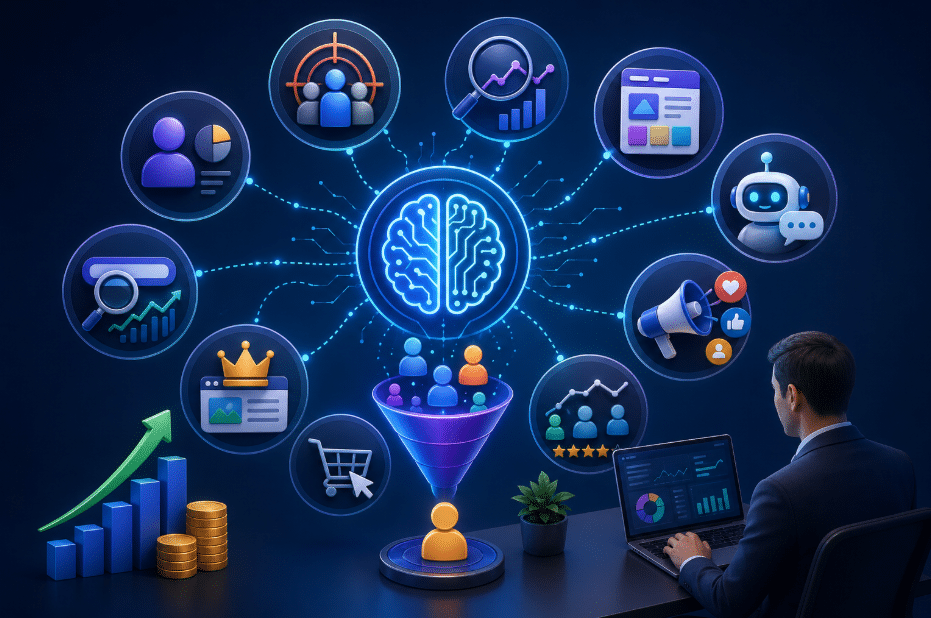
This isn’t an isolated case. It’s representative of what many marketing teams are quietly experiencing right now. The way businesses attract and convert customers is shifting, and AI in digital marketing services is driving a meaningful part of that change.
Here’s a grounded look at ten ways it’s actually happening.
1. Targeting That Goes Beyond Demographics
Most audience targeting still starts and ends with demographics: age, location, household income. It’s a reasonable starting point, but it doesn’t explain why a specific person is ready to buy.
AI targeting tools analyse behavioural signals – what people search for, what content they engage with, how long they spend on certain pages, and what actions typically precede a purchase. Your budget stops being spent on audiences that loosely resemble your customers and starts working harder on people who are already exhibiting buying behaviour. For brands running social or display advertising, this shift can produce a measurable reduction in cost per acquisition.
2. Making Sense of Data Before Decisions, Not After
In marketing, it resembles rather disillusioning trends; data from the past quarter usually are used for decisions based on performance, when the teams find out that those data become irrelevant immediately. Markets have, by that time, moved away.
Predictive analytics flips this dynamic. Rather than analysing the past, AI models use historical and real-time signals to anticipate what’s likely to perform – before the budget is committed. Which customer segments are most likely to convert next month. Which ad placements are likely to perform best next week. Which content topics are gaining search traction before competitors have addressed them.
No predictive model is perfect. But a model that’s right more often than gut instinct creates compounding advantages in how budgets get allocated.
3. Personalisation that Doesn’t Require a Large Team
Research consistently shows that the majority of consumers expect personalised interactions from brands – and feel frustrated when they don’t receive them. The benchmark has been set by the largest consumer platforms, and audiences now apply that expectation broadly.
True personalisation at scale used to require significant engineering infrastructure. That’s changed. AI now enables lean marketing teams to deliver dynamic website content that adapts based on visitor history, email sequences that respond to individual behaviour rather than a fixed send calendar, and product recommendations that reflect what a specific customer is likely to want next. A clean dataset and thoughtful configuration are still prerequisites — but the barrier to entry is substantially lower than it was a few years ago.
4. Chatbots that Actually Help
Most people have had a frustrating chatbot experience – bots that respond to every question with a link to a FAQ page, or decision trees that can’t accommodate anything outside a narrow script.
AI-powered conversational tools are a different proposition. They understand context, handle follow-up questions, and carry the thread of a conversation from one exchange to the next. For customer acquisition specifically, this shows up in a few concrete ways: qualifying leads before routing them to sales, answering pre-purchase questions instantly without requiring a human in the loop, and re-engaging visitors who are about to leave without converting.
One software company seeing dramatic improvements in talking-new-starting-trials-into-buyers integrated an AI chatbot that guided novices through the software during the first week. The chatbot didn’t replace the onboarding team; it took care of the volume that the human team could not reach.
5. SEO Built Around What People Actually Want
Search engine optimisation services used to be largely mechanical: identify high-volume keywords, build content around them, earn backlinks. That model still has relevance, but it’s no longer sufficient on its own.
The search algorithms are improving and getting efficient enough to understand user intent i.e., what a user actually wants rather than which words they typed for finding their desired answer. AI-based solutions may allow marketers to be in sync with this change by detecting intent patterns from masses of search data. Ad-hoc manual research would take ages to find these patterns. However, AI can also pinpoint content gaps and flag pages with wrong intent that are underperforming.
Though some might say the line between keyword-based and intent-based SEO is subtle, the difference in quality between the traffic that follows is huge. Visitors who land on your page because it really does offer an informative response to what they were seeking are more likely to convert than those who land because of loosely matched keyword hits.
6. Paid Campaigns that Optimise Continuously
Managing paid media campaigns has traditionally been labour-intensive, checking performance daily, adjusting bids manually, pausing underperforming ad sets, and testing new creative on a limited schedule.
Artificial intelligence now goes dance on iteratively optimizing tools: making constant little tweaks; shifting budget away from converters and toward placements and audiences that convert; and carrying out much faster creative tests than any manual A/B tests allow. Improvement soars in these campaigns without waiting for weekly or monthly reviews.
Being focused on optimization is just plain unworkable if the workings or thorough aims of the campaign are not crystallized, the conversion tracking is not quite right, or the data quality is unacceptable. Whereas good inputs can be set up to be magnified by technology, the bad ones cannot..
7. Content Strategy with Less Guesswork
Most content teams publish more than they should, with only a fraction of output driving meaningful traffic or conversions. The issue usually isn’t effort – it’s prioritisation.
AI content intelligence tools help by identifying topics with genuine growth potential before they become saturated, surfacing existing pages that are close to ranking well and need targeted improvements, and mapping content gaps against what audiences are actively searching for. Many high-performing pages are sitting on page two of search results and could reach page one with specific, identified changes – AI can systematically surface those opportunities in a way that manual content audits rarely do.
To be clear: AI doesn’t write strong content on its own. What it does is remove the guesswork from deciding what’s worth writing in the first place.
8. Understanding Where Customers Actually Drop Off
A typical case: a business regularly monitoring its overall conversion rate, with only a vague idea what stops it from being higher. Suspecting the checkout or pricing pages, indistinct cause or perhaps onboarding. Changes are made in a rather lacklustre manner due to the absence of data, and one or another team waits for the results.
Through AI-powered journey analytics, behavioral data spread over sessions, devices, and channels is used to reveal exactly where users are abandoning the funnel-and, in some cases, why. Most important is that these tools can segregate drop-offs characterized by a real problem (a confusing pricing structure, a broken form) from those that were just natural for the buyer behavior (users who need to come back a few times to get convinced); and that is the difference that creates the differentiation between solving a real problem or optimizing for natural audience behavior.
9. Lead Scoring that Sales Teams Actually Trust
The tension between marketing and sales over lead quality is longstanding. Marketing sends leads; sales says they’re unqualified. Sales doesn’t follow up fast enough; marketing says the leads were good. The cycle repeats..
AI-based lead scoring doesn’t resolve the underlying tension, but it gives both teams a shared, objective framework. Rather than scoring leads purely on demographic fit, AI models factor in behavioural signals: how many times someone visited the pricing page, whether they downloaded a case study, and how long they engaged with a product demo. Blending firmographic and behavioural data produces scores with stronger predictive power. Sales teams spend less time on leads that won’t convert. Marketing gets more precise feedback on which acquisition activity is generating genuinely qualified interest.
10. Acting on Data in Hours, Not Weeks
Standard marketing reporting cycles run weekly or monthly. Something goes wrong on a Tuesday; the insight arrives two or three weeks later – by which point a campaign has spent considerably more than it should have, and the window to intervene has closed.
Real-time AI analytics changes the operational tempo. Anomalies in campaign performance surface immediately. Alerts flag underperforming activity before it accumulates significant wasted spend. Content or creative that is outperforming expectations gets identified early enough to act on.
This is especially valuable for time-sensitive campaigns – product launches, seasonal promotions, event-driven advertising – where the window to capitalise on momentum is narrow and a week-old insight is already stale.
Sweet operational shift, right? Rather, the apt thing to do would be to think of campaign monitoring as an everyday endeavor rather than an occasional one. AI makes it possible. The trick remains in furthered good judgment, which would differentiate between relevant signals from plain noise, determining whether such capacities will indeed result in better decisions
Here’s How It Adds Up
AI today is more than just a speculative entity in acquiring new life for a customer; it is shaping the way businesses attract, engage, and convert leads into prospects. The bench-marking tools utilized in SEO, paid search advertising, and content marketing are six thousand times better at making more accurate decisions consistently-and that too, without losing limited resources.
And it finally boils down to humans, not machines. Because no one and no system can take human judgment out of a business. The machine’s prime objective is to empower human judgment with the means necessary to reach decisions much more quickly and far more efficiently. Businesses that find this balancing act, functioning in tandem between data-powered tools and strategic thinking, are better geared to embrace growth in a digital environment where competition is moving with stealing exhilaration.