

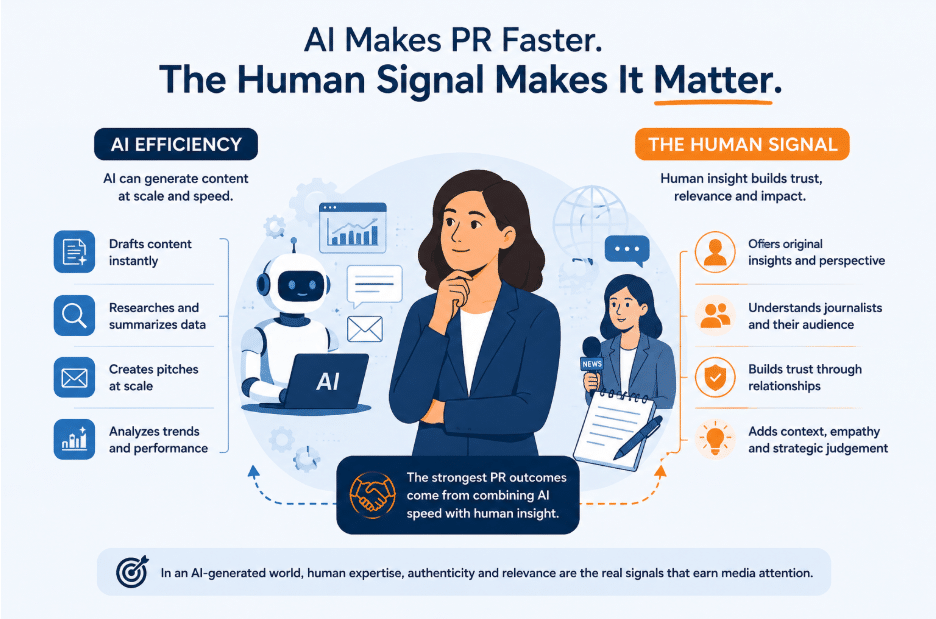
Artificial intelligence has reshaped the way public relations teams produce and share content. From writing press releases to creating media pitches, AI enables communicators to work faster and at a much larger scale. While these capabilities have improved efficiency, they have also contributed to a surge in the volume of content reaching journalists every day. With inboxes becoming increasingly crowded, standing out is no longer about producing more content—it is about delivering something genuinely valuable.
This shift has made the concept of the Human Signal more relevant than ever. In an AI-generated world, journalists are looking beyond polished copy and perfectly formatted pitches. They pay greater attention to authentic expertise, original insights, timely relevance and a clear understanding of their audience. These qualities separate meaningful stories from the growing stream of automated communication and form the foundation of effective journalist outreach.
Rather than replacing human judgement, AI in PR is changing where communicators create the most value. AI can streamline routine tasks and accelerate content production, but it cannot replicate the trust, credibility and meaningful relations that develop through genuine expertise and thoughtful storytelling. As AI becomes a standard part of modern PR workflows, organisations that consistently earn earned media will be those that use technology to enhance—rather than replace—the human qualities journalists continue to value most.
AI Increased the Noise, Not the Attention
Artificial intelligence has significantly reduced the time it takes to create PR content. A single announcement can now be repurposed into multiple press releases, media pitches, social posts and email campaigns within minutes. While this has improved efficiency, it has also contributed to an overwhelming increase in content competing for journalists’ attention. Newsrooms are receiving more outreach than ever, much of it generated or heavily assisted by AI. The result is not necessarily better communication, but a much noisier information environment.
For journalists, this growing volume has changed how they evaluate incoming pitches. Well-written copy alone is no longer enough to make a story stand out because AI can produce polished language at scale. Instead, reporters quickly look for indicators that a pitch offers genuine value, whether through a timely perspective, exclusive information or a clear connection to their audience. Generic messages, even when grammatically flawless, are often easy to recognise because they lack specificity and meaningful context.
This shift highlights an important reality for modern public relations. Automation can help create content faster, but it cannot guarantee meaningful media coverage or stronger relationships with journalists. As more organisations rely on similar AI tools, attention becomes the scarce resource rather than content itself. PR professionals who prioritise originality, relevance and authentic insight are far more likely to rise above the noise and capture the interest that automated communication alone cannot achieve.
What Journalists Actually Notice First
With inboxes overflowing, journalists have become highly selective about the stories they choose to explore. Personalising a subject line or mentioning a recent article may help a pitch get noticed initially, but those tactics rarely sustain interest on their own. What captures attention is the substance behind the message. Reporters want information that helps them explain a trend, uncover a new perspective or provide genuine value to their readers.
One of the strongest signals is originality. Journalists are constantly exposed to recycled statistics, predictable commentary and announcements that closely resemble dozens of others. A pitch built around fresh research, proprietary data, customer insights or a unique point of view immediately stands apart. It gives reporters something they cannot easily find elsewhere and makes the story more relevant to their audience.
Context is equally important. Even a compelling story can be overlooked if it fails to explain why it matters now. Successful journalist outreach demonstrates an understanding of current industry conversations and clearly connects the story to broader developments, rather than presenting it in isolation. Combined with credible sources and genuine expertise, this approach strengthens brand credibility and shows that the pitch is designed to inform rather than simply attract attention. In an era where AI can generate endless content, these human qualities remain the signals journalists value most.
Relationships Are Becoming More Valuable Than Automation
As AI continues to streamline content creation, one aspect of public relations has become even more important: building genuine relationships with journalists. Automation can draft emails, summarise research and suggest headlines, but it cannot establish the trust that develops through consistent, thoughtful interactions. Strong media relations are built over time, not through a single well-written pitch.
Journalists are more likely to engage with PR professionals who understand their beat, respect their deadlines and consistently share relevant stories instead of sending every announcement to every contact. This reliability creates confidence that future pitches will also be worth considering. In contrast, mass outreach generated with little regard for a journalist’s interests can quickly weaken relationships, regardless of how polished the content appears.
The most effective PR strategy treats media engagement as an ongoing conversation rather than a series of isolated campaigns. Following up with useful information, offering access to knowledgeable spokespeople and providing timely updates all contribute to stronger professional relationships. These interactions demonstrate that the goal is to support accurate reporting, not simply secure coverage.
As AI becomes a standard part of communication workflows, relationship capital is becoming a greater competitive advantage. Organisations that invest in trust, credibility and meaningful collaboration are far more likely to earn long-term media attention than those relying primarily on automated outreach. In today’s environment, authentic relationships remain one of the strongest human signals a PR team can offer.
Why Original Thinking Is Becoming a Competitive Advantage
As AI-generated content becomes more common, originality is becoming one of the few qualities that cannot be easily replicated. Most AI systems generate responses by identifying patterns in existing information, which means they often produce content that is accurate and well-structured but familiar. While this can improve efficiency, it rarely delivers the fresh perspective journalists need to create compelling stories.
This is why organisations with genuine expertise are gaining a stronger advantage in AI in PR. Original research, first-party data, customer trends, executive insights and real-world experiences provide information that AI cannot invent or reproduce independently. These assets give journalists access to new angles and credible evidence that help their reporting stand out, making the source itself more valuable.
Original thinking also reflects a willingness to contribute to industry conversations instead of simply responding to them. Brands that publish meaningful analysis, share lessons from practical experience or offer informed opinions on emerging developments are more likely to be recognised as trusted voices. This type of thought leadership supports long-term brand credibility because it is based on knowledge rather than repetition.
In a crowded media environment, journalists are not just searching for well-written content—they are searching for something worth covering. As AI continues to make content creation easier for everyone, the organisations that consistently produce unique insights and valuable expertise will have a greater chance of earning meaningful media attention and sustaining long-term relevance.
The Human Signals Every PR Team Should Strengthen
While AI can improve efficiency across many PR tasks, the qualities that consistently attract journalists remain deeply human. Strengthening these signals helps organisations create outreach that is more credible, more relevant and more likely to result in meaningful media coverage.
A clear point of view is one of the strongest differentiators. Rather than repeating widely accepted opinions, effective communicators explain why an issue matters and contribute informed perspectives supported by experience or evidence. This makes a story more useful to journalists looking for expert commentary instead of generic statements.
Evidence is equally important. Proprietary research, customer insights, industry data and real case studies add credibility that AI-generated copy alone cannot provide. Supporting claims with verifiable information increases confidence in the story and gives journalists stronger material to reference in their reporting.
Successful journalist outreach also reflects an understanding of each publication and its audience. Tailoring a pitch around topics that genuinely align with a journalist’s beat demonstrates preparation and respect for their work, making outreach feel relevant rather than transactional.
Finally, PR teams should view AI as a tool that supports better decision-making, not one that replaces it. Automation can assist with drafting, research and organisation, but human judgement is still essential for identifying newsworthy angles, building media relations and protecting brand credibility. These capabilities form the human signal that continues to separate effective communication from content that is quickly overlooked.

AI Is Becoming Standard. Human Judgment Is Becoming the Differentiator
The rapid adoption of AI means that advanced technology is no longer a competitive advantage on its own. As more organisations use similar tools to draft content, analyse trends and streamline workflows, the quality of AI-generated communication is becoming increasingly consistent across the industry. When everyone has access to comparable capabilities, technology becomes the baseline rather than the factor that sets a brand apart.
What continues to create differentiation is human judgement. Deciding which stories deserve attention, identifying the right spokesperson, understanding the wider context of an issue and recognising what will genuinely interest journalists all require strategic thinking that extends beyond automation. These decisions are shaped by experience, industry knowledge and an understanding of how media narratives develop over time.
This shift is redefining the role of AI in PR. Instead of replacing communicators, AI is allowing professionals to spend less time on repetitive tasks and more time refining strategy, strengthening relationships and uncovering meaningful stories. The greatest value no longer
Conclusion
Artificial intelligence has undoubtedly changed how public relations teams work, making it easier to create content, manage workflows and scale journalist outreach. However, the growing use of automation has also made attention more difficult to earn. As journalists receive an increasing volume of AI-assisted pitches, they are placing greater value on qualities that technology alone cannot deliver—original insights, credible expertise, relevant context and trusted media relations.
The Human Signal is not about rejecting AI but about recognising where human judgement creates the greatest impact. Automation can support efficiency, yet meaningful earned media still depends on authentic storytelling, strategic thinking and relationships built over time. These are the factors that help organisations stand out in a crowded media environment and strengthen long-term brand credibility.
As AI in PR continues to evolve, the most successful communicators will be those who use technology to enhance, rather than replace, human expertise. In a world where content is increasingly easy to generate, it is the distinctly human qualities behind that content that will continue to capture journalists’ attention and build lasting trust.
comes from producing more content, but from producing content that reflects insight, credibility and purpose.
The future of public relations will belong to organisations that combine the speed of AI with distinctly human strengths such as critical thinking, ethical judgement, creativity and empathy. These qualities transform efficient communication into trusted communication, ensuring that brands remain relevant even as technology continues to reshape the media landscape.