

AI has redefined the search process, diminishing the impact of traditional SEO—and making PR more critical than ever for brand visibility, credibility, and discovery within AI-driven search results. As AI-powered features increasingly control what users see (and don’t click), brands that rely solely on SEO risk becoming invisible.
With the rise in the volume of AI overviews and the introduction of Google AI Mode, brands must focus more on mentions in trade publications and local news than on owned media like blogs. By consistently associating your brand with specific expertise or values, businesses can use that earned media to stay visible in AI search. This post will help you understand how to use PR to optimize your company’s visibility in today’s AI-powered search.
Understanding How AI Search & Google AI Mode Work
Traditional web search largely relied on keyword matches and link hierarchies, but that’s changing with the use of AI.
With Google AI Mode, users engage in conversational, AI-powered search queries and receive a synthesized answer drawn from multiple web sources. Google accepts search queries in the form of text, voice, and even images.
Moreover, search results are also evolving from lists of links to richer, contextual responses that anticipate follow-ups, understand complex queries, and treat search more like a dialogue than a list.
What’s Changing in Search Behavior?
Search behavior is undergoing a significant transformation as users adopt AI-powered tools.
AI-generated summaries and answer boxes are increasing, which means many searches end without a click-through to a website, so-called “zero-click” searches (accounting for 60% of Google searches).
At the same time, visual, voice, and multimodal searches are rising. Search engines and AI systems are placing more weight on intent, context, and brand authority than just keyword matching.
Why PR Matters in the AI Search Era
Earlier PR was all about earning high-value, organic backlinks, securing brand mentions, and building credibility through media placements. But in the AI era, it has changed dramatically. Here are some reasons why PR matters:
- LLMs and AI search systems rely on brand mentions and citation signals to evaluate authority. The earned media that PR generates helps create that.
- Besides earned media and citations, establishing a brand narrative is also crucial. With PR, you can shape your brand narrative on the web that ensures that when AI systems cite content, they draw from consistent, high-quality sources about who you are and what you do.
- With features like Google AI Mode and AIOs gaining ground, brands that lack a substantial media presence risk being invisible in responses, even if they rank well in traditional search.
Legal expert Jill Kolodner from WGK Personal Injury Lawyers notes that AI often struggles to make the careful judgments we do. It may not accurately differentiate between older issues and current situations. As a result, AI-generated content can include outdated or misleading information, promote negative feelings, or completely misunderstand the context.
PR teams must be vigilant in monitoring online reputation and quickly address any misinformation or negativity before it becomes part of AI-generated summaries.
In all three pointers, a planned PR strategy is the ultimate solution.
How PR & SEO Converge & Diverge in the AI Search Context
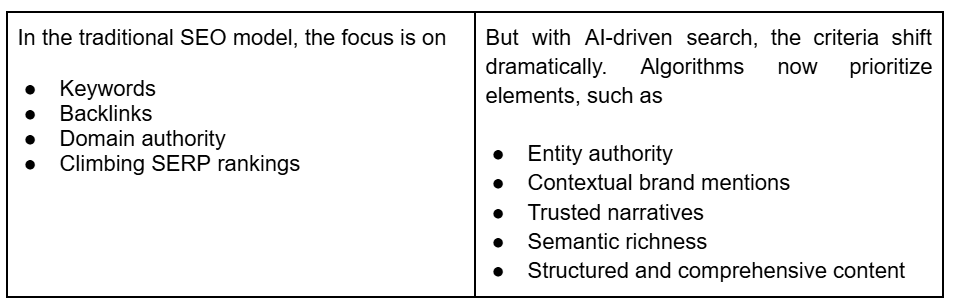
PR bridges both worlds. On the SEO side, it still supports link-building. But more strategically, it delivers high-trust earned media that LLMs and AI systems interpret as credibility signals. This helps your law firms show up not just in search rankings, but in AI-generated summaries.
Key Elements of a PR Strategy for AI Search & Google AI Mode
If you aim to beat the market in terms of online visibility, you need an effective PR strategy with a blend of editorial credibility, technical optimization, & ongoing engagement. Nicole Duncan, Founder of Duncan Family Law, recommends the following critical elements of that strategy.
Earned Media in Authoritative Sources
AI-driven systems heavily lean on trusted, third-party content. For instance, one report found that 85.5% of AI citations come from earned media, not paid ads. Look for targeting respected publications or well-known business press, and cite expert commentary because these are the sources that AI models are most likely to trust and cite.
Also, be sure to focus on maintaining a clear, uniform narrative across all earned media. Whether it’s a quote in a news article, a bylined op-ed, or a discussion in a webinar, your messaging should reinforce your unique value. Consistency helps AI systems correctly map your brand as a credible expert.
Optimize Your Brand Mentions
Ensure that mentions of your brand name and any are precise and consistent. It’s best to use the full name of your brand in every external mention. These repeated, well-structured references serve as strong entity signals that help AI systems build a rich “knowledge graph” around your company.
Create Semantically Deep & Conversational Content
To optimize for AI, produce thought leadership content that is detail-rich, includes or refers to expert commentary, and answers to FAQs. These must be semantically rich and anticipate client questions. AI systems favor content written in clear, conversational language that explores not just the what, but the why and how. This helps your brand become a trusted source for AI-generated answers about your specialty areas.
Note: As 80% of voice searches are conversational in nature, often phrased as full questions, the created content can serve as answers to queries and help significantly in ranking.
Monitoring & Measuring Brand Mention Impact
Most important of all, track your brand’s presence in both traditional media and AI-generated content. Use AI visibility tools (or media monitoring platforms) to see how often you are cited in AI Overviews, LLM outputs, or similar contexts. This will help you understand which narratives resonate and where to double down.
As AI search becomes less about links and more about recognition, AI visibility functions much like reputation tracking, you’re not just measuring presence, but influence. Tools like SE Visible help teams observe how often brands are surfaced, summarized, or referenced by AI systems, similar to seeing which experts get quoted repeatedly in news coverage. This kind of visibility insight makes it easier to understand whether PR efforts are translating into meaningful exposure within AI-driven results.
Helpful Suggestion: Profound is an AI visibility tracking platform that can help track brand visibility and share of voice in AI search engines. It can also suggest actions that can improve your AI search rankings and increase brand exposure.
Challenges and Pitfalls in PR for AI Search
While there are ways to strengthen your PR efforts for AI search, there are some fine challenges and pitfalls that you must be aware of.
- Quality over Quantity: Simply racking up mentions isn’t enough because AI systems check where those mentions come from. Coverage in low-trust or irrelevant sources carries less weight than earned media in authoritative points.
- Attribution Uncertainty: It’s difficult to directly connect PR efforts to AI-search visibility. Unlike traditional SEO, the models’ internal reasoning and citation behavior aren’t fully transparent.
- Rapidly Evolving Landscape: AI search engines, models, & algorithms change fast. A PR strategy that worked six months ago may no longer be effective today.
- Crawlability & Accessibility Issues: If your content or mentions are behind paywalls, poorly marked up, or not crawlable, AI systems may fail to “see” or cite them.
Conclusion
With the changes in the AI landscape, Google search is changing rapidly. Though SEO is still important, it can be risky to rely solely on it. Today’s brands must promote the use of PR in boosting their ranking and visibility in AI results, whether it is in Google AI mode or LLM results. Aligning your brand’s PR practices with the mentioned tactics can help you beat the competition and come out on top.