
PR Measurement: The Ultimate Guide
For decades, Advertising Value Equivalencies (AVEs) were the default way PR teams measured value. In the era when coverage was calculated by column inches and broadcast airtime, AVEs assigned a dollar figure to earned media by estimating what the same space would have cost as an ad.
As newer media channels developed and consumer preferences shifted, the PR industry has gradually moved away from traditional metrics and adopted newer metrics that provide deeper context into campaign performance and align with the growing emphasis on a data-driven strategy.
PR measurement now covers a range of qualitative factors to paint a clearer picture of campaign performance. Measures such as industry benchmarking, sentiment analysis, message pull-through, and mentions provide much more insight into how the audience perceives your brand and how your efforts compare with your competitors’.
And the rapid rise of AI has accelerated this transition, with PR and communications professionals expected to measure faster, more accurately, and more deeply than before. Teams are embracing AI-powered sentiment analysis, automated insights, real-time trend detection, and new questions around accuracy, governance, and data ethics.
Modern-day PR measurement has come a long way from AVEs; now it’s all about aligning metrics to business objectives, understanding how the campaign performed across multiple touchpoints, and benchmarking metrics to analyze performance in a broader context.
But before we understand how it works, let’s dive into what PR measurement is and why it is so important.
The Key Benefits of PR Measurement
Tracking results and analyzing media performance is critical to demonstrating impact, prioritizing budgets, and optimizing future course of action. Let’s go over key benefits as to why measurement remains a cornerstone of every PR strategy:
Optimizing campaign performance
Accurate PR measurement helps reveal which messaging resonates with the audience, highlights the channels driving the most traction, and identifies the core drivers of campaign success. Real-time results provide greater visibility into performance, enabling the tweaking and refinement of campaigns for improved success.
Informing future strategy
Analyzing results from current and previous campaigns highlights the critical metrics and key performance indicators (KPIs) most important to your organization.
It offers a roadmap for future campaigns, helping focus on what KPIs to closely observe and establish realistic goals.
Enabling accountability
With greater insight into performance, PR teams can effectively highlight strengths and opportunities while also addressing potential threats and weaknesses that could harm an organization’s reputation.
This helps enable responsibility across key stakeholders and facilitates effective communication with clients.
Proving PR value
Modern PR measurement focuses on KPIs that go beyond reach and views, helping organizations understand the impact of their PR efforts and how they shape their overall brand reputation.
Demonstrating the ROI on PR spend helps secure better budgets and also increases leadership buy-in for your ideas.
Demonstrating Impact – How to Measure PR
Measuring impact and proving ROI has been a perennial PR obstacle, with 50% of PR and communication professionals stating it is their biggest challenge.
However, before we dive deeper into how to measure PR, there are three crucial points we want to make:
- There is no single magic metric that will replace AVEs.
Especially not one that will provide a universal value for all your various activities. When building your measurement framework, look at each of your PR activities individually and determine which metric(s) best capture success. It will require more effort, but the results will be worth it.
- If you still use AVEs, we’re not here to condemn you.
You’re part of a small minority (6%) that still uses them. We will encourage you to consider them in the same way you would other metrics, not in isolation. Otherwise, the value is far too open to interpretation. If all your media coverage this month was worth $150,000 in advertising equivalencies, that’s great… right? Not if your goal was $250,000 and your coverage was worth $300,000 last month. Metrics are far more valuable and helpful when you have benchmarks or goals to compare them to.
- If you don’t have benchmarks – set them!
Look at your media coverage, your web traffic, social media followers, or whatever is important to you, for the last month, quarter, or year. If you don’t already keep track, you’ll need to devote a bit of time to the project, but we promise you’ll thank us for it later.
Defining impact in PR measurement
Proving PR impact in a way that leaders understand is challenging, but it is absolutely achievable. At its core, impact means driving a desired effect on a desired outcome.
Direct impact occurs when a PR activity leads to an immediate, visible business result. For example, a banking brand sees new inquiries referencing a recent article, or a retail client’s product sells out after a television feature. In these cases, the connection between coverage and outcome is unmistakable.
If only it were always like that.
However, chances are most likely you’ll end up with indirect impact—a PR activity that has an implied business outcome.
PR will rarely get the credit for increasing sales or winning new customers. Even if you got your hands on the data, you wouldn’t be able to draw a straight line from your PR outcomes to overall revenue.
Often, PR delivers indirect impact – outcomes influenced by communications but not directly tied to a sale or conversion. This is where proxy metrics, such as impressions, reach, share of voice, and earned media value, demonstrate their contribution and provide essential context.
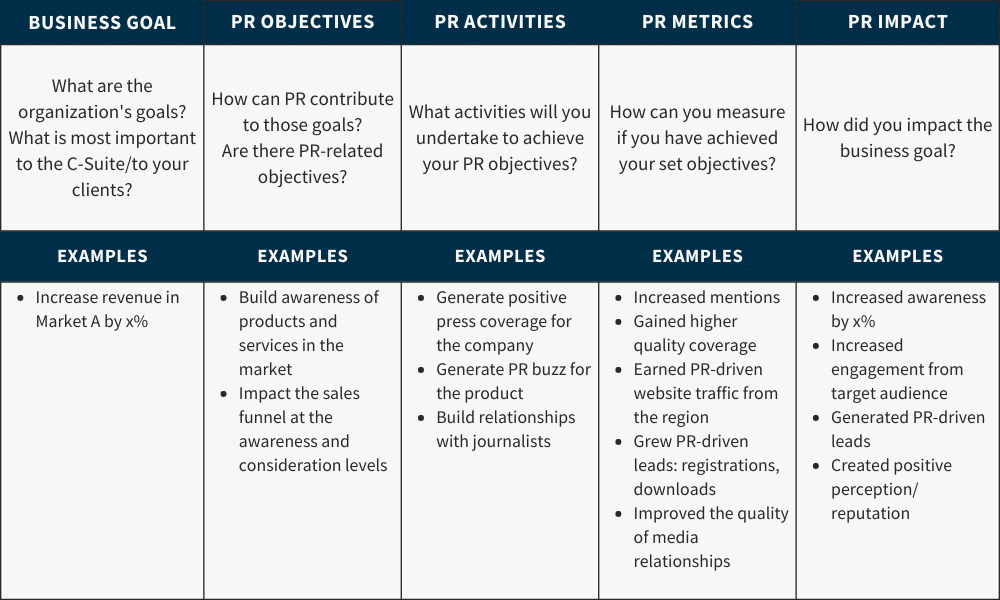
Regardless of whether your impact is direct or indirect, it only becomes meaningful when mapped back to business goals. Before launching any initiative, clarify the organization’s aim, determine how PR supports that objective, and select the metrics that will demonstrate progress. This alignment is the foundation of credible, strategic PR measurement.
Here it is broken down a bit more and placed into an accessible framework that our team uses with clients.
Key metrics for PR measurement
Modern PR measurement relies on a blend of quantitative and qualitative metrics that show how well your communications efforts drive visibility, shape perception, and influence real business outcomes.
PR metrics and KPIs should offer PR teams a structured way to evaluate coverage quality, audience impact, and long-term brand results. By consistently tracking these metrics, organizations can transition from activity-based reporting to insight-driven decision-making.
Here are the top metrics and KPIs that modern PR and communication professionals use to gauge PR success:
Impressions
The total number of times your coverage is displayed. This helps organizations understand overall visibility and the scale of potential exposure.
Reach
The number of unique individuals exposed to your coverage. It reveals the true breadth of your audience and the extent to which your message ‘reaches’ them.
Earned media value
An estimated monetary value of coverage based on what equivalent placements would cost. It helps quantify the financial impact of PR activity.
Share of voice
A measure of your brand’s presence relative to competitors. It indicates market prominence and how effectively your messaging leads the conversation in your industry.
Conversion rate
The percentage of users who complete desired actions, such as demos or signups. This connects PR programs to tangible business outcomes and pipeline influence.
Sentiment
An evaluation of whether coverage is positive, negative, or neutral. It provides a clear read on brand reputation and the public perception tone.
Social media engagement
Interaction metrics such as likes, comments, shares, and reposts. Engagement shows the level of audience interest and the resonance of your message.
Brand mentions
The number of times your brand is referenced across media. This helps measure awareness, topic relevance, and growth in visibility over time.
The volume of users visiting your website is often tracked during or after campaigns. It reveals how effectively PR drives discovery and deeper audience interest.
Leading PR platforms, including Agility PR Solutions, offer integrations with Google Analytics to help PR teams understand how users interact with their brand online and correlate website traffic with media activity.
SEO impact
Measures search visibility improvements driven by PR, including backlinks and ranking lifts. This shows how media placements strengthen long-term discoverability.
Lead generation
The number of qualified leads attributed to PR efforts. It helps organizations link communications to revenue potential and downstream sales outcomes.
Message pull-through
Tracks whether key messages appear consistently across coverage. This indicates how effectively your narrative is resonating and whether reporters are highlighting key themes.
Media quality score
Assesses each placement based on authority, relevance, and depth. It helps teams understand the strategic value of coverage beyond volume alone.
Reputation impact score
A composite measure that reflects how coverage affects trust and brand perception. It helps quantify long-term reputation trends rather than short-term reactions.
Crisis response performance
Evaluates the speed and effectiveness of communication during crises. This helps organizations refine its response workflows and measure recovery in sentiment and media framing.
For a deeper understanding of the core metrics for PR measurement, read our in-depth blog here.
Individually, these metrics provide siloed snapshots of performance, but their true impact becomes apparent when put together.
A unified measurement framework connects visibility, sentiment, engagement, and conversions to provide a clear picture of how PR contributes to brand reputation and organizational growth. By aligning these indicators with your strategic goals, you can demonstrate measurable impact, optimize future campaigns, and communicate results with confidence.
Track share of voice, sentiment, performance trends, and more! Via Agility PR Solutions’ dynamic dashboards.
PR and the customer journey
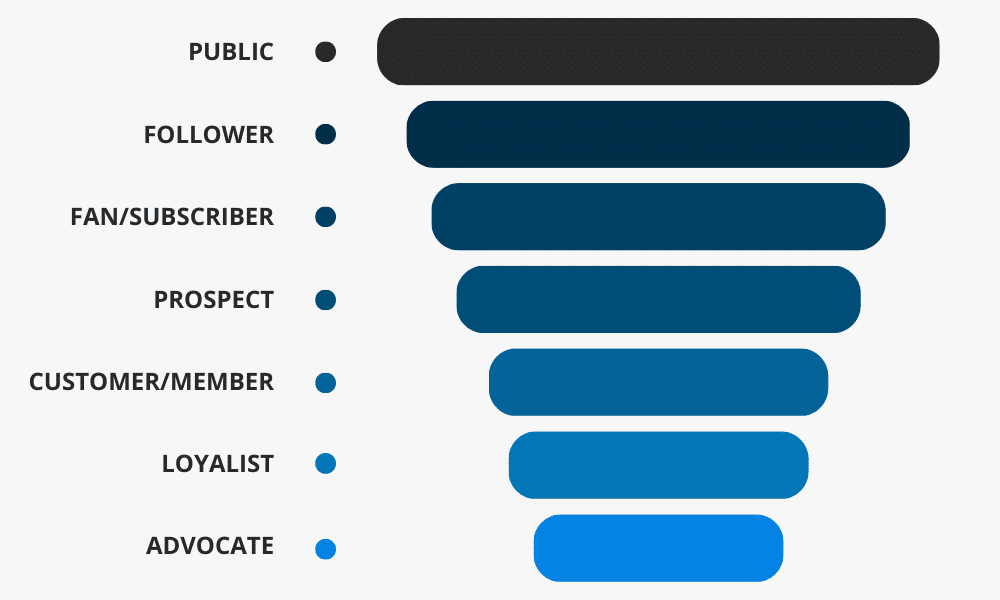
Mapping your consumers’ conversion journey is crucial for understanding how they interact with your brand and how you can position yourself to deliver value at different stages of the conversion process.
PR plays a pivotal role in shaping how individuals move from general awareness to long-term loyalty and advocacy. The funnel shown above illustrates this progression: starting with the broad public and narrowing to dedicated customers who actively promote the brand. PR activity directly influences each stage by increasing visibility, strengthening trust and deepening engagement.
- Public: Creating Awareness at Scale
The journey begins with the general public, i.e., people who may have no prior knowledge of your brand. PR drives top-of-funnel discovery through earned media, thought leadership, social coverage and influencer mentions. These touchpoints generate broad visibility, ensuring your brand enters the consideration set long before a buying decision is made.
- Follower: Turning Attention into Interest
Once awareness is established, some individuals choose to follow your brand more closely. They may engage with your social channels, visit your website or subscribe to updates. PR supports this step by delivering compelling stories, consistent messaging and helping establish a clear brand narrative that keeps audiences interested and encourages them to stay connected.
- Fan or Subscriber: Deepening Engagement
Fans and subscribers demonstrate a stronger level of intent. They actively consume your content, attend virtual events, read your coverage and interact more frequently. PR nurtures this segment by highlighting the USPs of your offering, addressing consumer pain points, and maintaining an ongoing narrative that positions the brand as trustworthy and authoritative.
- Prospect: Strengthening Consideration
Prospects are individuals evaluating whether your product or service is the right fit. PR influences this stage by providing credible evidence and third-party validation, such as case studies, expert features, testimonial-driven stories and reputation-boosting coverage. These assets help prospects assess your value with confidence.
- Customer or Member: Supporting the Decision Stage
At this point, prospects convert into customers. PR continues to play a crucial role by reinforcing buyer confidence, showcasing customer success stories, and ensuring the post-purchase experience aligns with the promises made during earlier stages. Consistent, positive narrative reinforces the brand choice and encourages retention.
- Loyalist: Fostering Long-Term Relationships
Loyalists are repeat customers who trust your brand and return because of the positive experience you deliver. PR helps strengthen loyalty through community engagement, ongoing communication, thought leadership and reputation management. These touchpoints maintain connection and reinforce the emotional bond with the brand.
- Advocate: Turning Loyalty into Promotion
Advocates are the most valuable outcome of the customer journey. They publicly champion your brand, share positive experiences, and influence others through word of mouth or user-generated content. PR enables advocacy by amplifying customer stories, elevating positive sentiment and providing platforms where advocates can be seen and heard.
PR’s influence is not limited to the top of the funnel. It shapes perceptions, strengthens trust and drives engagement at every stage:
- It brings new audiences in at the top.
- It builds meaningful connections as individuals move closer to your brand.
- It supports customer experience and strengthens loyalty after purchase.
- It fuels advocacy that drives future awareness, continuing the cycle.
By understanding these stages and aligning PR activity with each one, organizations can ensure a cohesive journey that moves people from first exposure to lasting advocacy, while generating measurable impact at every step.
Common PR Measurement Mistakes
Even seasoned communicators struggle with PR measurement due to inherent challenges your organization may face.
Shifting consumer preferences and AI’s transformative impact on media measurement mean PR pros can be overwhelmed when figuring out the right strategy to gauge and analyze PR performance.
Let’s take a look at some of the common PR measurement challenges.
- Data overload and quality
From gauging impressions to ensuring accurate CTR measurements, organizations need to track a lot of data. Monitoring this data requires an integrated tech stack to effectively measure and record it.
Data for the sake of data won’t be helpful, and you’ll quickly find it overwhelming if you lack formal data collection and analysis processes.
When you know what you’re aiming to measure (awareness, reputation, and engagement), you can find the data that highlights the impact and helps tell your story. Otherwise, it’s all too easy to get lost in numbers.
How to begin:
-
- Start with your PR data. Make sure the vendor or tool you are using is reliable and has high data integrity.
- Integrating data from other departments, like marketing and sales, is always challenging, so pluck the low-hanging fruit. Website analytics is an easy one to access and use.
- Harness other established sources of data. You will be surprised by how much has already been gathered and used. For example:
- Sales data on average deal time
- HR data on average hit rates for new job postings
- Customer service data collected from chat tools
- Regular customer/employee surveys
Look for the business impact you are aiming to achieve through your activities, such as sales, hiring, or customer satisfaction. Which department “owns” that impact? How do they track their data? Talking ahead of time allows for collaboration—perhaps they use data-gathering processes that could help facilitate your post-campaign measurement.
- Resources
Tools
Make sure you have the right tools and make your vendors and/or agencies work harder for you. Do not compromise on your end goals. A good vendor will want to work with you to provide more. Ask specific questions.
You may find these two articles helpful if you plan to use media monitoring or media database tools:
Time
For your PR measurement program to be effective, you must commit to the time, energy, and attention it requires. While you may have people, tools, and vendors, at the end of the day, it’s your inputs and directional guidance that are critical in making it work.
- Culture
Does your organization have a data-driven culture? If so, that’s excellent news! It makes your job easier. But if not, this is an excellent chance for you to take the lead and demonstrate how it can benefit the company as a whole.
Need an edge on convincing the skeptical? If you are fighting for something, be it budget, data, or tools, create mock-ups of what the end product could look like (such as that snazzy dashboard from earlier). Being able to visualize the outcome really helps people understand and appreciate what they’ll get.
- Budget
According to Ragan’s 2025 Communications Benchmark Report, 37% of communicators cited budget limitations as a top challenge.
Securing leadership buy-in for PR efforts can be challenging, but connecting them to business outcomes can help ensure increased budgets.
5 Best PR Measurement Tools
| Tool | Key Features | Ideal For PR Teams That |
| Agility PR Solutions | Sentiment and entity analysis per mention, customizable dashboards, and executive reporting | Comprehensive analytics, cross-channel measurement, and role-specific reporting |
| Critical Mention | Broadcast monitoring, sentiment analysis, Google Analytics integration | Fast tracking of broadcast media and quick-turn reporting |
| Brandwatch | Trend analysis, competitor benchmarking, historical social data | Advanced social listening, audience segmentation, and conversational insights |
| CoverageBook | Estimated views, social share metrics, SEO indicators (domain authority) | Easy, visually clean reporting without complex analysis |
| Brand24 | Emotion and sentiment tracking, anomaly detection, share of voice | Fast detection of brand shifts, accessible analytics, competitor comparisons |
Agility PR Solutions
Agility PR Solutions offers an integrated suite of media monitoring and PR analytics capabilities, enabling communications professionals to gain strategic insights from global news, online, and social coverage.
It combines AI-powered monitoring across online news, print, broadcast, podcasts, and social channels (over 2 billion indexed items annually) with sentiment analysis, entity recognition, and customizable dashboards.
Agility’s platform provides in-depth metrics like share of voice, sentiment analysis, reach, and campaign performance, enabling users to tie PR results to broader business objectives. Agility’s tools focus on real-time monitoring, actionable reporting, and custom analytics tailored for comprehensive PR campaign measurement.
The platform is recognized for its ability to turn complex data into actionable insights and is frequently cited as a leading PR analytics platform on trusted SaaS review sites, such as G2.
Key Features:
- AI-driven sentiment & entity analysis for individual mentions
- Customizable executive reports and briefings with role-specific insights
- Broad content coverage (online, print, broadcast, podcasts, social) with real-time alerts
- Detailed analytics dashboards with share of voice and sentiment insights
Critical Mention
Critical Mention is a comprehensive media monitoring and PR analytics platform providing real-time tracking across broadcast (TV/radio), online news, print, and social channels. Its analytics suite allows users to visualize campaign performance, measure brand sentiment, and instantly generate shareable reports with relevant data visualizations.
Key Features:
- Real-time monitoring and sentiment analysis for earned media coverage
- Customizable dashboards and automated KPI reports across multiple media types
- Google Analytics integration for linking PR coverage to web activity
Brandwatch
Brandwatch leverages robust analytics to track and analyze online conversations, providing measurement of brand reputation, media coverage, influencers, and consumer sentiment. The platform’s visual dashboards uncover trends, track share of voice, and analyze reach and engagement.
Key Features:
- Integrated sentiment analysis and trend tracking
- Customizable dashboards for real-time social and media insights
- Robust influencer and crisis monitoring tools
CoverageBook
CoverageBook provides PR measurement and reporting solutions, turning media coverage into visually compelling reports. The platform extracts data such as estimated views, domain authority, and social engagement, enabling teams to present impactto stakeholders.
- Automated metrics (views, DA, shares) aggregated for each PR campaign
- Visual, customizable reporting templates for easy sharing
- Simple integration with media coverage sources
Brand24
Brand24 offers real-time digital and social media monitoring to quantify PR performance and brand sentiment. Its analytics provide valuable insights into media reach, engagement, and influential mentions, helping teams track results and adapt messaging quickly.
- Live monitoring with instant alerts for keyword and brand mentions
- Analytics dashboard tracking reach, sentiment, and engagement metrics
- Identification of top influencers and sources contributing to campaigns
Looking Forward
PR measurement has evolved far beyond counting clips or calculating advertising equivalencies. Today, communicators are expected to demonstrate how their work influences awareness, shapes reputation, deepens engagement and supports the organization’s most important goals. The shift from activity reporting to insight-driven measurement is not just a trend. It is now a non-negotiable expectation for PR teams seeking credibility, influence, and long-term strategic value.
As you move forward, the opportunity is clear: build a consistent measurement approach, aligned with business objectives, and grounded in meaningful metrics. When you benchmark performance, integrate data from across the organization, and present insights in the language of impact, PR stops being viewed as a cost and becomes recognized as a driver of growth, trust, and competitive advantage.
The work does not end here. Effective PR measurement requires iteration, refinement and the right tools to support your efforts. If you are ready to strengthen your measurement strategy and see how unified monitoring, analytics and reporting can accelerate your progress, explore how Agility can help.
Build a Smarter PR Measurement Framework
Centralize monitoring, analytics and reporting with Agility PR Solutions so your team can focus on strategy.
Download your free PR measurement guide today!
Sign up to receive your guide and occasional emails about PR news and resources.
We take your privacy seriously & will never sell your info. You are free to opt-out at any time. Privacy policy