
Public relations budgets are tightening, and business leaders want solid numbers that show real ROI.
But here’s the catch.
When it comes to return on investment (ROI) in PR, you can’t solely focus on sales revenue. You need to tie your ROI metrics to business goals to show that your PR campaigns are doing what they set out to achieve.
But measuring PR ROI doesn’t work the same way in every industry.
Let’s take a closer look at why “one-size-fits-all” metrics fall short — and how you can align ROI with the measurable goals that matter in your sector.
What does ROI in PR mean?
ROI in PR refers to measuring whether the returns your clients receive are higher or lower than what they invested in PR campaigns.
But those PR returns aren’t always tied to revenue. Sometimes your PR efforts are geared toward attention, trust, or behavior change, and that makes ROI harder to pin down.
So the real questions are:
- What’s your measurable objective?
- Are you achieving the results you set out to achieve?
- And are those results worth more than what you spent achieving them?
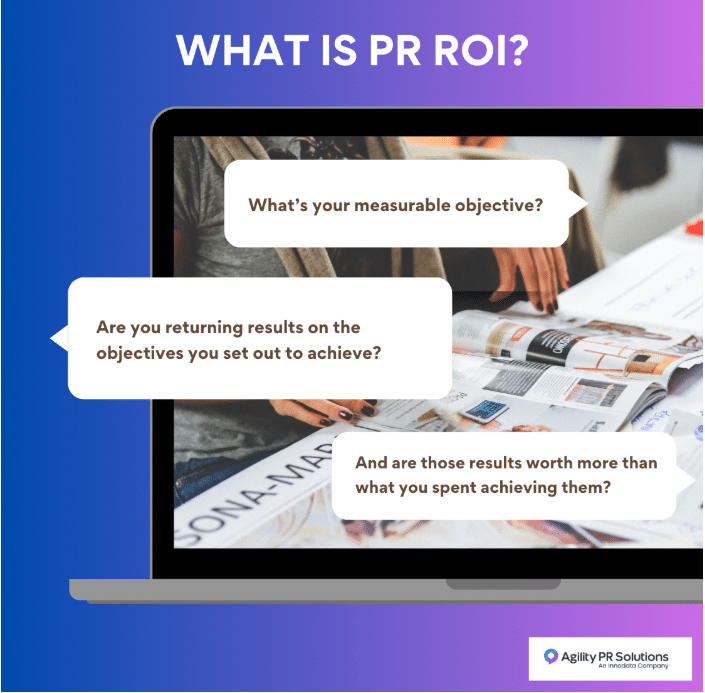
Image by Ioana
Take brand awareness, for example.
In this case, the return might be more visibility, a bigger share of voice, or increased organic traffic.
To track it, you may want to monitor organic traffic, earned backlinks, and brand mentions. (And then look at how each campaign lifts those numbers and whether the improvement justifies the cost.)
But if your goal were to generate leads, you’d track different key metrics, like:
- How many people clicked through from the coverage
- How many filled out a form or signed up
- Whether leads turn into sales
If you choose the right metrics and benchmark them before and after a campaign, you’ll get a more accurate sense of your PR ROI.
How to judge ROI when your results aren’t tied to revenue
How do you know if a campaign was worth the investment when there’s no direct revenue to measure?
➜ Start by defining what success is worth before the campaign begins.
Say your campaign cost $40K and your goal was brand awareness.
You could compare the outcome — for example, 10,000 new website visitors and a 20% increase in share of voice — to what it would’ve cost to get the same results through paid ads. If buying that reach would’ve cost $60K, then your PR campaign saved you $20K. That’s a solid return.
ROI doesn’t have to come from revenue. It can show up in cost savings, stronger brand perception, or future customer potential.
Whatever your value metric is, you need to define it from the start.
Why “one-size-fits-all” ROI doesn’t work for every PR sector
Proof of ROI in PR isn’t a one-size-fits-all model. Different industries have different goals, stakeholders, and communication challenges. And, businesses have their own expectations for digital PR, so it’s difficult to establish a universal standard.
For example, a healthcare nonprofit needs to measure trust and policy impact. But a tech company might focus more on backlinks and signups.
If you want leadership to take PR seriously, you need to measure the key metrics that matter for your industry.
Let’s explore some of the major sectors and how you can measure PR ROI for each.
How to Track ROI in the Tech Sector
Tech PR is fast-paced and digital-first. For SaaS, fintech, and software brands, success often hinges on visibility, trust, and conversions in the digital funnel.
Below, you’ll see how to track PR ROI in tech.
Financial ROI: Tracking the bottom line
Tech companies rely on lead generation to fuel growth, so conversions are the clearest way to show the financial impact of PR.
Add UTM parameters to links in press coverage to track where traffic converts into signups or demos.
Then compare the campaign cost to the pipeline value. If the sales return is more than the cost of your public relations campaigns, you’re seeing good financial ROI.
Visibility ROI: Measuring digital reach and engagement
Visibility fuels the top of your sales funnel.
Track media-driven traffic in Google Analytics. And pay attention to “time on-site” and “bounce rates” to understand if your PR content resonates.
Track branded search terms as well to see if your press coverage is driving visibility in search.
If your branded keyword volume increases and PR stories start appearing in search results, it indicates that people are searching for your brand in response to your campaign.
Compare this lift to what you spent on the campaign. If earned media boosts discoverability more efficiently than paid search, you’ve got a strong ROI on visibility.
Trust ROI: Proving credibility in the market
In crowded tech markets, trust is what convinces risk-averse buyers and investors to choose your solution.
Use sentiment analysis tools to track how people talk about your brand before and after coverage.
You can also measure trust ROI by evaluating the domain authority of your media placements — a metric used by 91% of PR pros.
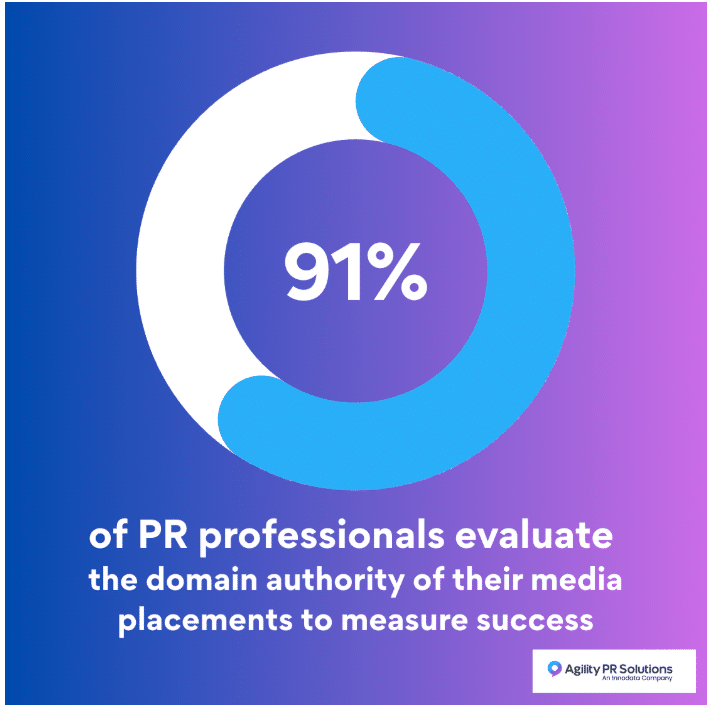
Image by Ioana
The higher the DA, the more credible the source.
Third-party credibility builds trust ROI — when respected sources believe in you, prospective customers are more likely to believe in you, too.
To gauge return, compare the cost of putting out coverage and earning high-DA placements to the value of the deals you get from them.
How to gauge ROI in retail and eCommerce
Retail PR is product-driven. It focuses on visibility that drives action — ideally, a sale.
Below, you’ll see how to track PR ROI in retail and eCommerce.
Financial ROI: Linking PR to sales
Retail success hinges on transactions.
Use promo codes, affiliate links, or UTM-tagged URLs to tie PR coverage to conversions.
If a product feature results in a 300% sales spike, you can attribute that revenue to PR.
Visibility ROI: Measuring reach and attention
Getting seen is half the battle in retail.
Track how your PR coverage performs across social platforms — shares, tags, mentions, and total reach. If your message spreads beyond your own channels, that’s a sign your PR is working.
To measure ROI, start by tallying campaign costs. Use your corporate credit card or expense tracking software to get a clear picture of what was spent. Then compare that spend to the value of the visibility earned.
If your campaign generated more reach or engagement than a paid media campaign of the same cost, you’re getting a return on your investment, even without direct revenue.
Trust ROI: Building consumer confidence
Retail customers want proof before making a purchase.
Track user-generated content, such as reviews, unboxings, and social mentions, that occur after a PR campaign is launched. If your PR drives buzz that turns into real-life endorsements, it’s a sign of growing consumer trust.
To measure ROI, compare your campaign cost — say, $5K to seed products to influencers and secure coverage — to the value of the content it sparked. If it results in coverage that drives hundreds of shares and boosts purchase intent, you’ve got a high-trust ROI. Consider mentioning how tools like the can help streamline PR tracking and influencer collaboration remotely.
How to work out ROI in healthcare and pharmaceuticals
Healthcare PR is a trust game. Your audience is making life-impacting decisions based on your message, so they need to trust that the health provider can deliver.
Below, you’ll see how to track PR ROI in the healthcare and pharmaceutical sectors.
Financial ROI: Tracking audience actions
Patient engagement translates to service uptake.
Use campaign-specific tracking to monitor downloads of whitepapers, signups for health webinars, or patient inquiries.
These actions reflect customer intent to learn, seek treatment, or choose your facility.
To measure ROI, compare campaign spending to the value of inquiries or appointments. Say an $8K media push around a new service results in five new patients who generate $25K in revenue. That’s a solid return.
Visibility ROI: Measuring educational impact
Public health outcomes often start with education.
Use analytics to track time spent on medical explainers, downloads of informational materials, and article shares.
These metrics indicate whether your campaign is effectively informing your audience, which is crucial for health behavior change.
To assess ROI, weigh the campaign cost against the value of digital engagement.
If your goal was 4,000 downloads from a $5K campaign, that’s $1.25 per download. If you get 6,000 downloads instead, your cost per download drops to about $0.83. That’s 50% more downloads at the same cost — a stronger return than expected.
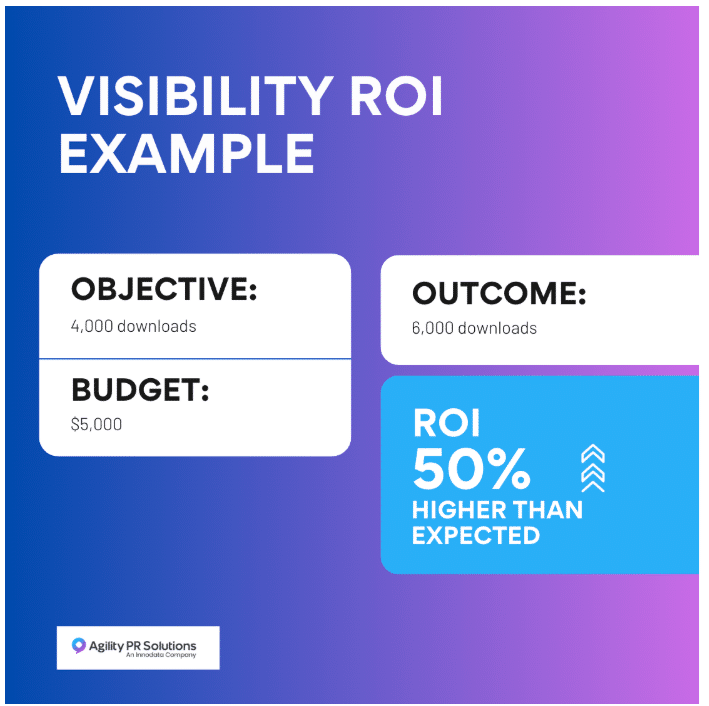
Image by Ioana
Trust ROI: Monitoring sentiment and credibility
In healthcare, trust determines whether patients follow your guidance or not.
Use media monitoring tools to track sentiment before, during, and after a campaign. Monitor your coverage in respected, high-authority publications that improve medical legitimacy.
But how do you work out the ROI?
Look at whether your sentiment scores are higher than your goal and if your outreach led to more (or better) coverage in medical publications. If so, you’re seeing a strong return on trust.
How to Track ROI in nonprofits and advocacy work
Nonprofit PR is about influence and action. The return isn’t financial profit — it’s participation.
Below, you’ll see how to track PR ROI for nonprofits and advocacy work.
Financial ROI: Measuring donations and participation
While the overall impact isn’t about profit, donations fund projects.
Use Google Analytics or donation platforms to track spikes in giving, petition signups, or volunteer interest during campaign windows.
If a $5K media campaign generates $15K in donations, it’s clear your message drove action.
Visibility ROI: Tracking spread and echo
Policy change requires awareness.
Track share of voice, media pickup, and mentions in policy documents or coalitions.
If your campaign is cited in public hearings or by influencers in your cause area, you’ve built visibility with real-world influence.
Now compare that to what it would’ve cost to achieve the same exposure via paid routes — like sponsoring a policy briefing or running awareness ads across news outlets.
If a $7K PR campaign delivers visibility you’d otherwise pay $20K for in placements and access, that’s a clear return.
Trust ROI: Building supporter confidence
Supporter trust drives recurring donations and long-term advocacy.
Monitor the tone of your coverage and the sentiment in social mentions.
When your target audience positively echoes your messaging, it indicates alignment with your values and reinforces loyalty.
Set a goal: You may want to improve supporter sentiment by 15% after a new campaign launches. If a $5K PR push earns glowing coverage and a 15% shift in supporter tone, you’ve hit your target.
Now compare it to what it would have cost for a months-long outreach or paid influencer partnership.
Wrap up
ROI in PR isn’t one-size-fits-all. It’s about matching your goals to the right metrics.
To prove value, start by defining success before the campaign begins. Then track results that tie back to real outcomes.
Want to connect PR efforts to business impact? Speak to an Agility PR expert about smarter, sector-specific measurement tools.