

Today, AI in marketing is a strategic pillar. Whether you’re using predictive analytics to optimize email marketing send times or using chatbots to personalize the customer journey, AI-powered marketing campaigns are changing the way marketing professionals engage audiences, automate workflows, and drive performance.
But CMOs and data scientists alike are now under pressure to prove that their AI-driven initiatives deliver real business value. So how can you measure the return on investment (ROI) of artificial intelligence in your marketing workflows?
In this article, we’ll walk you through a step-by-step framework to track, quantify, and improve AI marketing ROI so you can allocate marketing budgets more confidently, win stakeholder support, and scale what works.
Measuring AI marketing ROI becomes easier when each campaign has clear inputs, attribution rules, and business outcomes attached from the start.
Why Measuring ROI Matters in AI Marketing Campaigns
Clear ROI measurement is the bridge between experimentation and executive buy-in.
According to McKinsey research, 88% of organizations now use AI in at least one business function, but only about one-third have started scaling AI programs across the enterprise.
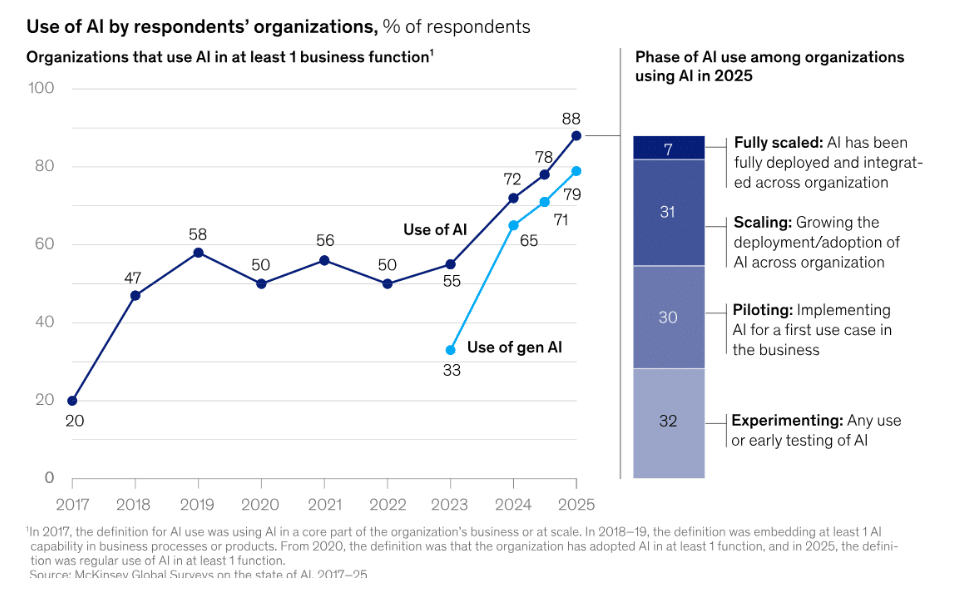
That gap is why ROI tracking cannot stop at tool adoption. Marketers need to connect AI-assisted work to revenue, customer acquisition cost, lead quality, and efficiency gains before asking for a larger budget.
Due to rising digital budgets and evolving consumer behaviors, companies today need to justify every investment, especially in emerging technologies such as generative AI and recommendation engines.
At the PR campaign level, that gap shows up in examples like these:
- A communications team uses AI-powered social listening to spot a shift in sentiment before it becomes a reputational issue, and then adjusts campaign messaging based on audience response.
- A PR team uses media monitoring and attribution data to connect earned coverage to referral traffic, branded search lift, or qualified lead activity.
- An agency uses AI-assisted reporting to reduce manual analysis time while giving clients a clearer view of share of voice, message pull-through, and campaign reach.
These are more than success stories. They’re budget unlockers. When businesses have a clear understanding of their ROI, they can defend pilot projects, scale high-performing advertising solutions, and optimize the marketing mix modeling strategy with precision.
Aligning AI Initiatives with Business Goals
To achieve a measurable AI marketing ROI, every AI-driven initiative must be directly tied to core business objectives, such as revenue growth, margin expansion, or increased customer retention. This is true for every business, regardless of size.
The more clearly your AI tools support business goals, the more effectively you can communicate their value to leadership in enterprise companies. In SMBs, those advantages are crystal clear.
Take predictive analytics in email marketing, for example. By fine-tuning send times and subject lines based on behavioral insights, marketers can significantly boost open rates and drive more conversions. This can lead to higher revenue per campaign.
Meanwhile, AI-powered chatbots enhance the customer acquisition journey by delivering personalized, real-time responses that guide visitors through qualification workflows.
These bots don’t just answer questions. They accelerate the sales cycle by capturing leads more efficiently.

Image created by the author
Similarly, smart audience targeting models powered by artificial intelligence can identify and prioritize high-value prospects. By learning from past behaviors and outcomes, these models enable better ad optimization. This improves performance and reduces wasted spend. In each case, AI supports both campaign key performance indicators (KPIs) and overarching executive priorities.
Justifying Budget Allocation and Scaling
When marketers can demonstrate clear ROI from AI-powered marketing campaigns, it becomes much easier to justify larger marketing budgets, scale successful programs, and build internal support across departments.
A unified view of campaign performance, such as comparing revenue uplift from predictive emails with lead generation from AI chatbots, gives teams the insights they need to make informed decisions.
This kind of performance tracking also improves attribution. By linking increased customer engagement to personalized AI-driven experiences using multi-touch attribution, marketers can pinpoint exactly where each touchpoint creates value.
Just as importantly, it helps teams reallocate spend dynamically, moving budget away from underperforming ad copy or channels and toward strategies that consistently deliver. The beauty of this visibility is that it encourages smart, low-risk experimentation.
When you know what’s working (and why), testing new ideas becomes less of a gamble and more of a growth opportunity.
Key AI Marketing ROI Metrics to Track
To accurately measure AI marketing ROI, marketers should track performance across three key areas: revenue generation, operational efficiency, and long-term engagement. Each category provides distinct insights into how well AI-driven initiatives contribute to business goals.
1. Revenue-Based Metrics
At the heart of any ROI calculation is revenue. Marketers should examine how AI in marketing directly impacts sales metrics. This includes tracking the lift in average order value, the growth in customer lifetime value, and the incremental revenue from strategies such as AI-powered upselling and personalization at scale.
Boston Consulting Group research found that about four-fifths of surveyed consumers are comfortable with personalized experiences, and most expect companies to offer them.
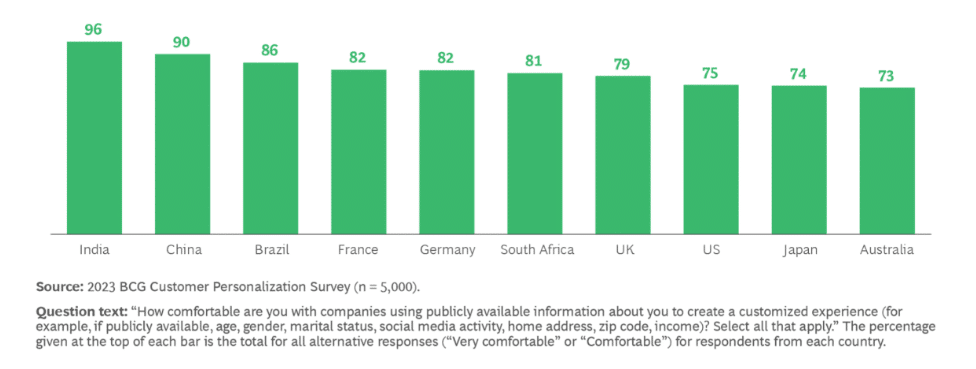
When AI tools analyze customer behavior and deploy real-time product recommendations, they can unlock powerful, revenue-driving moments across the customer journey. These gains not only impact short-term sales but also support long-term market share growth.
Generated with the help of AI
2. Efficiency Metrics
AI also plays a major role in cost reduction. Through tools such as automated bidding in programmatic advertising and smarter segmentation models, businesses can reduce customer acquisition costs and improve spend efficiency.
These systems reduce waste by delivering ads to the right audience at the right time, minimizing ineffective impressions and boosting returns. When marketers rely on predictive analytics and machine learning to refine campaigns on the fly, they’re able to do more with less, stretching marketing budgets without sacrificing performance.
Generated with the help of AI
3. Engagement and Retention Metrics
While harder to tie directly to revenue, engagement and retention are vital predictors of long-term success. Metrics such as time spent on site, frequency of return visits, and satisfaction with chatbot interactions provide meaningful indicators of how AI is shaping the personalized user experience.
These “softer” data points reveal how well your brand is building brand affinity, deepening loyalty, and delivering value throughout the customer lifecycle. The more effectively AI can adapt content and interactions to reflect individual consumer behaviors, the more likely customers are to stay engaged.
Generated with the help of AI
Setting Up Data Foundations
Your AI-driven initiatives are only as strong as the data powering them. If your information is messy, disconnected, or incomplete, your ROI calculations and the AI models themselves won’t be reliable.
To measure ROI with any degree of accuracy, you need a foundation of clean, connected, and compliant data. It’s not the most glamorous part of the process, but it’s essential.
Integrating Data Sources (CRM, Web Analytics, Ad Platforms)
Think of your data stack like a team—your customer relationship management (CRM), web analytics, ad platforms, and content management systems all need to be in sync to work together effectively.
When these systems are siloed, they lead to data fragmentation, making it nearly impossible to draw clear conclusions. But when everything is connected, you get a single source of truth that tells you not just what you’re spending, but how users are behaving and what outcomes your campaigns are delivering.
That’s the kind of clarity you need when tracking performance across multiple AI touchpoints.
Ensuring Data Quality and Governance
Of course, integration is only part of the story. Even the most sophisticated AI models can’t perform well if the data going in is inconsistent or non-compliant. That’s where data governance comes in.
Establishing clear naming conventions, ensuring compliance with data privacy standards (such as GDPR), and conducting regular audits all contribute significantly to maintaining data integrity. Clean, structured data not only improves the accuracy of your ROI measurement but also boosts the performance and trustworthiness of your AI systems.
Attribution Models in the Age of AI
If you’re still relying on last-click attribution to measure performance, you’re likely missing the bigger picture. To obtain a more accurate reading of ROI, you need more sophisticated attribution models. Let’s discuss more below.
Multi-Touch vs Last-Click for AI Campaigns
Multi-touch attribution spreads the credit across all the key steps a customer takes before converting. That means recognizing the value of an AI chatbot that qualified a lead, or the AI-assisted content creation that kept them engaged across channels.
Even your digital asset management system—if it helped serve the right visuals on the right platform—deserves some credit. Compare that to last-click models, which only acknowledge the final click and overlook everything that led up to it. The result? Skewed data and misguided optimization.
Using Predictive Attribution with Machine Learning
Machine learning takes attribution a step further by analyzing historical performance to predict which touchpoints truly drive conversions. These models weigh each interaction based on actual impact, giving you a clearer sense of where your efforts are paying off.
With Explainable AI tools, you’re getting insights that help you reallocate budget, cut out underperformers, and strengthen strategy without the guesswork.
Calculating ROI Step-by-Step
Now let’s get practical.
1. Define Investment Inputs
Start by identifying all the costs associated with your AI-powered campaign. This includes expenses for software tools, such as chatbots, and costs for creative production. For instance, if your strategy relies on AI-generated content to scale marketing assets, you must account for the subscription fees of those generative tools.
Don’t forget about human resources—if your team includes data scientists, analysts, or external vendors, be sure to factor in the time and money spent on their contributions.
Security risk should also sit on the cost side of the ROI equation. AI tools often connect to CRMs, ad platforms, dashboards, and third-party data feeds, which can create exposure if a vendor or script is compromised. Controls that reduce the risk of Living Off the Land attacks should be included in the total cost of ownership.
2. Quantify Uplift from AI
Next, determine the performance improvement that can be directly attributed to AI. The easiest way to do this is by comparing campaign results with and without AI support. You might use a control group, historical baselines, or even incrementality testing to isolate the AI’s impact.
For example, if your AI-optimized email campaign shows a 25% higher conversion rate than your usual send, that increase represents your AI-driven uplift.
3. Use the ROI Formula
ROI should also account for long-term value. Investors evaluating a 721 exchange, for example, weigh future income, tax treatment, and portfolio fit alongside upfront costs. AI marketing ROI works the same way: compare the value created over time against the full cost of running the system.
Once you have your cost and uplift figures, plug them into this simple formula:

Image created by the author
Let’s say your total investment in AI tools, content, and labor was $10,000, and your revenue increase from the AI-enhanced campaign was $25,000. Your calculation would look like this:

Image created by the author
In this case, the campaign generated a 150% ROI. Put another way, every $1 invested produced $1.50 in net return, or $2.50 in total revenue.
How to Measure AI Marketing ROI with AgilityPR
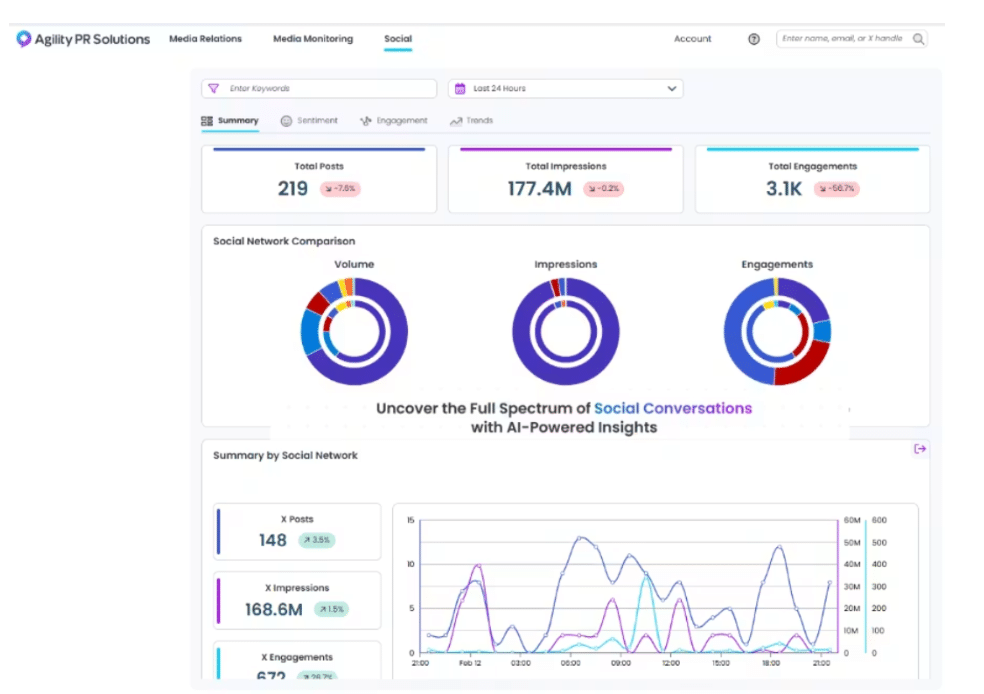
For Agility PR Solutions’ audience, AI marketing ROI should not be limited to paid ads, email automation, or chatbot conversion data. PR and communications teams also need to show how AI-assisted media monitoring, social listening, and reporting connect campaigns to business outcomes.
Agility helps teams connect those signals by bringing media monitoring, social listening, and campaign reporting into one place. Instead of manually tracking brand mentions, coverage volume, sentiment shifts, and journalist engagement across disconnected tools, teams can use Agility to monitor results and turn campaign activity into clearer performance reports.
This makes it easier to show stakeholders how AI-assisted marketing and PR efforts contribute to broader business goals. Whether the goal is stronger brand awareness, better message pull-through, faster reporting, or more informed campaign decisions, Agility gives teams the visibility they need to measure what is working and refine what is not.
Wrapping Up
Measuring AI marketing ROI is more than a numbers game. It’s a strategic necessity. With the right framework, you can:
- Track efficiency gains from smart ad optimization and customer targeting
- Defend and grow your digital marketing investments with confidence
- Align AI to outcomes like revenue, margin, or market share
As AI adoption grows, PR teams will be judged less on whether they use AI and more on whether they can demonstrate how AI improved results. That means moving beyond activity-based reporting and showing how AI-assisted work affects media coverage, sentiment, audience engagement, and business outcomes.
Ready to measure AI marketing ROI with clearer media intelligence? AgilityPR can help PR and communications teams monitor coverage, track campaign performance, and turn PR data into stakeholder-ready reporting.
Agility PR Solutions is a recognized leader in enterprise-ready AI-optimized PR tools and resources, including AI-powered media monitoring, media database, and media intelligence and measurement.